


130 years after its scandalous premiere, Daniel Benoin adapts Alfred Jarry’s bluntly truth-telling play with chilling precision, but also a sense of humour.
Anthéa director Daniel Benoin’s signature play this season, Ubu Roi, is about a cowardly, greedy, foul‑mouthed bully who seizes power, plunders everyone in sight and breaks every promise he ever made. Although this might conjure up images of certain controversial contemporary politicians or business leaders, the story dates back to the 19th century. First performed in 1896 to a shocked Parisian audience, 23‑year‑old student Alfred Jarry’s text was based on a puppet play mocking one of his teachers which he himself watched years earlier. But if your mind immediately went to some modern-day dictator‑like figures, you were still on the right track.
The original Ubu exercises his power with the delicacy of a tank: tyrannical, plundering, murdering the nobility, magistrates and financiers. A joyful archetype of human baseness, Ubu is a formidable user of the brainwashing machine and the croc à merdre, a grotesque weapon of his own invention. But while he thought to eliminate his opponents in order to reign over the improbable imaginary Poland he covets, Ubu neglected to keep his promises. His only way out is therefore to press ahead: attack the ‘Czar’ and Russia.
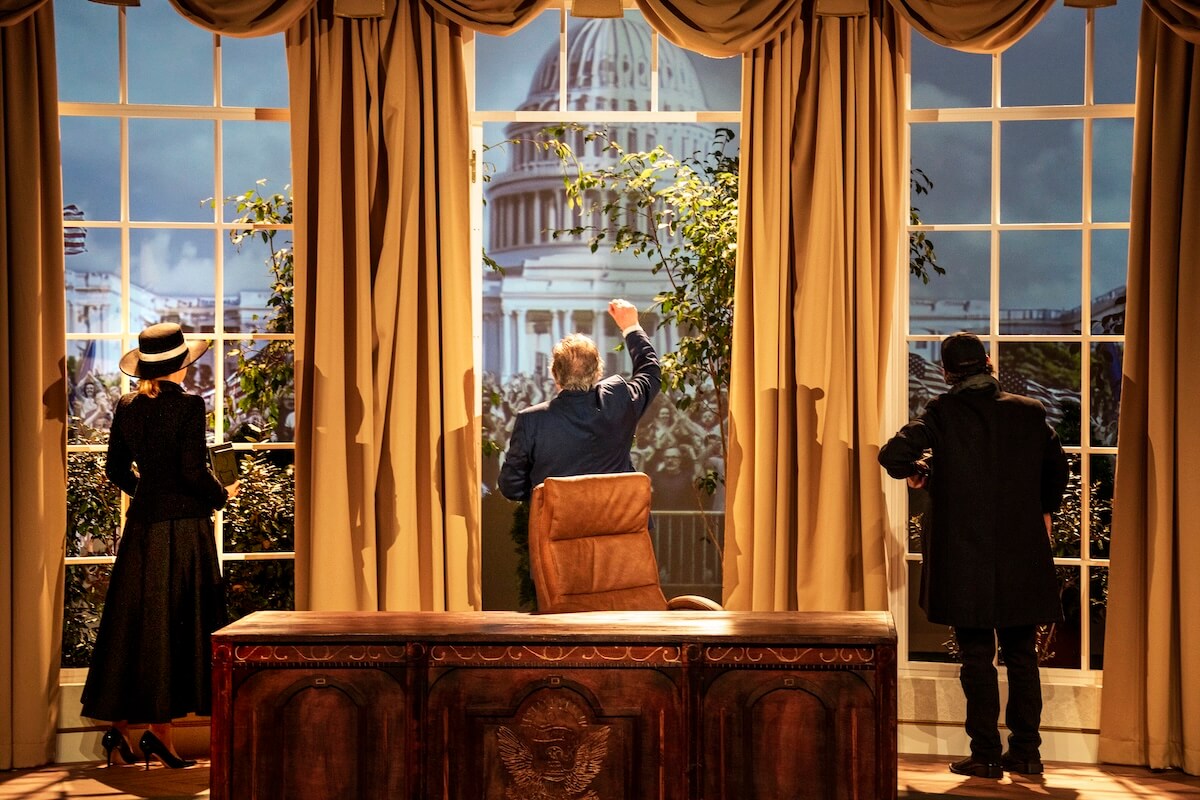
Photo © Philip Ducap
As soon as the curtain lifts, the spectator is thrown into the centres of today’s global powers. Videography shifts the scenography seamlessly between the Oval Office and the Kremlin. Iconic and instantly recognisable contemporary markers like the orange-toned character representing Ubu or an outfit uncannily reminiscent of Melania Trump’s inauguration look leave no doubt who or what this story is all about. At one point, “Drill, baby, drill” rings out across the theatre, a catch phrase that has made it into the history books of 21st‑century events. Even Ubu’s near‑miss with an assassin’s bullet, grazing his ear, raises a knowing smile. Benoin’s production is a masterclass in saying everything without saying anything.
Controversial since its creation, Ubu Roi continues to make people laugh and react today: the Ubus are indeed still very much present, embodying the vengeance of our repressed instincts. And when this Ubu rants about the universe from an Oval Office, haloed with orange hair, Jarry joins Chaplin’s The Great Dictator, and the character reinvented by Daniel Benoin becomes the instinctive reflection of the aggressiveness of an entire society, an entire civilisation, our entire world.
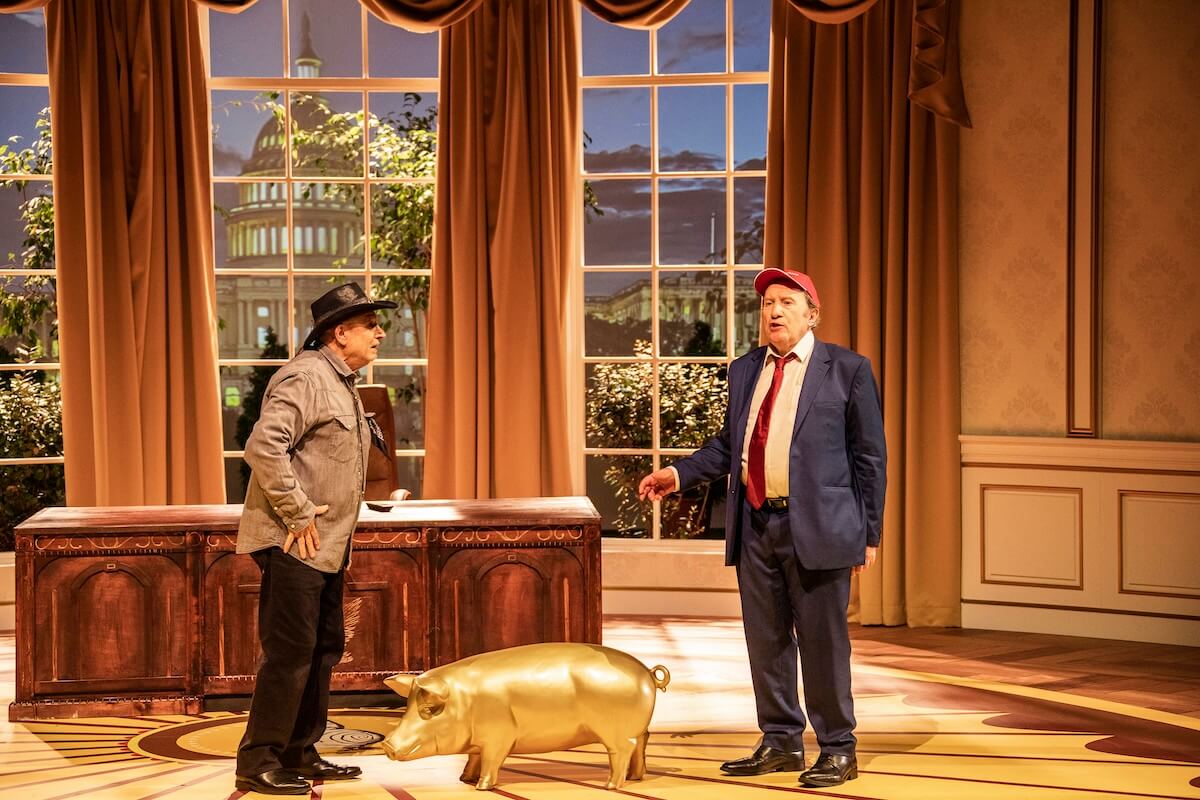
Photo © Philip Ducap
Jarry’s play is one of the most anarchic in the French theatrical canon, a satirical attack on bourgeois complacency, greed and the abuse of authority. It was also a formal provocation against theatrical convention, language and decorum. And apart from contextualising parts for the 21st century, Benoin’s adaptation leaves Jarry’s text intact, feeling that the King Ubu figure embodies precisely what happens when a leader of a Western democracy decides he is no longer bound by law, norm or diplomatic constraint.
Benoin’s credo has always been that the theatre holds a mirror up to society. In times of increasingly violent and anti‑democratic events, its role is to act as a watchdog, and actors are there to offer a different perspective.
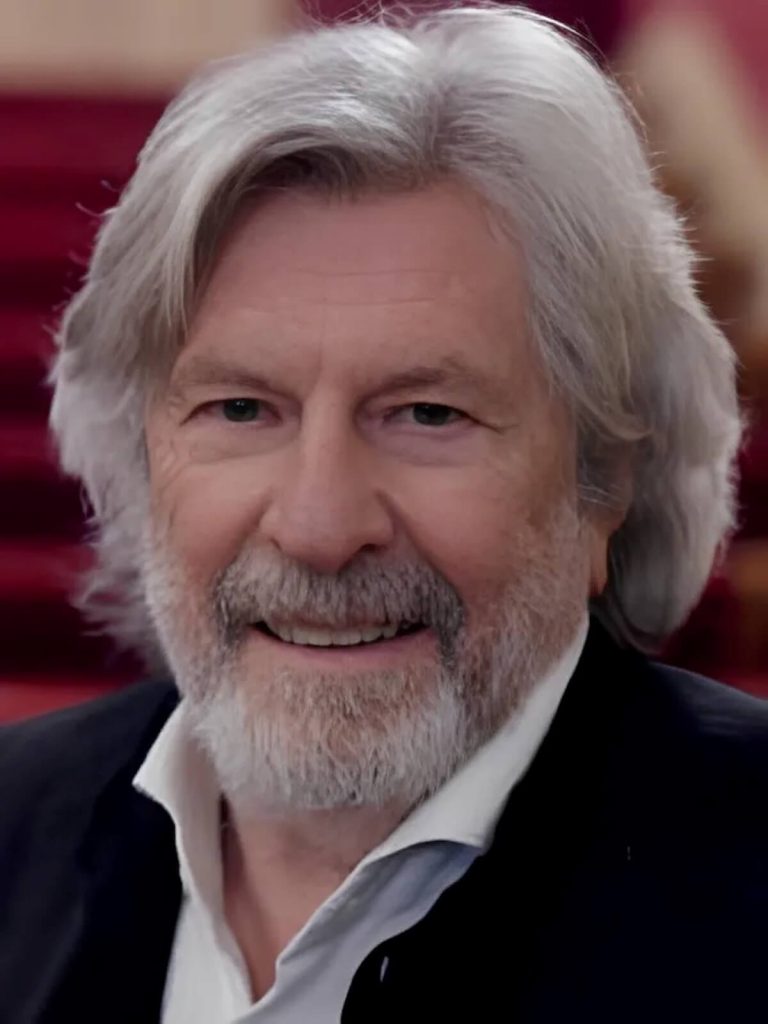
When in the last few years the political environment became increasingly fraught with tensions, Benoin was looking for a text capable of recounting what he calls ‘the fall of the Roman Empire’. But none of the contemporary authors he approached took up the challenge. The project stalled until he reread Jarry, whose Father Ubu is a grotesque, brutal, incoherent tyrant, embodying the traits of many dictators past and present. And then Benoin immediately knew this was what he was looking for. “I found it incredibly contemporary.”
“Since November 2024, with Trump’s renewed election as President of the United States, and combined with an extremely explosive geopolitical situation in the East and the Middle East (which is escalating at all levels), it seems to me that the world is in a state of crisis and intense transformation that was unthinkable just a short time ago,” Benoin says. In his opinion, a crisis this intense has not been seen since 1945 – and this comes from a man who was born in 1947 and has lived through the post‑WWII era and the Cold War. “But what is happening now is even more tense, more dangerous, more pernicious.”Although Benoin sees
Although Benoin sees Trump, Putin and Musk all contained within Ubu, his aim was never caricature. What he wanted to show was something more fundamental: what a man of power looks like when he simply decides the rules no longer apply to him, discarding in the process everything that has kept the peace in Europe for eighty years. Of the three, Trump is the closest to Ubu, because this particular kind of destruction, Benoin argues, can only be done from within a Western democracy, by someone who finds something new to say, something new to break, every single day.
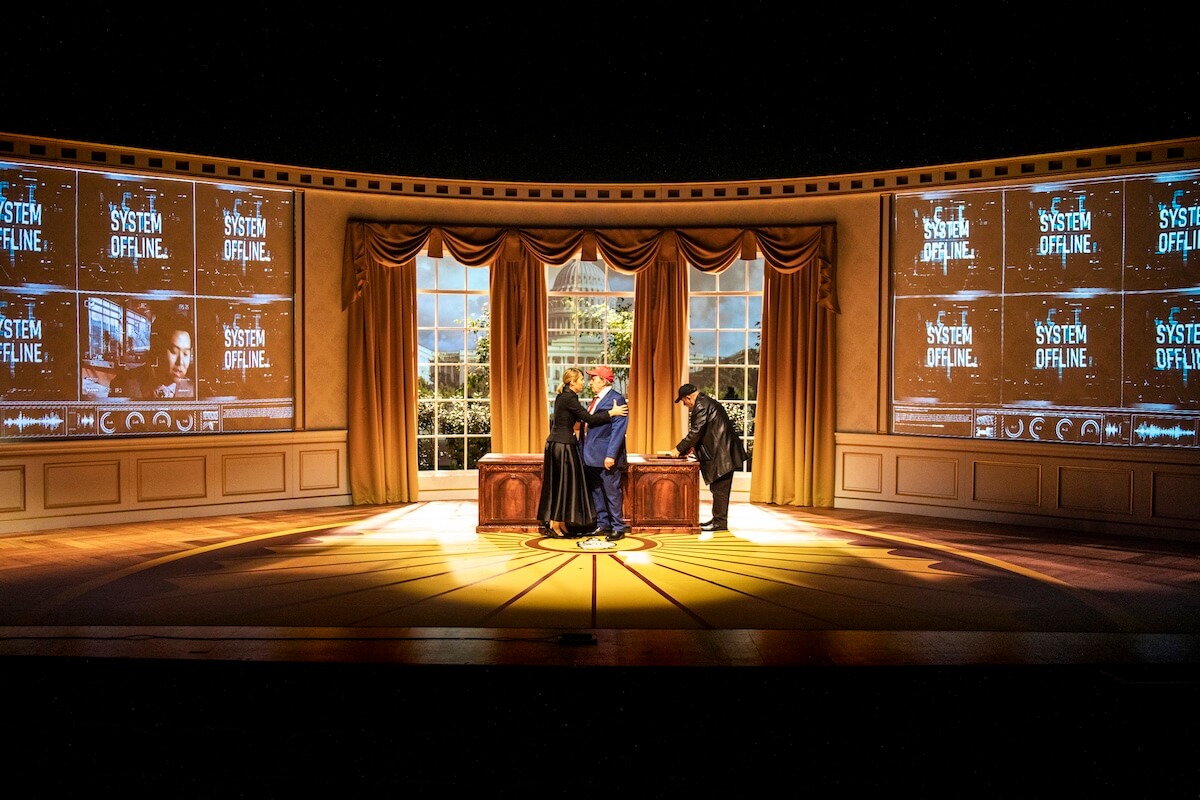
Photo © Philip Ducap
“It is a particularly outrageous text, very similar to Trump’s madness,” says Benoin. “Comparing it to current events gives new meaning to what is happening (particularly the links with Russia) and allows us to view certain characters in a different light. There is a wealth of crazy material to explore.”
But in classic Benoin manner, the political message is in the service of art, never the other way round. For the role of the grotesque monster, he turned to two of the most accomplished French actors. Casting André Marcon in the role of Ubu was a long‑held dream finally come true, and Mélanie Page, whose performance in a 2022 Avignon production had impressed the director, is a perfect fit as the King’s devious wife.
Marcon brings to the role the full weight of a classical actor who recognises great dramatic material when he encounters it. He is driven by the extraordinary language – dense, invented and layered – and the baffling fact that something so apparently juvenile has held the stage with such force for 130 years. In Ubu he finds a role that sits squarely at the intersection of Shakespeare and Molière: epic tragedy and savage comedy, lyricism and vulgarity in the same breath… and plays it accordingly.
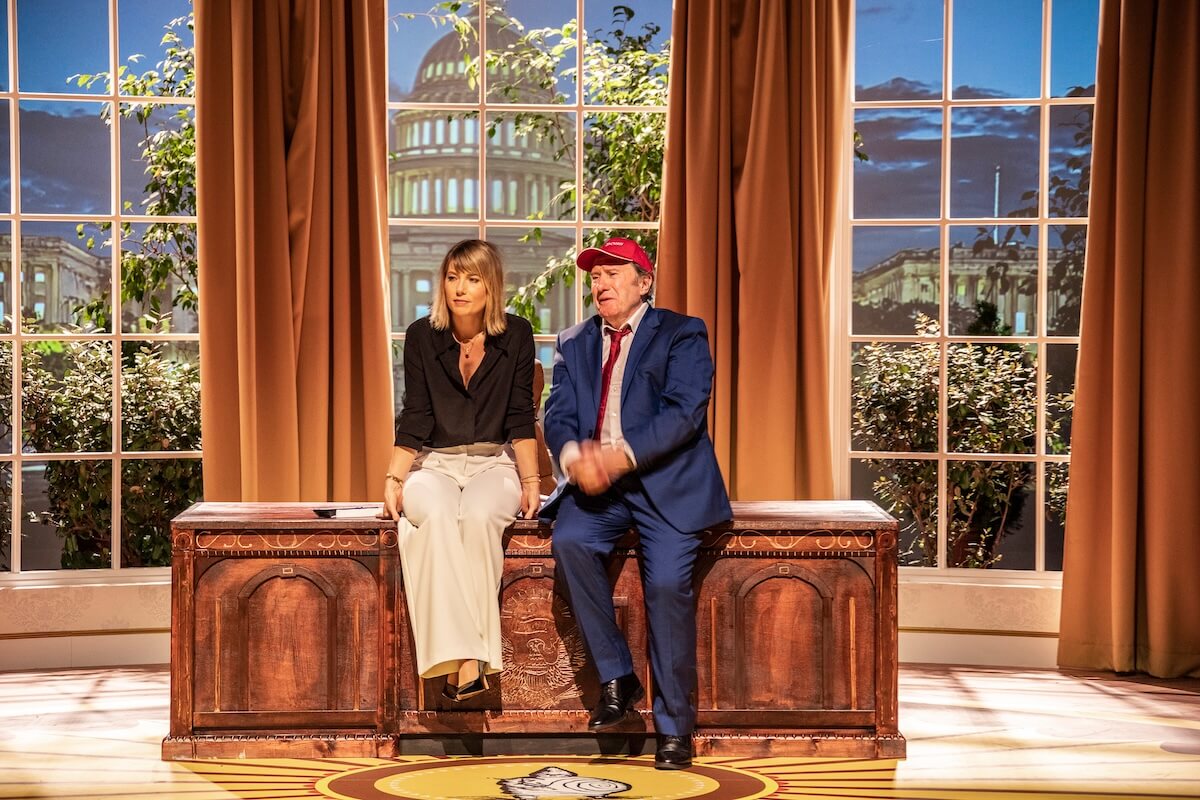
Photo © Philip Ducap
Facing him, Page delivers a Mère Ubu of glacial precision: manipulative, cynical, concerned about the murders happening around her only insofar as they might one day rebound on her. It is, she says, the most horrible woman she has ever played, and the most fascinating one – a character whose monstrous complexity reveals itself gradually, like the language itself, one layer at a time. Minor roles are carried by Anthéa talent like Clément Althaus, Gaële Boghossian, Paul Chariéras, Paulo Correia, Benjamin Migneco, Julien Nacache and Pascal Paolini.
The stage design, accompanied by Paulo Correia’s typically brilliant videography with cinematographic flashes reminiscent of Tarantino’s work, changes scenes at an incredible pace of 44 scenes in an hour and a half. Puppets give the play additional “body”, not only as a subtle nod to its origins but also as a reminder of what people become in such a society. Even Benoin himself makes a Hitchcock‑esque cameo appearance. And Clément Althaus’s virtuoso rock soundscape – jarring where needed, subtle where appropriate – only amplifies the sense of manic velocity.
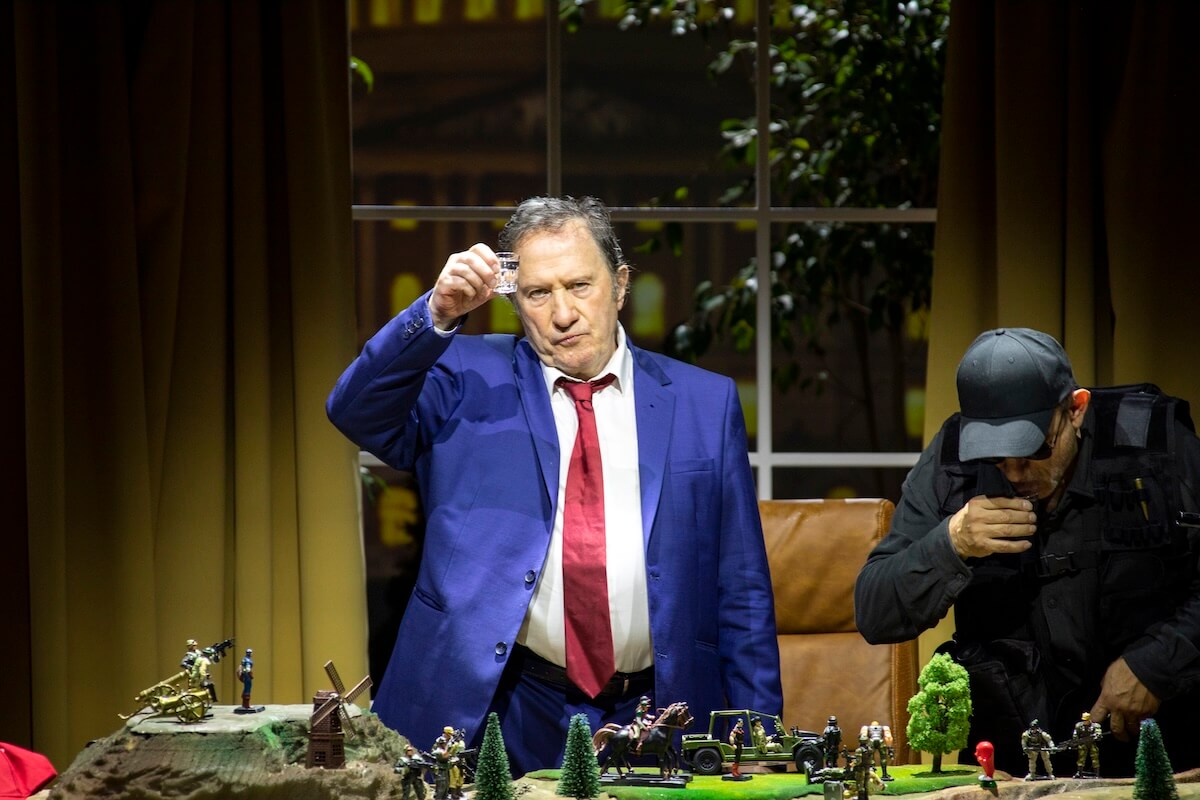
Photo © Philip Ducap
This flagship play of the 2025/26 Anthéa season provokes mind and senses alike. But beyond the violence it reveals humour and the joy of language, with the famous “merdre” and other made‑up words punctuating many of the dialogues in Jarry’s play. (Who doesn’t remember cofveve?) At the end of the day, this is a dark, cathartic, Rabelaisian comedy that reminds us that fears dissipate fastest when confronted head‑on.
Ubu Roi runs at anthéa, théâtre d’Antibes until 21 March, 2026. Performances start at either 8 pm or 8:30 pm, depending on the day. Tickets may be reserved online.

VENUE DETAILS
anthéa Antipolis Théâtre d’Antibes
260, avenue Jules Grec
06600 Antibes
Tel: +33 (0)4 83 76 13 13
PHOTO CREDITS
- All photographs and images courtesy anthéa Antipolis Théâtre d’Antibes and as credited








Leave a comment