


People talk about hidden gems in various locations, but there is something wonderfully unexpected about discovering Alex Doll in the narrow streets of Vieux Nice.
Situated at 4bis Ruelle de la Boucherie, his gallery is surrounded by the history, colour and constant movement of the Old Town, yet it manages to feel like its own little universe. The walls are alive with flowers, colour and movement, and the experience is considerably more than simply walking into a gallery to look at paintings.
There may be a painting on the wall, but there might also be fashion, swimwear, umbrellas, bags, accessories, music, an opera singer, a performer or an evening that turns the gallery into a stage. Alex Doll has never really treated art as something that should remain confined to a frame. For him, art is something that can be lived, worn, carried, experienced and shared. His Nice gallery is therefore not simply a place where his work is sold. It has increasingly become a place where people encounter the artist himself and the colourful world he has spent years creating.
Yet to understand the man behind the flowers, it is worth going back to a very different world.
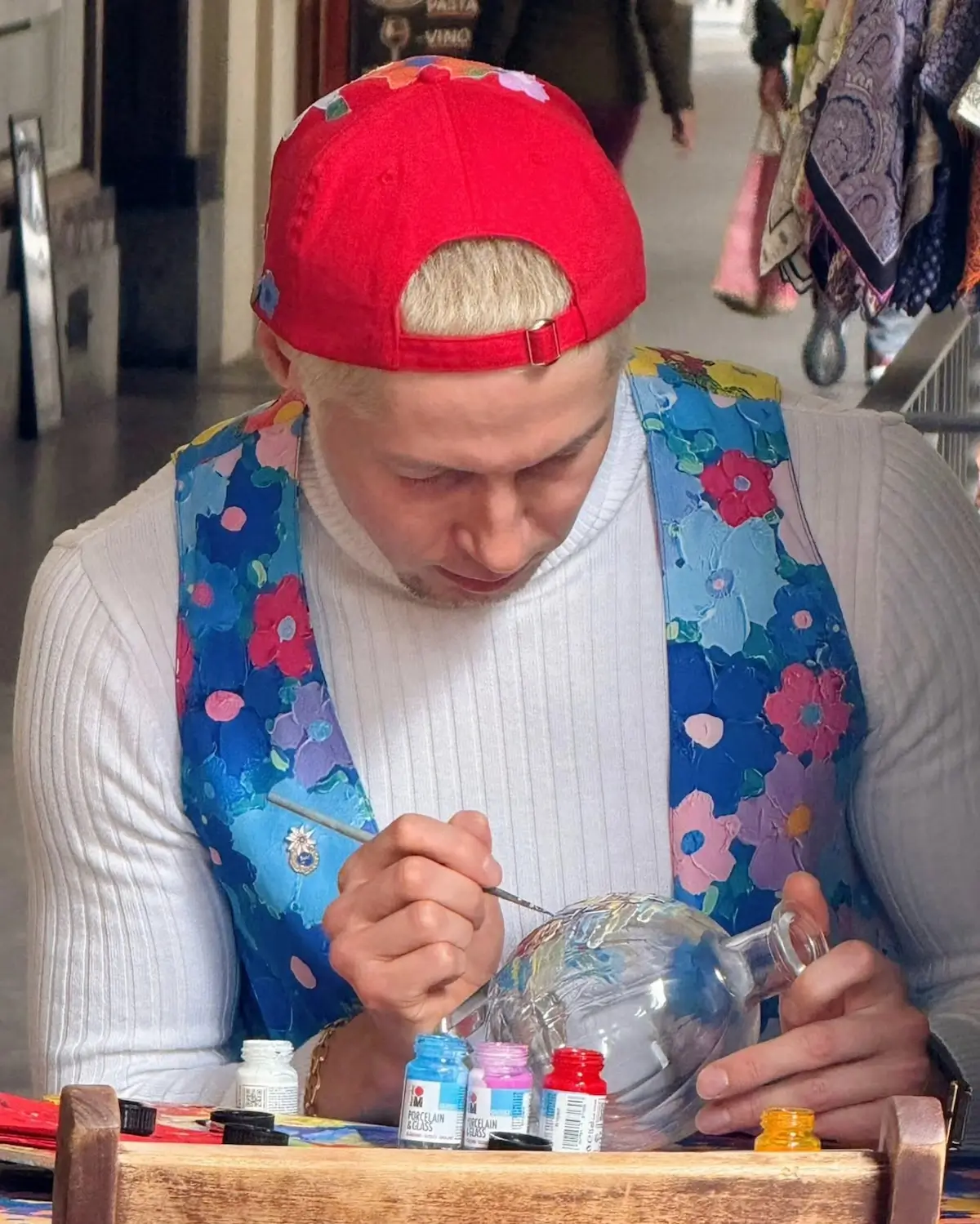
Alex Doll was born in Orenburg, Russia, in 1990. His family background crosses borders, with ancestors who had migrated from the southern German region to Russia centuries earlier. His childhood, however, would take him into an environment that seems almost impossibly far removed from the bright contemporary world he occupies today. Between the ages of five and fifteen, Doll lived in an Orthodox monastery near Orenburg, where he was taught icon painting by monks. Other accounts of his childhood describe him spending much of that period in a cathedral and monastery environment, wearing the long black robe associated with monastic life.
It is a remarkable place from which to begin the story of an artist who would eventually become synonymous with explosions of colour.
The young Doll learned the discipline of painting through religious iconography. He was taught to observe, reproduce, work carefully and understand the traditions of an artistic form passed down through generations. At sixteen, he continued his artistic education at art school in Orenburg, concentrating on drawing and oil painting, before undertaking further training in Moscow and eventually moving into the Swiss educational and artistic world. He studied at the School of Arts in Bern and Biel and developed his practice across painting, sculpture, installation, fashion, happenings and performance.
There was, however, another transformation taking place. The boy surrounded by religious imagery and black robes was developing an increasingly powerful need for colour and light.
Doll has explained that his floral work emerged partly from a desire to create an environment different from the darkness he sometimes experienced around him. His philosophy was essentially that if he could not change everything happening outside himself, he could create another space within which he could live. The flowers became that space.

That is an important key to understanding his work today. The flowers are not merely decoration; they are a response. They represent colour where there was darkness, optimism where there was negativity and life where the surrounding circumstances might otherwise have felt restrictive. The transformation from the black robes of his childhood to the explosion of flowers that has become his trademark is almost poetic, but it was not an overnight transformation.
Bern: Where an Artist Had to Find His Feet
Doll arrived in Bern, Switzerland, in 2009 and has often spoken about falling in love with the city almost immediately. By his own account, Bern became much more than the place where he happened to live. It became the place where he grew into the artist he wanted to become.
One particularly revealing account recalls Doll as a young man, only around seventeen, walking through Bern and showing his paintings to gallery owners. He was trying to establish himself, learn from the city and discover whether people would accept his work. He has said that Bern taught him to paint, helped him appreciate its nature and history, and gave him the opportunity to realise himself as an artist.
That part of his story matters because it places the success of today’s Alex Doll in context. The artist with galleries in two countries, international exhibitions and a recognisable visual identity once had to walk through the streets of Bern and persuade people to look at his paintings. He had to establish himself, earn acceptance and find the courage to keep going.
Doll eventually established his own atelier-gallery in Bern’s Old Town in 2019, creating a permanent base for his work. He became increasingly recognisable within the city’s cultural scene, while his flowers appeared in public and cultural spaces. In 2023, he transformed the backstage area of Bern’s ONO cultural venue with his floral motifs, and his paintings entered collections including the University of St. Gallen, Lindenhofspital Bern and the Swiss Federal Office of Transport.
Bern was no longer simply the city where he had arrived as a young artist trying to make his way. It had become home.
Doll has since obtained Swiss citizenship and has described himself as feeling increasingly like a Bernese. In 2024, Plattform J described him as an established figure in Bern’s cultural landscape, noting that he had spent roughly half his life in Russia and half in Switzerland.
That journey from outsider to established member of the community is one of the quieter but more powerful parts of his story.
The Flowers Become a Language
As Alex developed his artistic identity, the flowers became a language of their own.
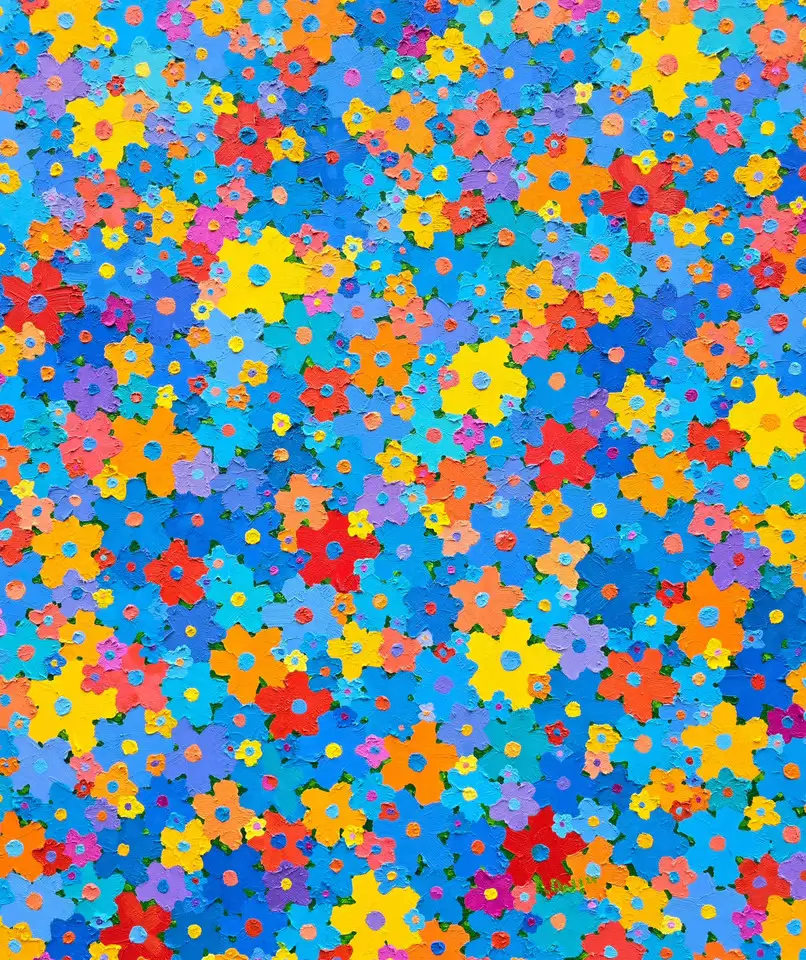
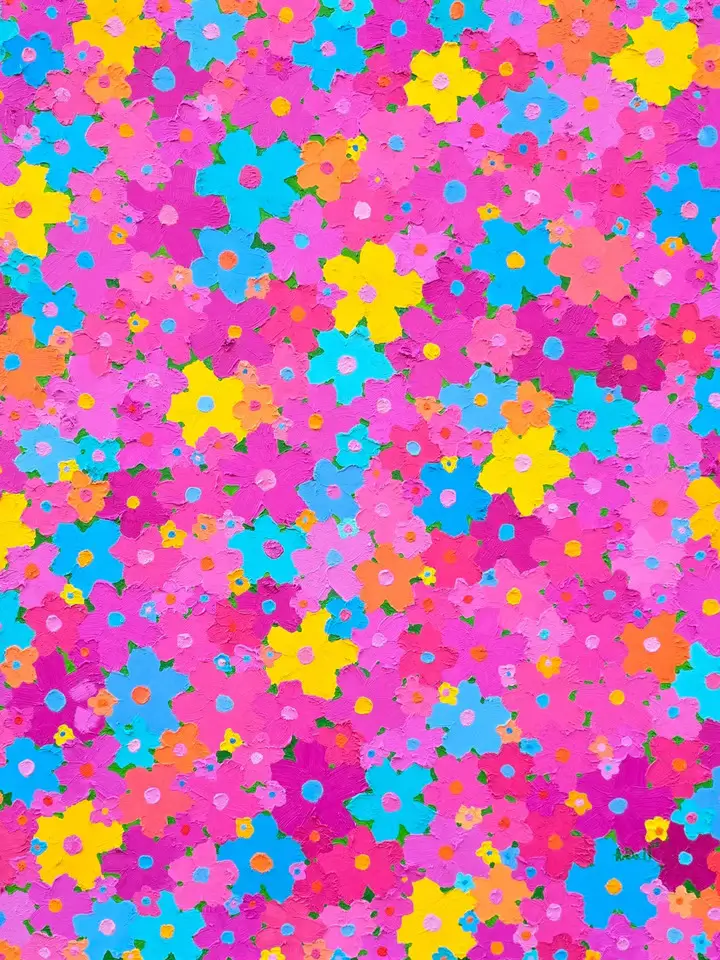
They appear on canvases, walls, clothing and objects, but their symbolism goes considerably deeper. Doll has associated his five-petalled flowers with humanity and positive emotions. The human form is embedded within the imagery, and his work repeatedly returns to ideas of people, nature, emotion, dialogue and connection.
That philosophy has extended into projects dealing with subjects considerably larger than decorative art. His work has addressed climate change and the environment, including a project involving an old pair of skis painted with flowers. The concept was a meditation on a future in which warming temperatures could transform landscapes where people once skied into places where flowers grow instead. His Flowers of Dialogue project for the St. Gallen Symposium similarly used his floral imagery to explore communication between generations, peace, hope and the environment.
The flowers may be colourful, but they are not necessarily superficial. They are often where Doll begins a conversation, and conversations have increasingly become an important part of his artistic practice.
When a Gallery Becomes a Stage
Alex has never been content to stay inside the conventional boundaries of painting.
His artistic practice includes sculpture, installation, fashion design, happenings and performance, and he has repeatedly collaborated with musicians, opera singers and dancers. His work can therefore change dramatically depending on the setting. A painting exhibition can become a performance, a performance can become a social gathering, and a gallery can become a stage.
That instinct has followed him to Nice.
His gallery in Vieux Nice is particularly well suited to this approach. The Old Town itself is theatrical, with its narrow streets, old buildings, restaurants, cafés, shops and constant movement. Doll has created a space within that environment where something can happen rather than merely something being displayed.
Occasionally, the gallery comes alive with dramatic evenings involving local performers and entertainers. Among those who have been part of Doll’s artistic circle is his friend Marie Gridneva, an opera singer whose voice can completely change the atmosphere of the space. There is also Mickey, a pole-dance instructor and performer whose physicality adds another dimension to Doll’s interest in movement, the body and performance.
Painting, opera, movement, colour and people come together in a space that might otherwise simply have been another small gallery in Vieux Nice. Instead, it has a pulse.
The Entrepreneur Behind the Artist
There is another side to Alex Doll that deserves recognition because it explains why his work can reach beyond the traditional art market.
Doll understands something very simple: not everybody can buy a large original painting, but that does not mean they should be excluded from his artistic world. His response has been entrepreneurial.
His designs have moved from canvases into swimwear, clothing, scarves, umbrellas, perfumes, backpacks, bags and other accessories. His official shop describes itself as “more than brand” and has developed collections that allow people to purchase and live with his designs in different forms.

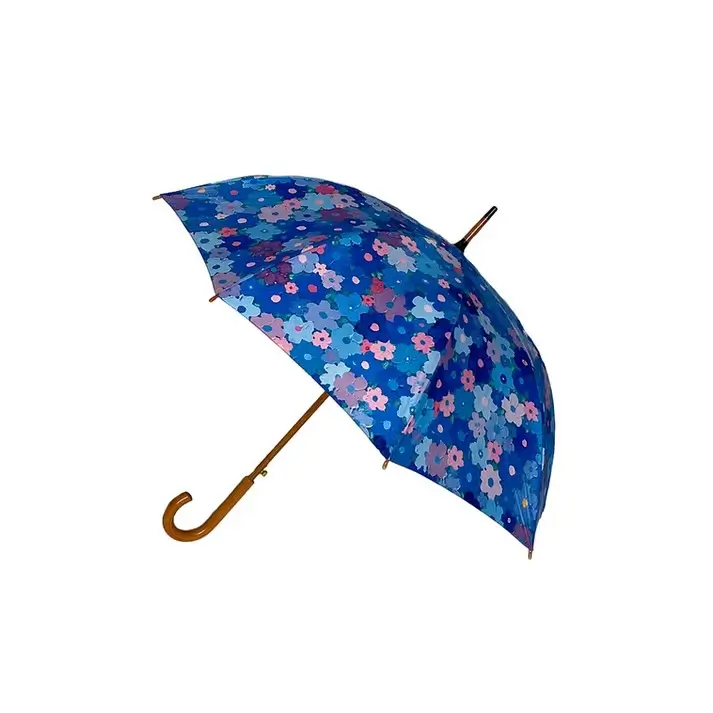
Someone might not have the space or budget for one of Doll’s major paintings, but they can still own a little piece of his visual universe and incorporate it into everyday life. It is not simply merchandising for merchandising’s sake. It extends the reach of the artistic language he has spent years developing and allows people who might never become traditional art collectors to participate in it.
In a city where fashion, beaches, colour and outdoor life are such an integral part of everyday culture, the idea makes particular sense.
From the Male Body to the Human Being
Doll’s willingness to explore the human body also takes his work into more provocative territory.
His Secret Exhibition, which continues to develop over several years, moves away from the flowers and looks directly at the human body, sexuality, modesty, shame and the way society responds to intimate subjects. The exhibition involved models from very different social backgrounds, including a sex worker, a homeless person, a doctor, a philosopher, a wealthy individual and a cardinal. Doll has also spoken about a Swiss National Council member participating while remaining anonymous.
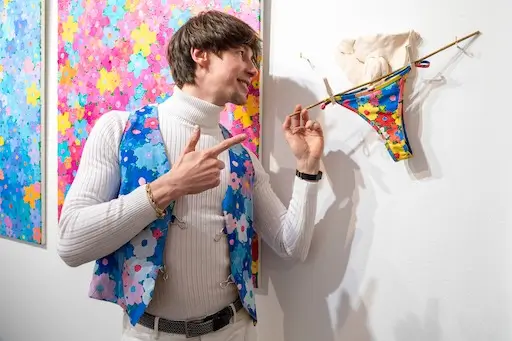
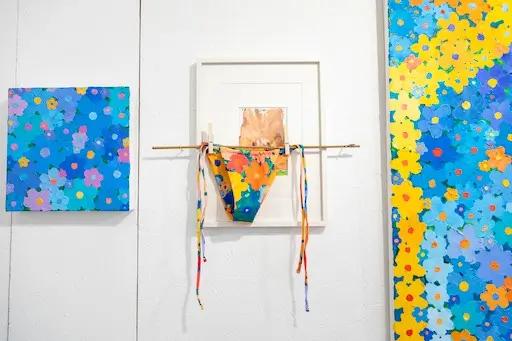
It is precisely this willingness to explore subjects that many people might prefer to avoid that creates an obvious connection between Doll’s work and LGBTQIA+ cultural life.
The body is political for some people and sexual for others. It can be a source of shame, pride, freedom, vulnerability or identity. LGBTQIA+ communities have long challenged conventional assumptions about how bodies, sexuality and identity are supposed to be seen.
Yet Doll’s work should not be reduced to simply being LGBTQIA+ art. His interest is much broader: the human being underneath the labels.
The businessman, the artist, the priest, the sex worker, the politician, the wealthy person and the person living on the margins of society all possess a body. By bringing these people into the same artistic conversation, Doll challenges the hierarchy that society so often places around them.
That is one reason his work can resonate so naturally with a contemporary Nice audience.
A Place Within Nice’s LGBTQIA+ Cultural Landscape
Nice has long had a visible LGBTQIA+ community, but its cultural life is changing and expanding. It is no longer defined solely by nightlife, bars and clubs. Increasingly, LGBTQIA+ life intersects with art, performance, fashion, film, literature and wider cultural activity.
Doll’s gallery fits naturally into that evolution. His exploration of the male body and sexuality, his willingness to stage performances and his collaborations with local entertainers create an obvious point of connection. His gallery has also become associated with LGBTQIA+ cultural programming, including events involving Polychromes.
The important distinction, however, is that the gallery remains open to everyone. And perhaps that is exactly how some of the best discoveries happen.
From Russia to Switzerland to the Côte d’Azur
There is also a fascinating geographical story running through Doll’s life.
Russia is where he was born and where his early artistic education began. Switzerland became the country where he developed his adult life, artistic career and permanent home. Nice is now another important chapter.
He has described the difference between his two principal cities almost playfully: in France he has the sea, while in Switzerland he has the mountains.
There is something almost perfectly symmetrical about that. The mountains and the Mediterranean are dramatically different environments, yet both have become part of the artist’s world. Now Nice has given his work another kind of canvas: the city itself. The flowers belong naturally against the Mediterranean light, and the gallery becomes another little piece of the Riviera.
Strength Behind the Colour
It would be easy to look at Alex Doll’s work and see only happiness. There are flowers, fashion, performance, music and theatricality everywhere, but underneath all of that is a story that has required considerable resilience.
Doll began life in a very different cultural environment, learned an intensely traditional form of painting, moved countries, established himself in Switzerland, built a gallery business, developed an international career and expanded into another country and another artistic community.
He has had to reinvent himself without abandoning the skills he learned at the beginning.
A Hidden Gem in Vieux Nice
For anyone interested in discovering a different side of Nice, Alex Doll Galerie is one of those places worth seeking out rather than simply passing by.
It is small, intimate and tucked away, but it represents something much larger than its physical size. It is a contemporary art gallery, a fashion outlet, a meeting point, a performance space and an expression of the artist’s personality.
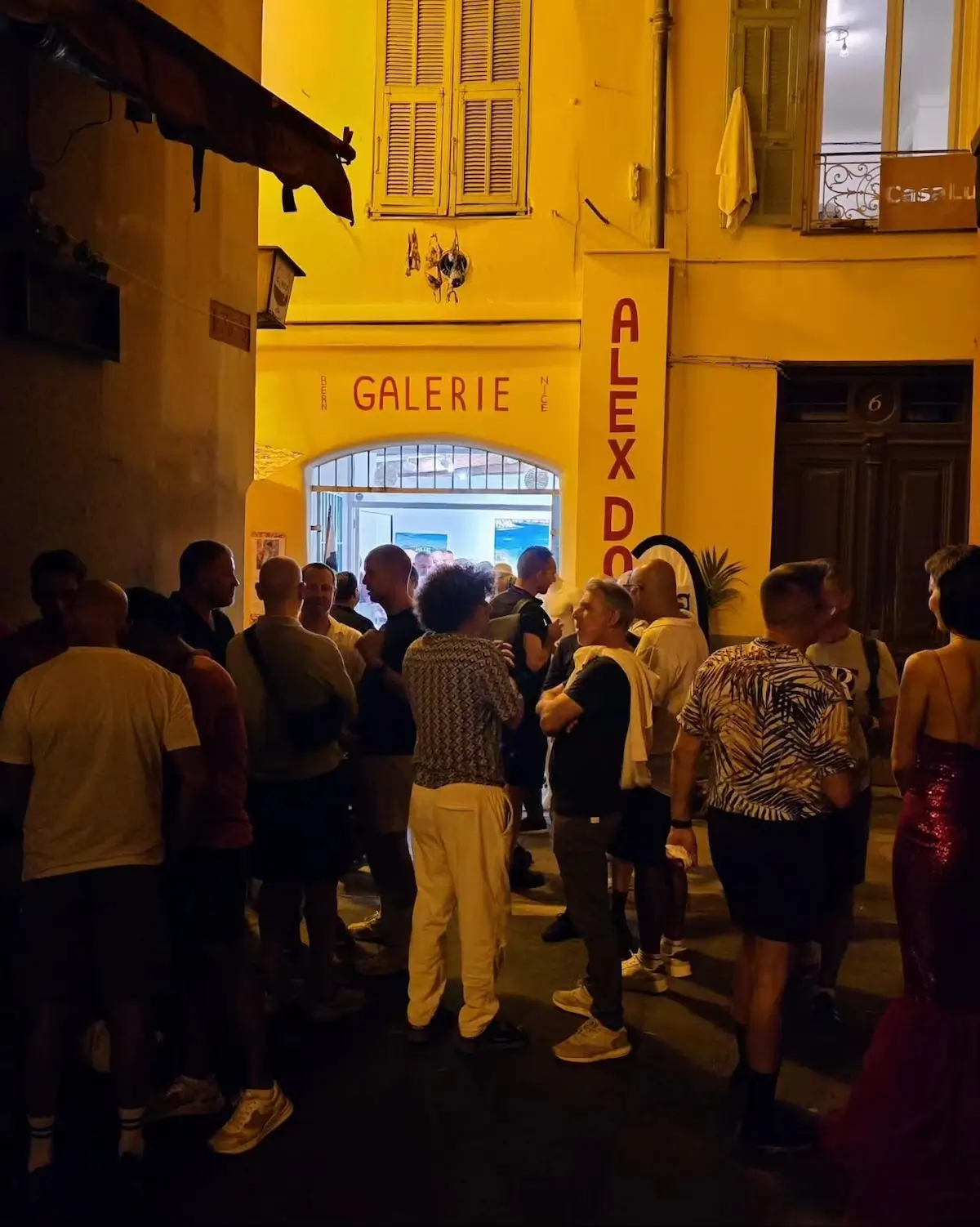
A collector can discover a major painting, while someone else might leave with an umbrella, a handbag, a backpack, swimwear or another piece carrying Doll’s unmistakable floral signature. Occasionally, the quiet little gallery in Vieux Nice can become something entirely different when the lights go down, the music begins and performers such as Marie or Mickey transform the space into a stage.
That is what makes Alex Doll particularly interesting in Nice. He has not simply brought his paintings to the French Riviera. He has brought his world.
A world that began in Orenburg, passed through the disciplined tradition of Orthodox icon painting, found its artistic identity in Bern, developed into an international practice and has now taken root in the winding streets of Vieux Nice.
The journey from a young boy in a monastery to an artist with galleries in Bern and Nice is a long one. It required talent, persistence, adaptability, courage and an extraordinary willingness to keep evolving.
Perhaps that is ultimately what the flowers represent: life continuing to grow, beauty emerging from difficult circumstances, different people coming together, and the determination to create something brighter than whatever darkness might have existed before.
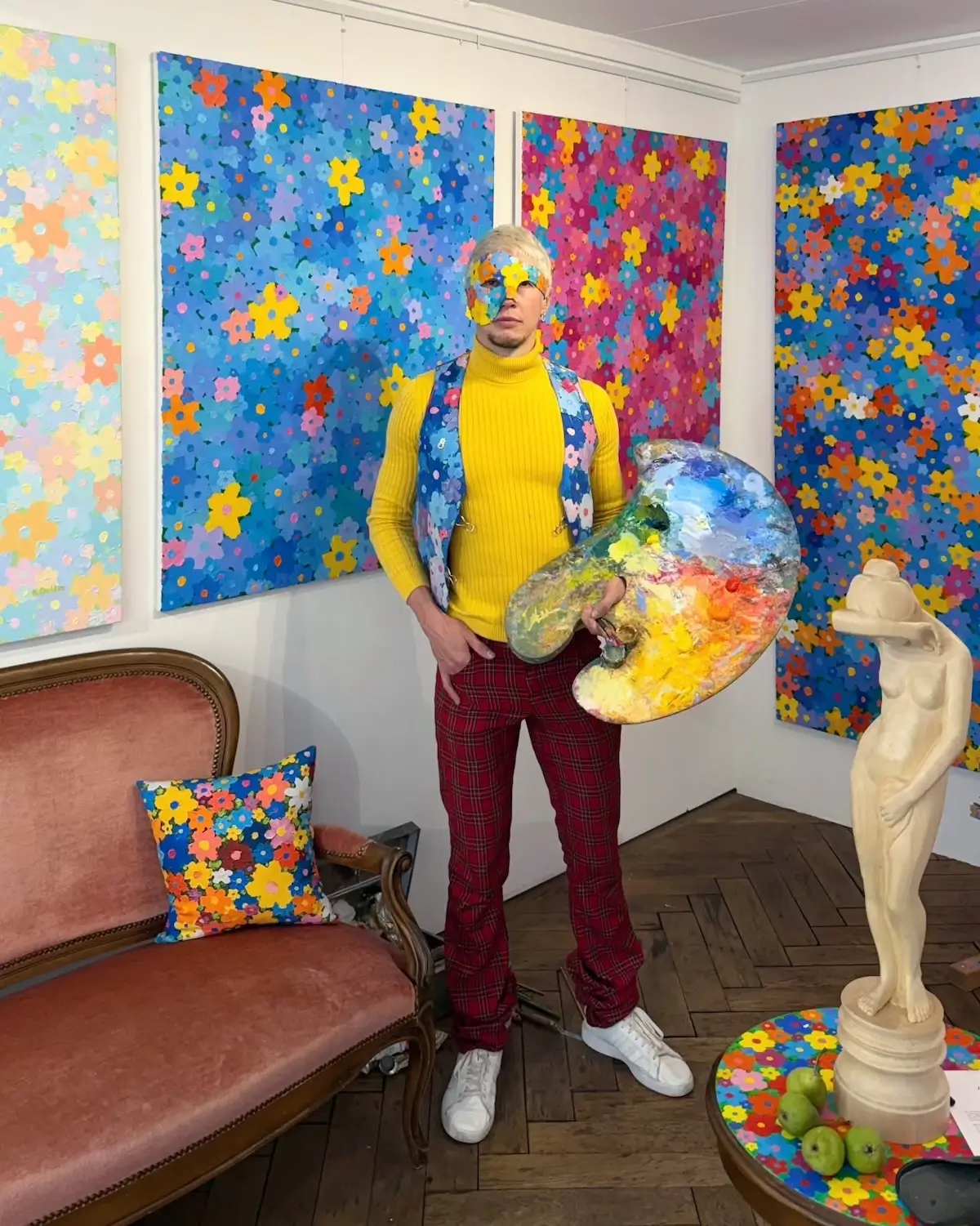
Alex Doll brings life wherever he goes. In Vieux Nice, he has found a particularly beautiful place to let that life bloom.

VENUE DETAILS
Alex Doll Gallerie
4bis Ruelle de la Boucherie
06300 Nice
PHOTO CREDITS
- All photos and videos courtesy Alex Doll
Advertisement








Leave a comment