


The play that has held France in its grip for the past two years asks uneasy questions of a Nazi bride who saw it all yet saw nothing…
As if the world we live in didn’t already have enough problems – wars, AI, the climate crisis, the ever-rising cost of living, corrupt politicians… Why would anyone, on top of our complex reality, want to deal with things that happened before our lifetime, back in the Nazi era? Majola, a play that has just swept the Cyranos with no less than four awards, tells us why: because the ghosts of the past still loom large even if we don’t want to face them. It is the story of how people lead their lives, while knowing there is horror all around them, but they would rather close their eyes to it as if it didn’t concern them.
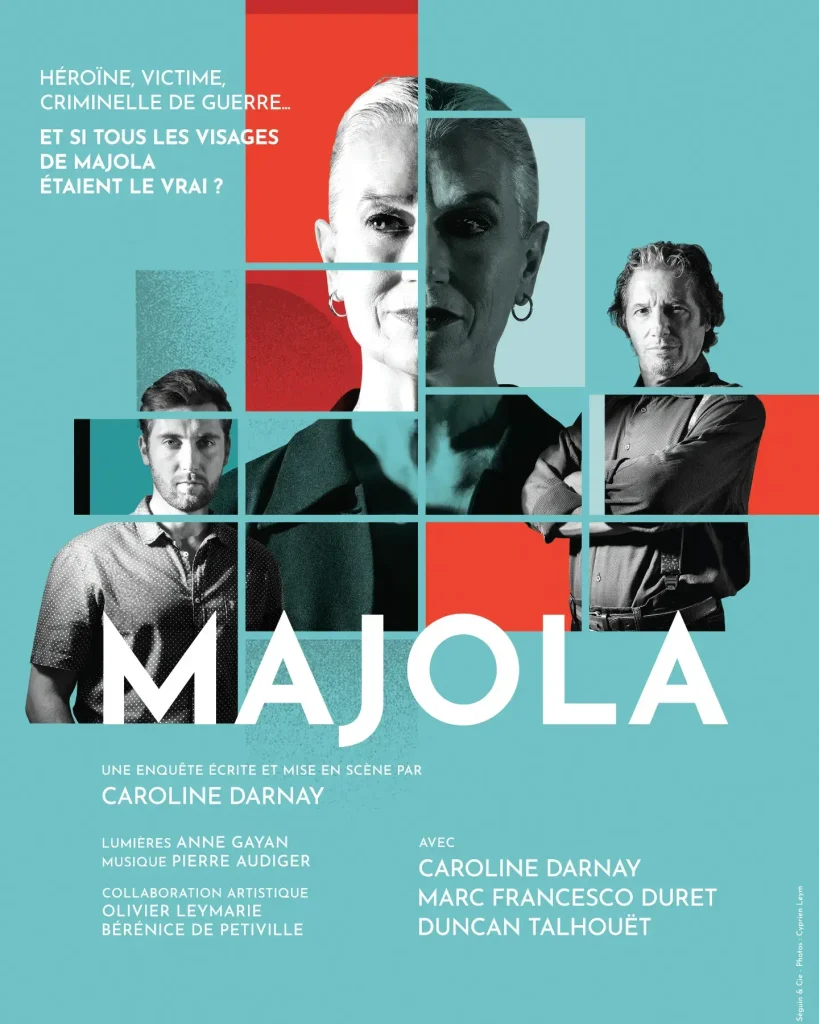
Majola treats this complex topic with grace and elegance, not least owing to a restrained set and the sensitive performances of Caroline Darnay (who also wrote it), Marc Francesco Duret, and Duncan Talhouët. But it leads us toward understanding that the past and the present are not always so dissimilar, and that the dark side of history sometimes lives uncomfortably close.
Beyond a reward for a well-made play, the four Cyranos are a signal that there is still an audience for work that refuses to simplify history.
FOUR NOMINATIONS, FOUR WINS
– Best play, general public: Majola
– Best lead actress: Caroline Darnay
– Best contemporary author: Caroline Darnay
– Best artistic direction: Caroline Darnay
Les Cyranos are the national awards of the Fédération du Spectacle Indépendant, which honour outstanding productions in France’s small independent theatres.
The story is based on a real person, Ruth Irène Kalder, a woman who could have been anyone’s grandmother or great-grandmother. Born in 1918, she was an aspiring actress turned secretary working at Oskar Schindler’s enamelware factory when she met Amon Göth. The Austrian SS functionary and war criminal oversaw the Płaszów concentration camp near Kraków. Göth, whose particular cruelty is chillingly depicted in Schindler’s List, ran Płaszów as a personal fiefdom of terror. Kalder lived with him in his house at the gates of the camp, planning to marry.
The title of the play, Majola, is taken from Göth’s Polish pet name for Irène and loosely translated as “little queen”. It is an intimate nickname that also hints at the myth that grew up around her – the idea that she could soften a monster. The play uses that name to ask whether she – or any of us – can be reduced to a single label: victim, accomplice, bystander, or saviour.
The real Irène Kalder later claimed she did not fully understand what was happening around her. And the play reflects that, but it does not sit in moral judgment. Rather, the question to be examined is, “Is this woman truly blind to everything, or does she selectively refuse to see it in the man she loves, and whose world she has chosen to share?“
Video via Jean-Pierre Bugnon on YouTube
The action is set in a Munich hotel suite in the early 1980s. An American journalist, who is a Second World War veteran, and his young Jewish cameraman have come to interview Kalder about Oskar Schindler, who is already being recast as a hero. But she deflects as best she can “No, Schindler was not a friend to Jews, he exploited them in his factories…. No, those camps were labour camps, not concentration camps…” What begins as a professional assignment for the journalist becomes a psychological puzzle of Kalder’s role, her responsibility, and the stories she has told herself for decades.
The direction and scenography are deliberately lean. A single location, three characters, no flashbacks, no projections, no archival material. This keeps the focus on the story, the protagonists, and the shifting balance of power between them.
Caroline Darnay as Irène Kalder
Darnay magnificently embodies the contradictions that make Kalder so difficult to judge. Her interpretation of Kalder is elegant and controlled but betrays the protagonist’s inner world through body language. She speaks with a precise German accent, constantly adjusting her story evoking the world of pre-war Central European theatre and cinema that Kalder once aspired to join. But beneath the varnish is a woman who has spent decades perfecting her denials.
Kalder tries to seduce, deflect and intimidate her interlocutors, using memory as both shield and weapon. Darnay’s performance makes clear that Kalder’s greatest talent may not have been acting in the conventional sense, but her ability to present different faces to different people… and to believe, or pretend to believe, her own versions.
In this reading, Kalder is not a monster in the Gothic sense, but a very human figure whose self-protection mechanisms have hardened into a kind of moral blindness. The play suggests that this is part of what makes such figures so unsettling: they are not aberrations, but extensions of ordinary capacities for denial and self-justification.
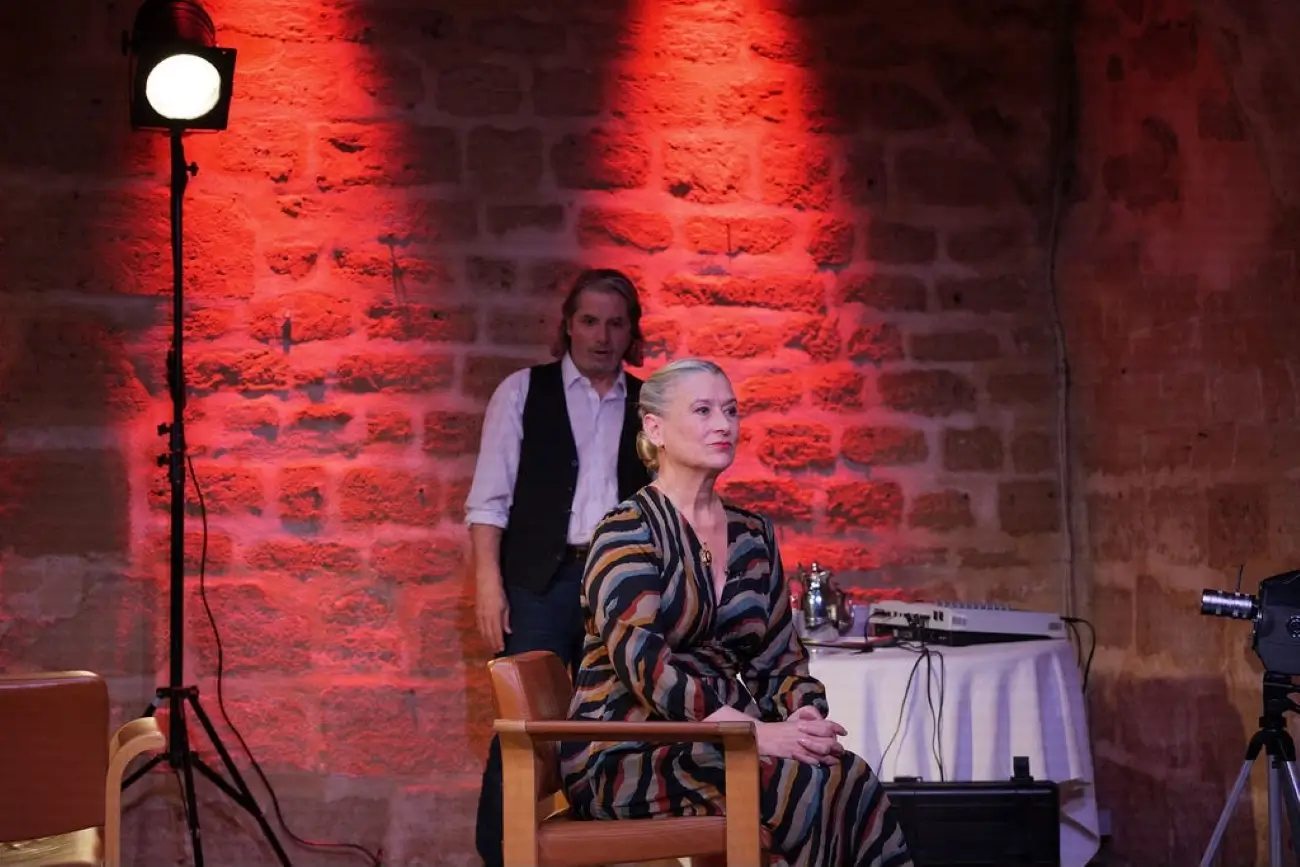
Photo courtesy Marc F. Duret
Marc Francesco Duret as the journalist
One of the leading French stage and screen actors, Duret plays the American journalist, a man marked by his own experience of war. He arrives in the suite as a professional, but his questions soon reveal deeper stakes: a need to understand how people live with what they have done, and what they owe to the dead. Duret brings a burnished, magnetic presence to the role, suggesting a man who has seen too much to be easily shocked but who still holds the world to account.
The journalist is not a neutral observer. He is suspicious of Kalder’s performance, yet also drawn into her logic. At times he seems to want to believe her version of events, if only to preserve some idea of moral order. At other moments he presses her with a ferocity that feels personal. Duret’s portrayal of the reporter makes it clear that this is not just an assignment; it is a test of his own beliefs about guilt, responsibility, and the stories nations tell themselves after a war.
In the play’s structure, the journalist stands between two generations and two ways of looking at history. He remembers a world in which categories like “hero” and “traitor” still felt stable. Kalder’s story threatens to dissolve those categories, and the cameraman’s insistence on clarity only heightens his discomfort. Duret gives the character a weary authority that makes the eventual cracks in his composure all the more powerful.
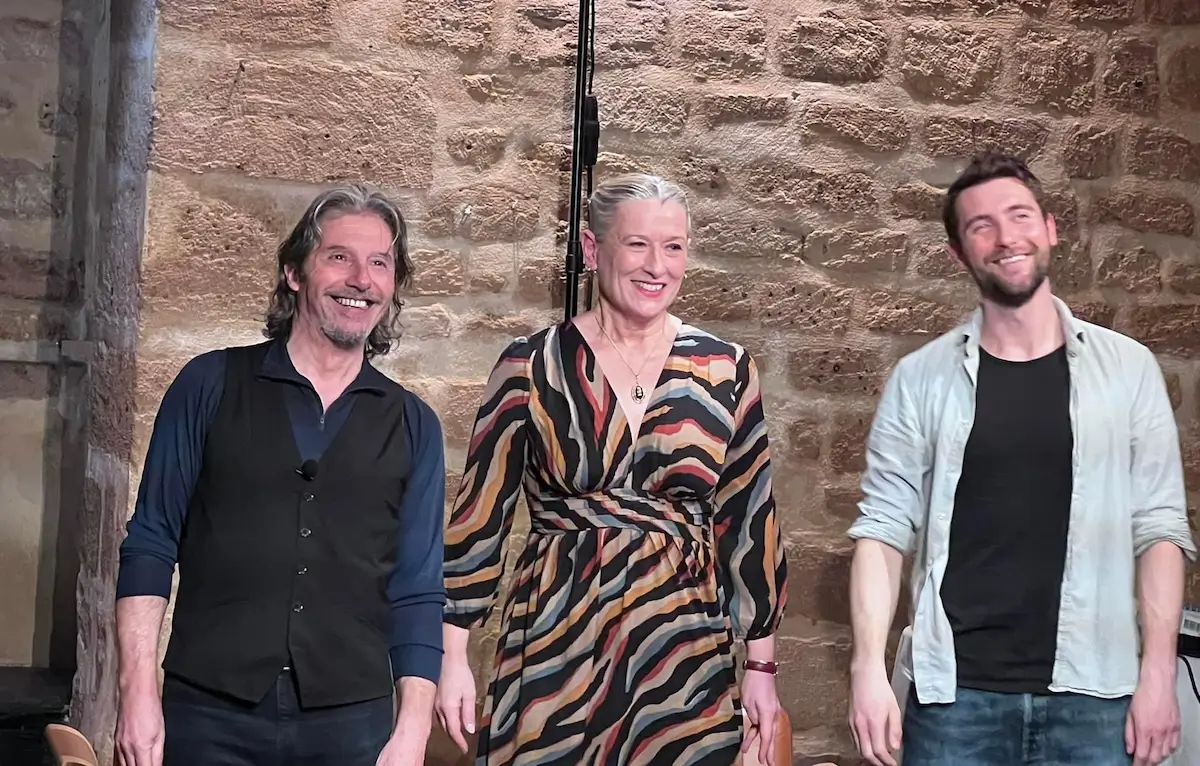
Photo courtesy Marc F. Duret
Duncan Talhouët as the cameraman
The third point of this triangle is younger, less compromised, and initially more confident in his moral certainties. He represents a generation that did not live through the war but inherits its consequences. For him, the interview is not just a professional task but a chance to confront a living link to one of the darkest chapters of the 20th century.
Talhouët brings an urgent, almost physical energy to the role. His character wants facts, names, dates, and clear lines between victim and perpetrator. As Kalder’s evasions multiply, his frustration grows. Yet the play does not allow him to remain a simple voice of conscience. His own assumptions are tested, and he is forced to recognise that the past cannot be reduced to a clean narrative.
In the dynamic of the suite, the cameraman is both observer and participant. His camera is supposed to record, but his presence changes what is being recorded. Talhouët’s performance captures the tension between the desire for truth and the realisation that truth, in this context, is always mediated by memory, performance and self-interest.
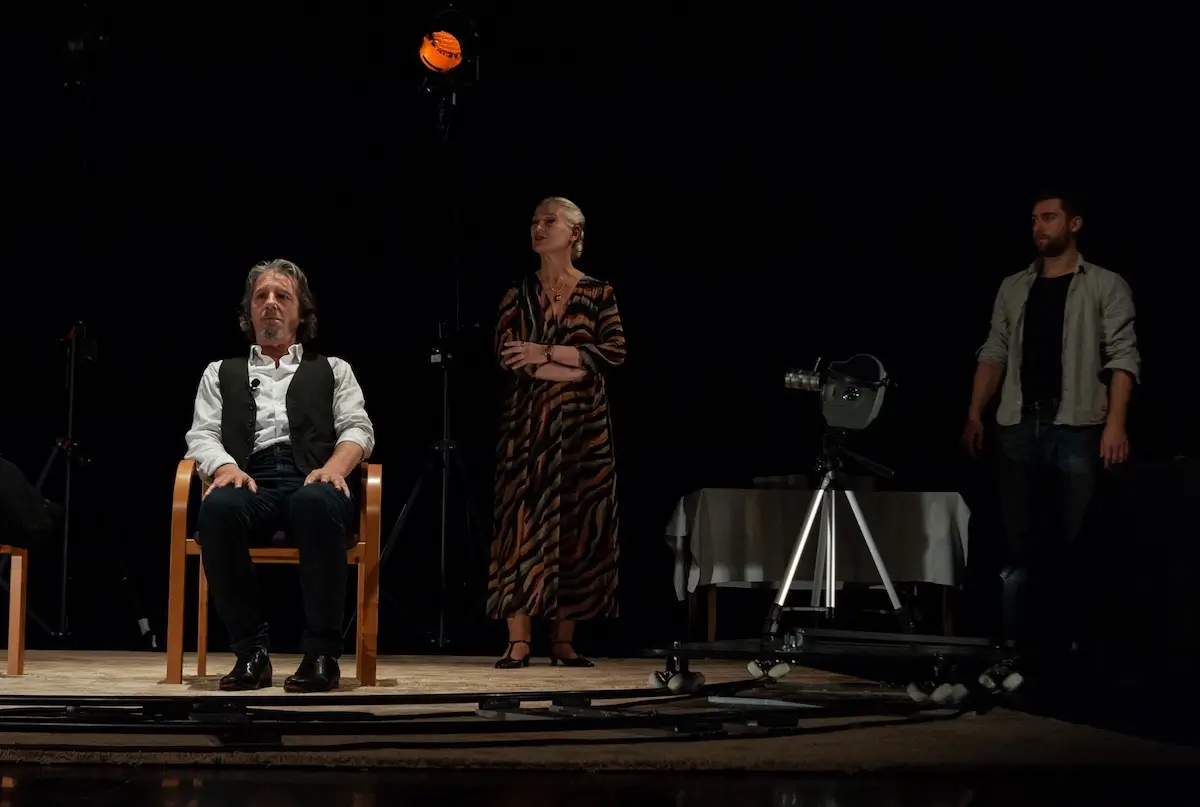
Photo courtesy Majola
Why this play, why now?
On paper, Majola might sound like a niche historical drama. In practice, it hits a nerve. The play arrives at a moment when debates about memory, responsibility and historical narrative are anything but settled. In France, the Second World War remains a reference point for discussions about collaboration, resistance, and the grey zones in between.
The questions raised by Kalder’s story echo far beyond 1940s Poland. They resonate in later reckonings with dictatorship and genocide, in Latin America, the Balkans or Rwanda. They surface in families that do not speak about what grandparents did during the war, in communities that prefer comfortable myths to complicated truths, and in individuals who construct versions of themselves that erase uncomfortable episodes.
Caroline Darnay makes this explicit. She recalls watching D-Day commemorations in Normandy, seeing Americans, French and Germans mingling as friends and wondering: who among them had fought, who had denounced neighbours, who had simply looked away? Majola extends that question to the intimate sphere: How well do we really know the people closest to us, and how many faces do they show the world? And at what point does self-protection become complicity?
Poster by Marianne Seguin
The real-life Majola
Irène Kalder died in 1983 by her own hand. Prior to that, she had given two major interviews, but the questions her life story raised have not gone away. She adamantly stuck to her version of events. She had had a daughter with Göth, Monika, born in 1945, ten months before he was hanged for his war crimes and genocide. The girl was raised in the belief – instilled in her by her mother’s unshakeable conviction – that he had been a good man, and only learned the truth as a young adult when watching a documentary about Schindler.
Monika had a daughter of her own, Jennifer Teege, born in Germany in 1970. Mixed-race, with a Nigerian father, she was given up for adoption and knew nothing about her past until she decided to do research into her biological mother for a book project she was working on. Only then did she learn about her family’s past. When she did, she said, “My grandfather would have killed me”, a line that later became the title of her book.
What the play wants us to understand
In a time when everyone is busy dealing with the present, Majola reminds us that the past is not over. It is still here, in the rooms we inhabit, in the stories we tell ourselves, in the faces we show to the world. We can close our eyes to it, we can ignore, embellish or resist it, but its invisible strings will always pull us towards the truth. But… how are we looking at our present, which will be tomorrow’s past?
What if the truth were more complex than a simple matter of black and white? What if all of Majola’s faces were the real one?“
— Caroline Darnay

PHOTO CREDITS
- All photos and images as credited
- Lead image courtesy Majola
- Video as credited
Advertisement








Leave a comment