


Dotting the village in an open-air exhibition, British artist Beth Carter’s bronze sculptures are a playful reflection on a complex world.
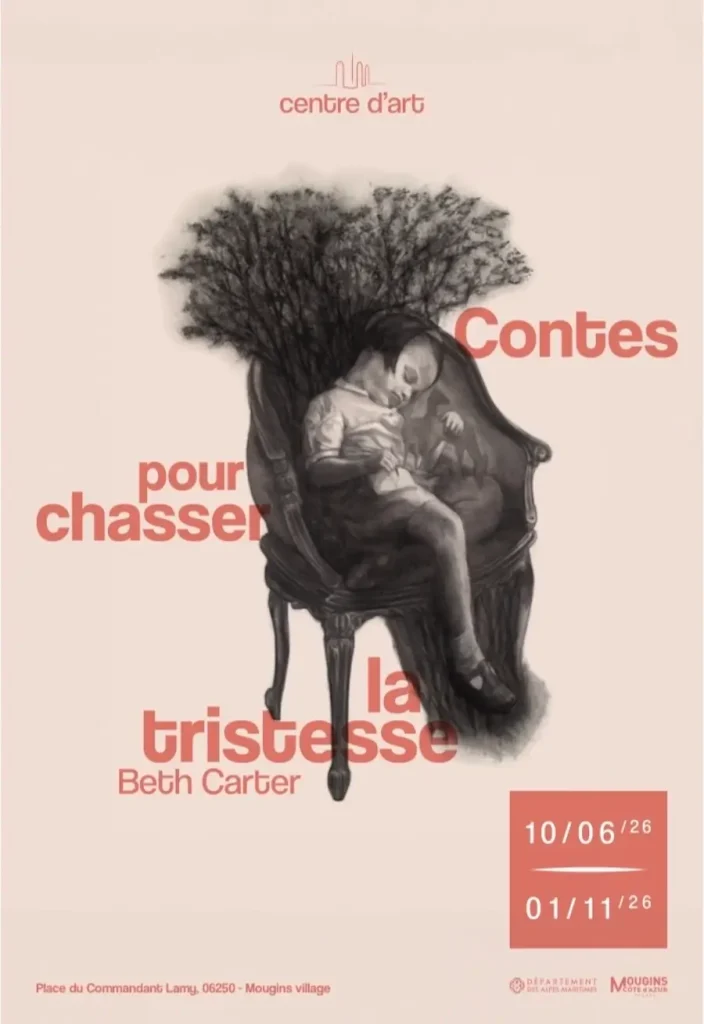
A Minotaur is not supposed to be easy to find. In Greek mythology, he was confined to a labyrinth. But in Beth Carter’s exhibition Myth, Melancholy, Magic, more than 30 large-scale bronze creatures are lurking around corners, in gardens, beside old buildings and under the open sky of Mougins. In parallel, Contes pour chasser la tristesse (Tales to Kill Sorrow) at Le Centre d’Art de Mougins brings together more than 20 of the British artist’s charcoal drawings, prints, reliefs and sculptures in plaster and bronze. Both shows run until 1 November.
The two complementary exhibitions show the breadth of Carter’s practice, but they also make a convincing case for seeing the works together. Outside, her hybrid creatures – half human, half something else entirely – share the village’s public spaces in peaceful cohabitation. Inside, the charcoal drawings offer a more private, unstable world: one in which figures can fly, float, alter their scale and move between memory and invention.
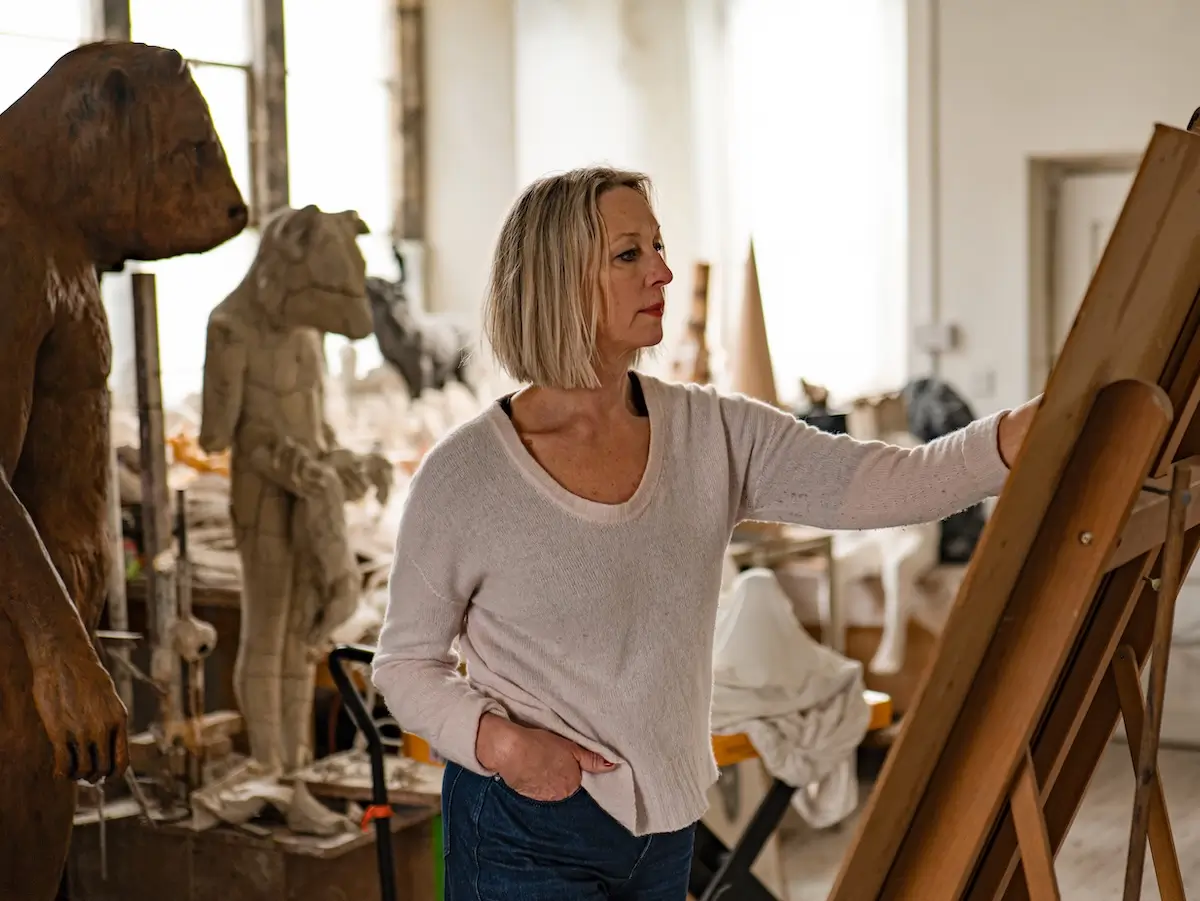
Photo by Stuart Mitchell
Beth Carter’s creatures are recognisable without being entirely explainable. Over the past 30 years, the versatile visual artist (pictured above), who is based between Bristol and Bath, has developed a symbolic language around duality, transformation, power and vulnerability.
There are birds, fawns, clowns, centaurs and Minotaurs, but none seems to belong neatly to a single category. Her fabled creatures draw on mythology, folktales, carnival, childhood and personal memory.
Mougins is an especially charged setting for the work. This was where Picasso lived and worked until his death in 1973, and the Minotaur was one of the most persistent figures in his imagery. At the entrance to the village, one of Carter’s Minotaurs now faces a giant bronze head of Picasso. The arrangement suggests a conversation, or perhaps a confrontation, but her relationship with the myth is not an extension of Picasso’s work so much as another expression altogether.
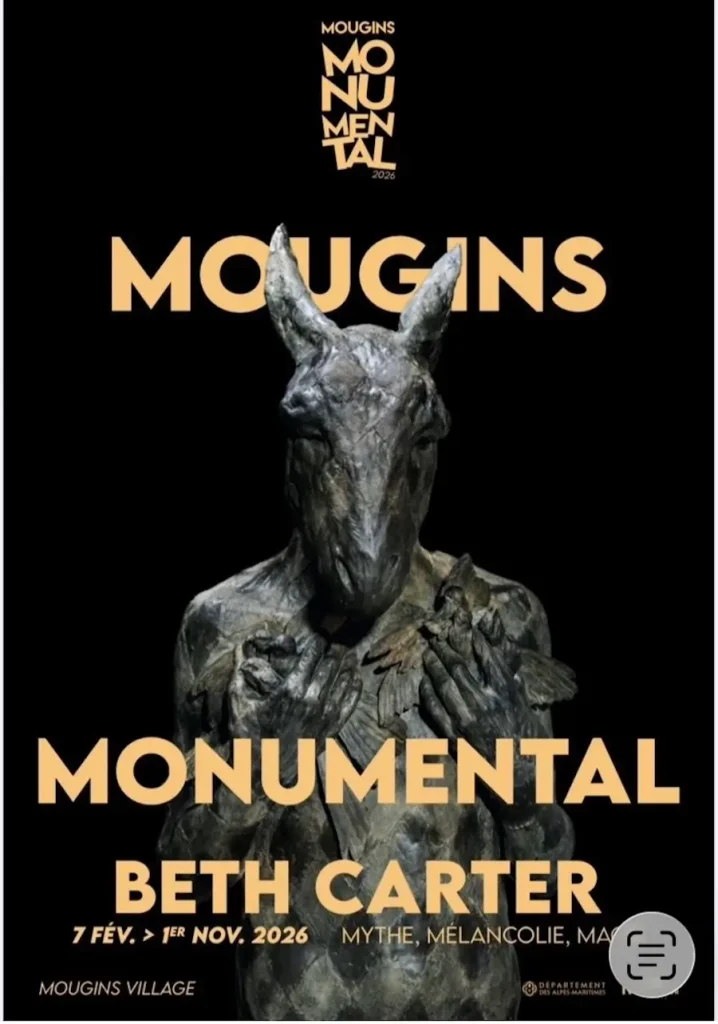
In an interview with RIVIERA BUZZ, Carter talks through the personal roots of her Minotaur, her refusal of a purely masculine perspective, and why charcoal remains the space where her figures are freest.
What did Mougins reveal about your sculptures that the studio could not?
I have never had this quantity of works together in one place at the same time. I usually have maybe three or four bronzes and clay pieces in the studio, some being worked on at the foundry and some exhibited in galleries, so this was the first time I was able to see the strong cohesion of the themes and the threads that link them all.
A few of the works were made about 25 years ago. I have recast them in bronze for this exhibition. It’s amazing for me to see how my personal and artistic preoccupations consistently recur throughout the sculptures and the drawings.
Which work has changed most dramatically?
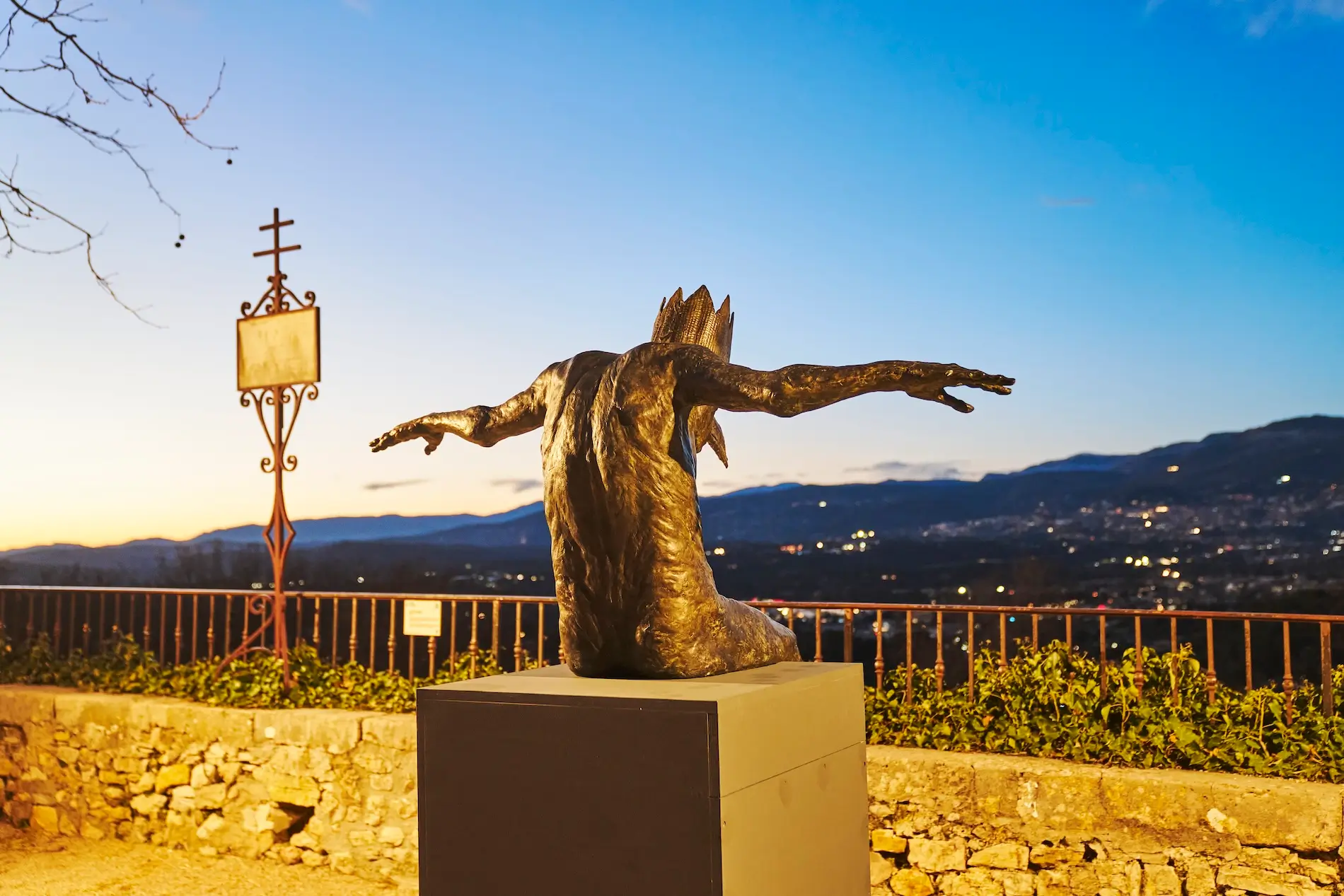
Photo credit Stuart Mitchell
I think the works which have changed most dramatically when placed in the village are the flying figures: Bird Man (with Cloth Wings) and King of the Birds II (pictured above). Seeing these particular works against the enormous sky and the Alps in the background dramatises their presence hugely and provides the perfect context to activate their stories. I don’t have a vista in my studio setting, so seeing them in Mougins has been transformative.
Did you intend for the visitor to follow a particular route?
It wasn’t my intention for the visitor to follow a particular route, and there is no specific arrangement or order in which to experience the sculptures. The village itself is made up of many winding, organic paths, so it seems natural that the visitor should encounter the works by surprise. There is also a map to guide you through, so none are missed out.
What happens to the Minotaur when it’s removed from the labyrinth and put in public?
This is a great question! I feel like the Minotaur becomes, paradoxically, even more lonely in a public setting, more vulnerable and alienated somehow…
Is your Minotaur a victim, guardian or the architect of the labyrinth?
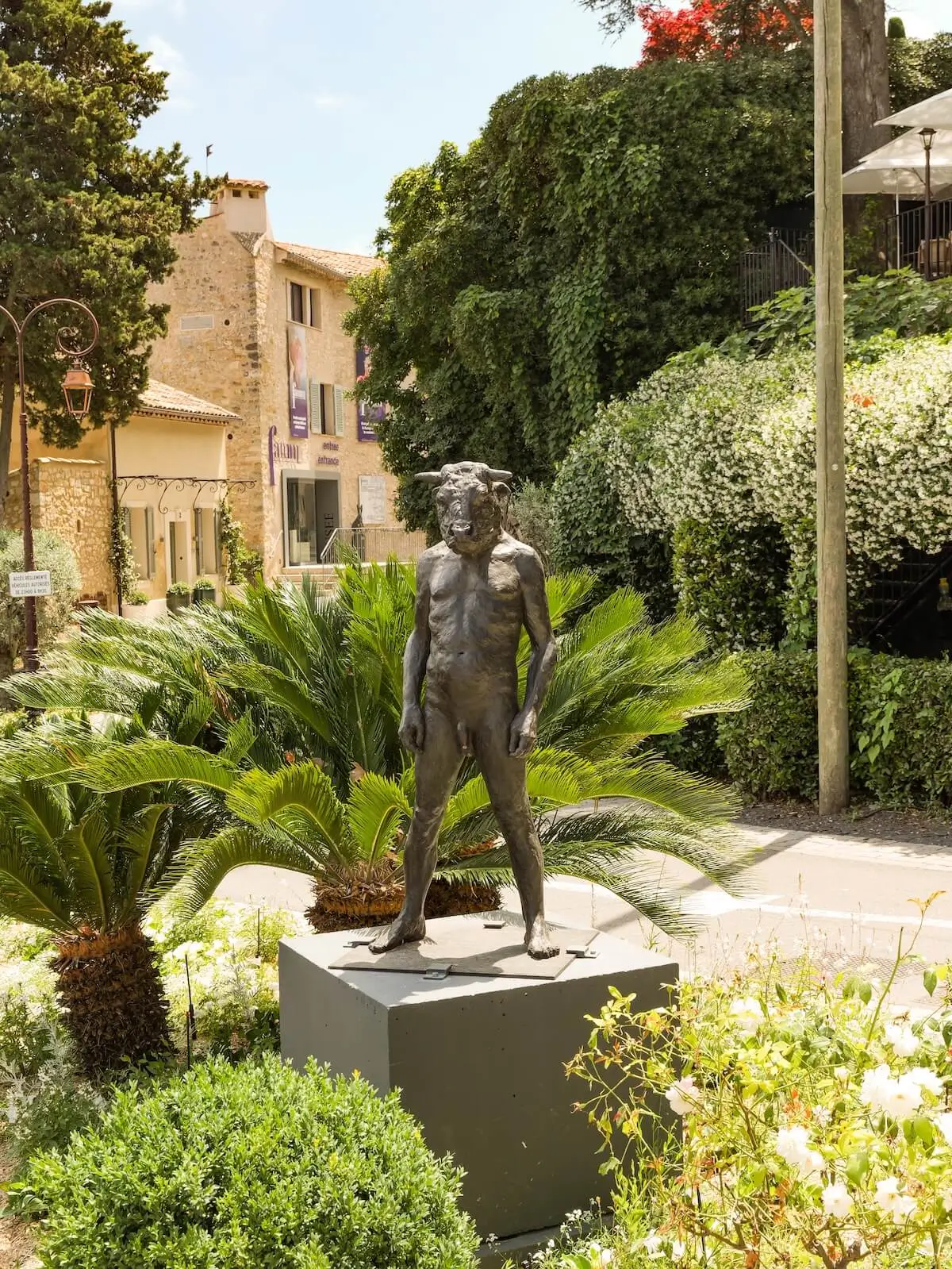
Photo credit Jonathan Birch
For me the Minotaur is a victim as well as a kind of guardian. A victim because he is the consequence of the capricious whims of the gods; and for me personally, he has grown to represent a kind of personal guardian.
In the myth, the Minotaur is a destructive, frightening animal force to be feared and imprisoned. Yet my interpretations are from a more empathetic viewpoint: I see an isolated and complex creature, a lonely hybrid who is shunned and confined within the Labyrinth. For me the Minotaur embodies dual states of masculine power and instinct with a complex human vulnerability.
What does your Minotaur refuse in Picasso’s inheritance?
I suppose that, put in simple terms, my Minotaur refuses the masculine perspective. Picasso’s Minotaur images have helped me understand my own relationship to it: he identifies directly with the Minotaur as a masculine force, and much has been written about this.
The Minotaur became Picasso’s alter ego; he cast its character in many different variations, including: the heroic, wounded, blinded, tender, passionate, sexual aggressor, violent and also, in the political context of war. I do not identify personally with the Minotaur; for me the Minotaur has become a symbol of my father.
I’ve explored this symbol over many years as an attempt to understand him, a man who was an artist, and who suffered with depression and rage. I’ve continually delved into the theme as a way of distilling the complexities of my relationship with him.
Were you concerned that the exhibition might be reduced to “Beth Carter meets Picasso”?
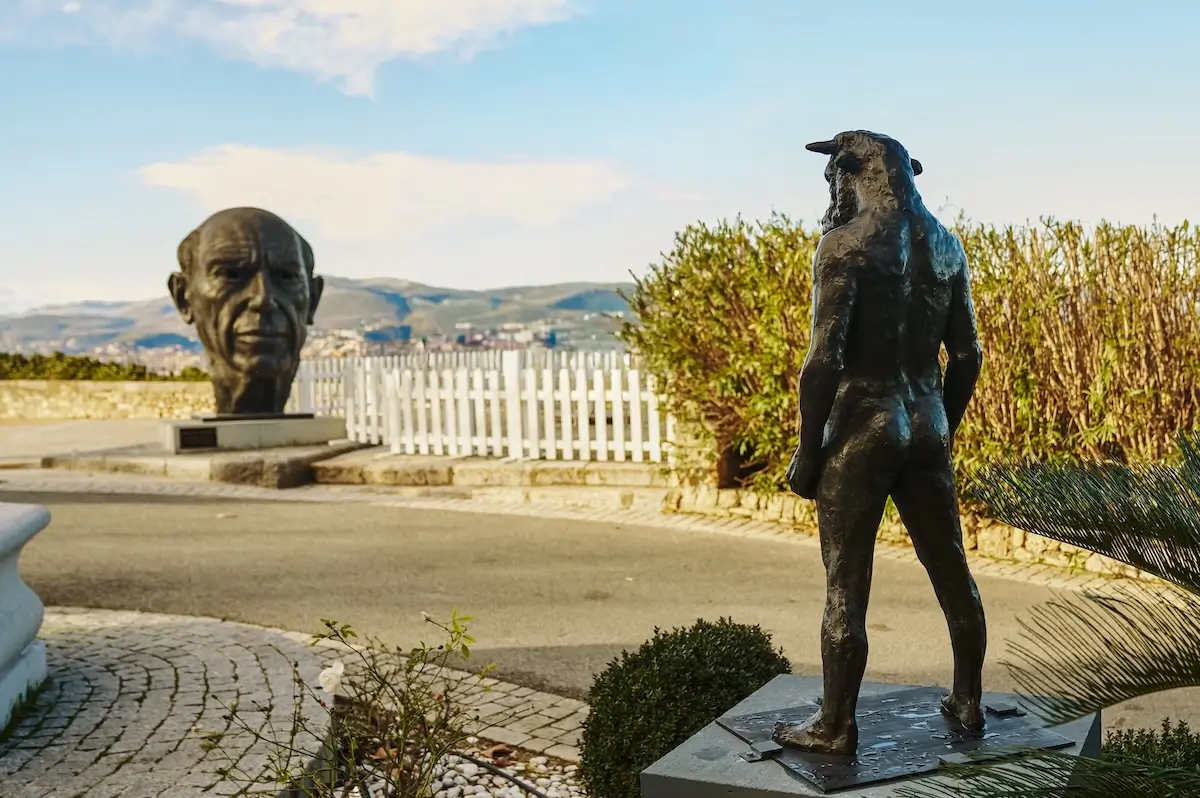
Photo credit Stuart Mitchell
No, this was not a concern to me; if people draw parallels between my work and Picasso’s, I am happy, as there are many overlapping themes. Despite Picasso’s terrible reputation for treating women badly, I view his work independently from that; his work retains an energy and immediacy which is utterly alive and relevant to me.
Why do your powerful creatures so often appear lonely, thoughtful or vulnerable?
I am fascinated by the sad, poetic power which certain animals have in our human psyches. I want to make sculpture which provokes emotion and human connection, and much of my work has a melancholy or introspective presence. Everybody experiences sadness in their lives; grief and sorrow are mostly inescapable.
Over the years, I’ve created my own symbolic sculptural language which explores my interest in emotions, in storytelling, and in transformation.
I usually find at a later point that these symbols which keep cropping up, or which I return to, correlate with the deeper personal themes of my childhood. I’ve come to realise over the years that my work has enabled me to process some difficult times in my past and continues to be the transformative centre of my life.
What can charcoal express that bronze cannot?
![Beth Carter - Tales to Kill Sorrow exhibition - Le Centre d'Art de Mougins, photo credit Stuart Mitchell [1]](https://riviera-buzz.com/wp-content/uploads/2026/08/Beth-Carter-_Tales-to-Kill-Sorrow_-exhibition-Le-Centre-d_Art-de-Mougins-photo-credit-Stuart-Mitchell-1.webp)
Photo credit Stuart Mitchell
With charcoal an illusory space can be created, a two-dimensional world which requires the viewer to enter. Things can fly and float about in the air; the scale of life can change, whereas when you make a piece of sculpture the work exists in our realm, it shares our three-dimensional space with us.
So, I find in a general way, drawing in charcoal can allow me to be more whimsical and playful, and it also gives me the scope to create the context for my characters.
What does the title Tales to Kill Sorrow mean to you now that the whole body of work is being shown in Mougins?
Tales to Kill Sorrow is an exhibition title I’ve wanted to use for many years; for me it is a hopeful title. I have a love of storytelling through drawing, so the drawings exhibited are my personal myths, my personal fables, and are my way of killing my sorrow.
I find the act of drawing can unleash a memory or an experience quite spontaneously and, as such, my drawings sometimes reference difficult times in my past. For me the process of drawing acts like a key into the subconscious, a kind of doorway to the psyche, and in this sense it can be both illuminating and transformative.
What contemporary anxiety entered this body of work without you consciously planning it?
The symbol of the Minotaur has remained embedded in my work for more than 25 years. It has endured with me because (as I explained above) it is essentially a symbol of my father. I also feel it has expanded and broadened. It has come to symbolise a wider alienation and loneliness and embodies a dual state of masculine power and vulnerability, all of which is poignant in today’s anxious, contemporary, social media-fuelled world.
Mougins is always worth a visit, but Beth Carter’s art adds an extra layer. Her Minotaurs and fabled creatures, both amusing and thought-provoking, create a parallel, mythological version of the village in which her works enter into dialogue with the medieval architecture, Picasso’s legacy and the Mediterranean landscape. And even if you have been to Mougins many times before, this exhibition will make you see it with fresh eyes.

VISITOR INFORMATION
Beth Carter – Myth, Melancholy, Magic – Mougins Monumental 2026
More than 30 bronze sculptures across Mougins
Until 1 November 2026
Free entry (maps available from the Tourist Office)
Beth Carter – Contes pour chasser la tristesse (Tales to Kill Sorrow)
Le Centre d’Art de Mougins, Place du Commandant Lamy, 06250 Mougins, France
Until 1 November 2026
Gallery times and entry info here
VENUE DETAILS
Le Centre d’Art de Mougins
Place du Commandant Lamy
06250 Mougins
Tel: +33 (0)4 92 18 50 05
Web: https://centredartmougins.com/
PHOTO CREDITS
- All photos and images courtesy Beth Carter and as credited
- Lead image – photo credit Jonathan Birch
Advertisement








Leave a comment