


What story could a new exhibition about the artist possibly tell that hasn’t been told already? Menton has not just one but two answers.
If you have ever scrolled past a fashion campaign where the set looks alive – walls that breathe, chandeliers that sprout arms, mirrors that seem to watch you back – you have already stepped into Jean Cocteau’s world. You just didn’t know it was designed in the 1940s and ’50s, and that much of it had its origins in Menton.
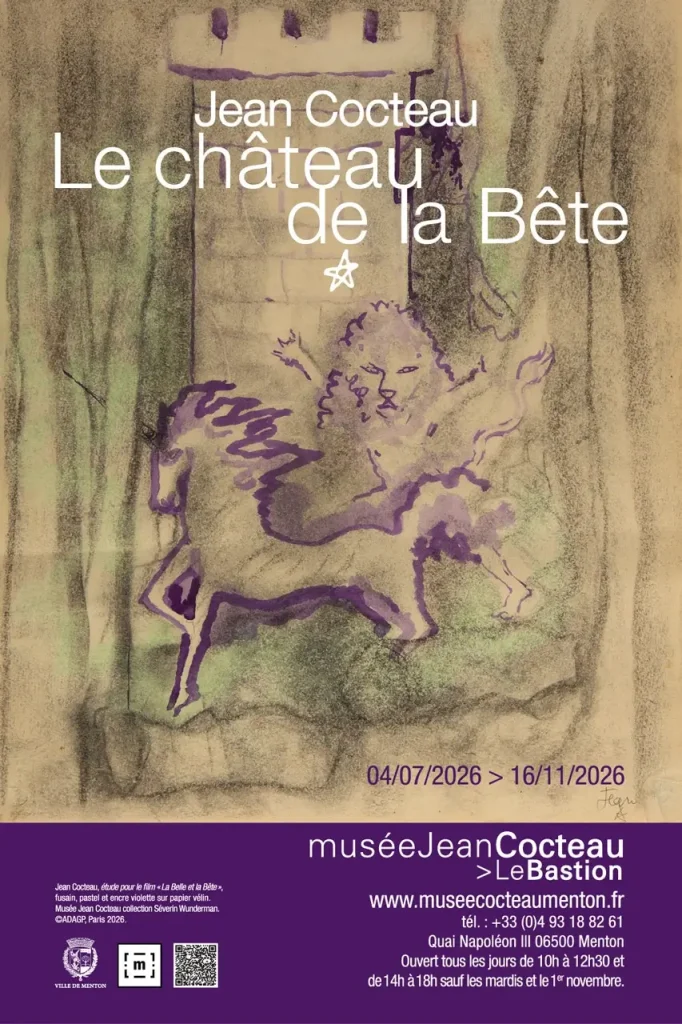
Right now, two exhibitions in the town that already enshrined the artist’s legacy in a museum are revisiting that universe from complementary angles: Jean Cocteau, Le château de la Bête at the Musée Jean Cocteau Le Bastion (through 16 November) and Les jardins enchantés de Jean Cocteau at the Galerie des Musées, Palais de l’Europe (through 30 January 2027). Each goes beyond a simple retrospective and can be visited as a standalone. Seen together, however, they read like a working notebook for a visual language that remains pertinent decades after it was first created.
TWO SHOWS, ONE LARGER STORY
The current pair of exhibitions put Cocteau’s visual vocabulary alongside living artists who are clearly working in its slipstream.
La Bastion : 80 years of La Belle et La Bête
At the Bastion, the focus is tight and cinematic. Marking the 80th anniversary of La Belle et la Bête (1946), the exhibition gathers around a hundred works linked to the film: drawings, manuscripts, photographs, posters and behind‑the‑scenes material, alongside pieces by contemporary artists Nicolas Dax, Gilles Cappadoro and Alnoor Mitha de Bharat, who reinterpret its imagery.
Video via DIA Detroit Film Theatre on YouTube
The exhibition’s layout moves from “A mythical film” and “A castle bristling with mysteries” to the famous proposal scene – “Belle, will you become my wife?” – and ends with “Recreation between two scenes”, drawing heavily on Cocteau’s Journal d’un film. The emphasis is on the production’s near‑impossible conditions (post‑war shortages, Cocteau’s illness, Jean Marais’s five‑hour make‑up sessions) and on what Cocteau called “the poetry of cinema”. The Bastion show celebrates the film’s living architecture: living candelabra arms, reverse‑motion tricks, mirrors as portals, anticipating later experiments with installation and immersive environments.
Artists in the 1960s and ’70s who turned galleries into staged spaces, and today’s creators of video installations and experiential sets, are all working with a similar premise: that space itself can be a character. Cocteau’s castle, as presented in Menton, is a prototype for that.
The fairytale world of Les jardins enchantés
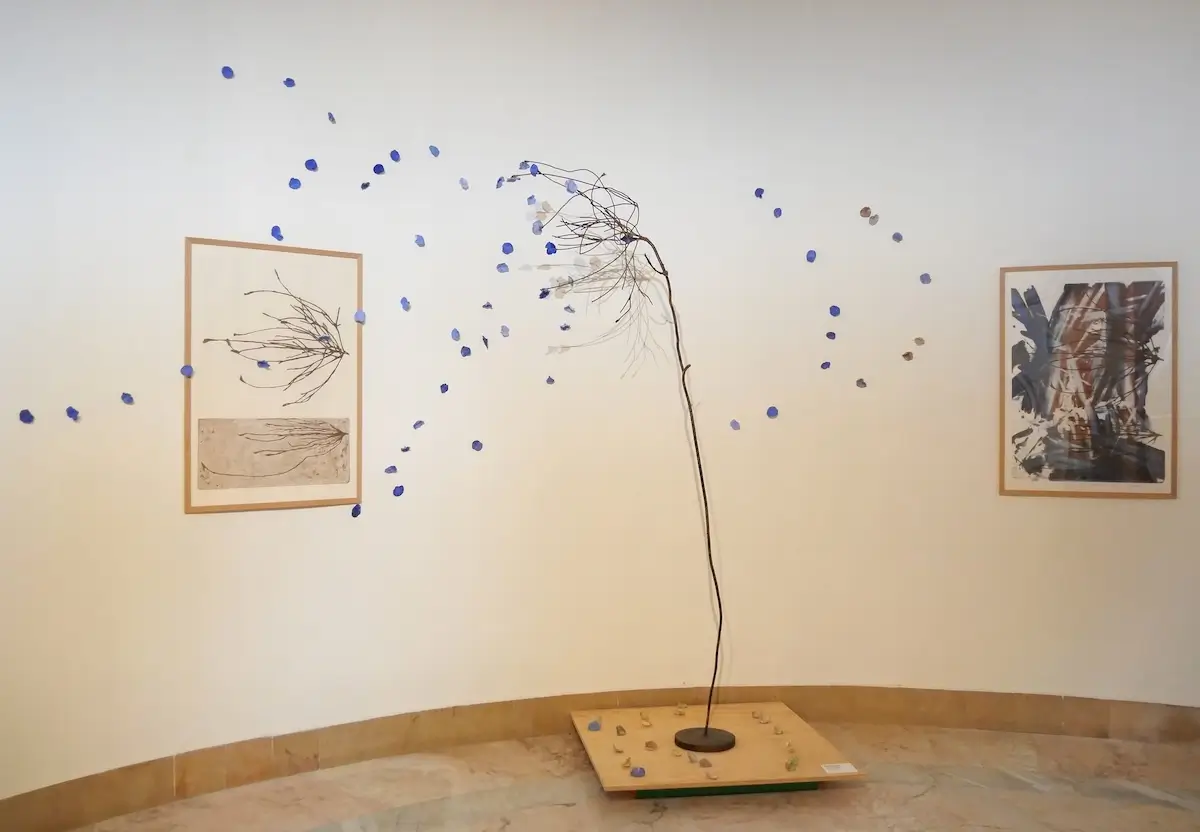
Across town at the Galerie des Musées, the garden exhibition pushes this further. This show builds on the Séverin Wunderman collection to explore how vegetation, myth and metamorphosis run through Cocteau’s graphic work. Here the “gardens” are as much mental as botanical. Cocteau’s vegetation breathes, twists, sprouts mythic figures and blurs the line between human, animal and plant: fauns and nymphs traced in a single line, unicorns whose horns act as spiritual antennas, hybrid beasts that look like sphinxes from a dream, and large studies for an unrealised Beethoven mural that seem to swim in an underwater soundworld.
Video via France 3 Provence-Alpes-Côte d’Azur on YouTube
Contemporary artists Claude Como, Kim Boulukos, Yvonne Bilis Régnier and Éric Massholder are shown in dialogue with Cocteau, all of them treating nature not as backdrop but as an active, sometimes uncanny participant. Ahmad Reshad’s scenography underscores this sense of wandering through an imaginary landscape rather than a conventional hang.
That way of thinking about nature prefigures Land Art’s treatment of landscape as material, and it also resonates with contemporary ecological and post‑human practices where plants, fungi and ecosystems are collaborators rather than motifs. The contemporary artists in the show – working with monochrome photography, drawing, design and painting – pick up on this idea of the garden as a thinking, responsive environment.
Seen together, the two shows form a diptych. Where the Bastion zooms in on one film and its backstage mythology, the Galerie des Musées opens out to Cocteau’s wider visual cosmos. One is about a single, legendary set; the other suggests that, for Cocteau, the whole Mediterranean coast was a set in progress.
The Surrealist in spirit who was not a card‑carrying member of the club
Cocteau’s garden universe feels close to a Surrealist’s imagination: he, too, sought the marvellous in everyday things and the dream in the object. Yet he never signed up to the movement’s manifestos. His fantasy creatures belong to the same family of images that fed Surrealist painting and film, but his motifs of choice were hedges, horns and living walls. Cocteau firmly remained a category of one.
One must be a living man and a posthumous artist.”
— Jean Cocteau
Cocteau discovers Menton, and Menton discovers Cocteau
Long before these two shows, Menton had already turned Cocteau into a permanent presence. He brought something the town didn’t have before: a full‑fledged visual mythology that could be lived in, not just looked at. From 1950 onwards he was a regular guest on the Côte d’Azur, notably at Francine Weisweiller’s Villa Santo Sospir in Saint‑Jean‑Cap‑Ferrat, where he began “tattooing” the walls with frescoes and drawings.
Courtesy Ville de Menton
When he settled in Menton in 1955, he quickly adopted it as a creative refuge, decorating the Salle des Mariages (wedding chapel) in the town hall from 1956 to 1958, and then designing the Bastion itself as a total artwork where the façade, staircases, pebble mosaics and tapestries were all conceived as extensions of his imagination.
He gave Menton more than a name; he gave it a way of seeing: living architecture, enchanted gardens, hybrid creatures that refuse fixed categories.
In return, the town gave his work a permanent set. After his death in 1963, the town went beyond preserving his work – it kept expanding the stage he had built. The Bastion (pictured in lead image), conceived in collaboration with him and inaugurated in 1966, became the first museum devoted to his plastic art. Decades later, the Séverin Wunderman donation transformed the municipal collection, giving Menton one of the world’s most extensive holdings of Cocteau’s drawings, prints and manuscripts. The result is a place where Cocteau is not frozen behind glass but resurrected again and again through a multitude of creative and thought‑provoking exhibitions.
Courtesy Ville de Menton
Today, Menton is synonymous with the artist, in the same way that Toulouse‑Lautrec is forever linked with Montmartre or Renoir with Cagnes‑sur‑Mer. Cocteau’s relationship with Menton is as well‑known as his works, but few people realise the immense impact these have had on subsequent generations of artists. Long after the cameras stopped rolling on La Belle et la Bête and after the last faun was created, Menton has remained, in effect, Cocteau’s open studio, just as he had intended it: a place where his monsters, gardens and living walls keep teaching new artists how to see.
The two current exhibitions are the latest chapter in that story, but by no means the final one. If you walk out of either show and find yourself looking at a hedge, a mirror or a lit room slightly differently, that’s not a side effect. It’s exactly what Cocteau – and now Menton, as his heir – had in mind.

Courtesy Ville de Menton

PRACTICAL INFORMATION
Jean Cocteau, Le château de la Bête
Musée Jean Cocteau Le Bastion, Menton | Through 16 November 2026
Open daily except Tuesdays and 1 November 10 am to 12:30 pm and 2 pm to 6 pm
Full admission €5, concessions available
Les jardins enchantés de Jean Cocteau
Galerie des Musées, Palais de l’Europe, Menton | Through 30 January 2027
Open Tuesday–Saturday, 10 am to 12 noon and 2 pm to 6 pm (closed public holidays)
Note: The main Musée Jean Cocteau (Séverin Wunderman collection) is currently closed for major renovation until approximately 2030.
VENUE DETAILS
Musée Jean Cocteau Le Bastion
5 Quai Napoléon III
06500 Menton
Tel: +33 (04) 89 81 52 50
Galerie des Musées
Palais de l’Europe
8 Av. Boyer
06500 Menton
Tel: +33 (0)4 92 41 76 73
PHOTO CREDITS
- Lead image by Jean-Pierre Dalbéra from Paris, France – Le musée du Bastion Jean Cocteau (Menton, France), CC BY 2.0, Link
- All other photos and images courtesy Ville de Menton and as credited
- Videos as credited
Advertisement










Leave a comment