


Clément Althaus returns to Théâtre Anthéa with a rarely-performed social comedy that is every bit as pertinent today as when it was penned 160 years ago.
In the 1850s and 60s, Victor Hugo, darling of the French intellectual elite, was in big trouble. The outspoken critic of Emperor Napoleon III had been banned to exile, first on Jersey, then on Guernsey. Refusing amnesty on the grounds that that would compromise his principles, he continued to write prolifically. Censorship kept him off French stages for fourteen years, so he created plays for what he called “the ideal theatre that everyone has in their mind.” Les Misérableswas written here in 1862. And in 1866, he produced L’Intervention, less well-known but every inch as acerbic a social critique.
Now, celebrated Niçois composer/musician Clément Althaus has pulled this near-forgotten text from obscurity and thrust it into the spotlights of Théâtre Anthéa in Antibes, where it will be performed from 6 through 17 January.
The story itself is deceptively simple. The flamboyant arrival of Mademoiselle Eurydice has disturbed the precarious domestic peace of a working-class couple struggling to survive under the rooftops of Paris. Betrayed, disillusioned, and ready to trade her aristocrat husband’s money for true love, the artiste is at the source of a scene of jealousy. Her hard-won conviction: money corrupts everything. She would rather have authentic affection in this humble garret than the gilded cage her aristocrat offers. What begins as a domestic quarrel escalates into something larger – a collision between two couples, two worlds, and two visions of what makes life worth living.
With his new, audacious take on L’Intervention, Clément Althaus dives into a little-known social 19th century comedy which is perfectly relevant to our modern times. The question at its heart remains as urgent as it was in Second Empire Paris: will temptation overcome a love worn down by the trials of a miserable life?
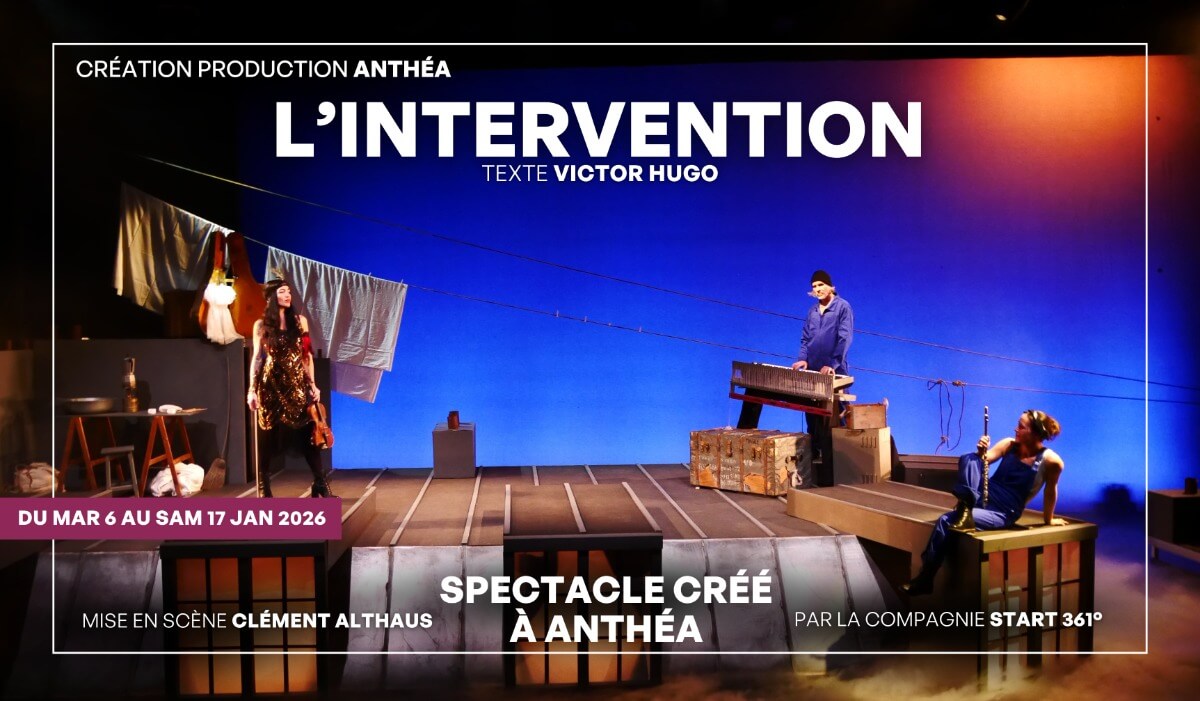
Victor Hugo wraps serious social critique in more digestible vaudeville, making the medicine go down with laughter even as the questions cut deep. Clément Althaus’ music becomes a means of amplifying these tensions while preserving the energy that defines Hugo’s great characters. Electric guitars and electronics add textures from contemporary music and make this 19th-century text visceral for audiences today. The scores drive, emphasise, and explode through the text in the signature style that Althaus’s company START 361° has refined over the years: a hybrid form where words and sounds collide without compromise, where theatre and concert meet on equal terms.

Courtesy START 361º
Three actor-musicians carry the production with raw energy. Gwenn Masseglia, an established talent in the Azurean music scene, brings emotional depth to Marcinelle, the woman caught between grinding poverty and the dangerous proposition that wealth might offer escape. Claudia Musso lends her character Mademoiselle Eurydice the vocal power and dramatic energy she is well-known for. She has established herself as one of the most compelling performers working in French theatre today, moving between operatic singing and dramatic acting with remarkable fluidity. Althaus himself plays both Edmond and the Baron, embodying both sides of the class divide. Adrian Althaus collaborates on the artistic vision.
Ironically, Victor Hugo considered L’Intervention one of his few works actually fit for real stages. His own tangled relationships and losses shadow the text, giving this apparent comedy unexpected emotional weight. The play was excluded from the first posthumous publication of his Théâtre en liberté in 1886 and only saw print in 1951. Patrice Chéreau staged it for the first time in 1964. It remains a rarity, which makes Althaus’s production all the more intriguing.
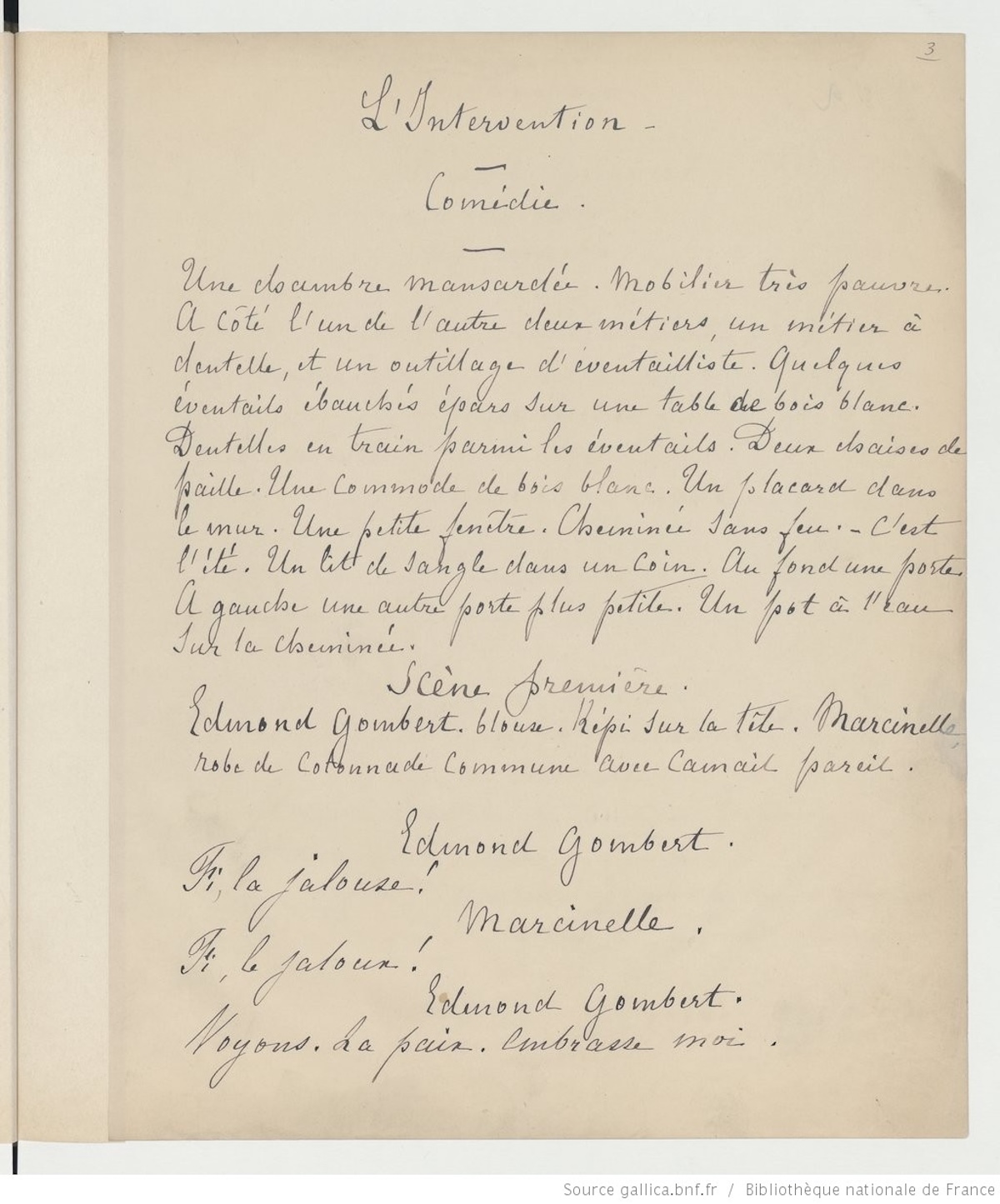
Fonds Victor Hugo. II — ŒUVRES. L’Intervention, comédie. Source : BnF/Gallica
The 19th century dialogues with our present in ways that feel uncomfortably direct. Then and now, ever-widening inequalities, intensifying social struggles, and justice that meets resistance at every turn are burning social issues. Hugo’s questions still sting: Can money become an obstacle to love? Has greed become a barrier to our shared humanity? Will temptation overcome affection already worn down by misery? The text is astonishing in its prescience, and Anthéa regular Althaus has seen its full contemporary power.
By moving the action from “under the rooftops” to “on top of them”, he exposes what would normally remain hidden… a fitting choice for a play about secrets, wealth, and the truths poverty reveals. When the guitars strike and the collision begins, it is therefore no longer about Second Empire Paris. It is about us.
Courtesy Anthéa

VISITOR INFORMATION
L’Intervention at anthéa Théâtre d’Antibes, salle Pierre Vaneck
From 6 to 17 January 2026 | Online booking
CONTACT DETAILS
anthéa Théâtre d’Antibes
(salle Pierre Vaneck)
260, avenue Jules Grec
06600 Antibes
Tel: +33 (0)4 83 76 13 00
PHOTO CREDITS
- All photos courtesy anthéa Théâtre d’Antibes unless otherwise stated








Leave a comment