


A current retrospective at the Musée Granet’s Chapel of the White Penitents brings long overdue recognition to one of postwar art’s most singular figures.
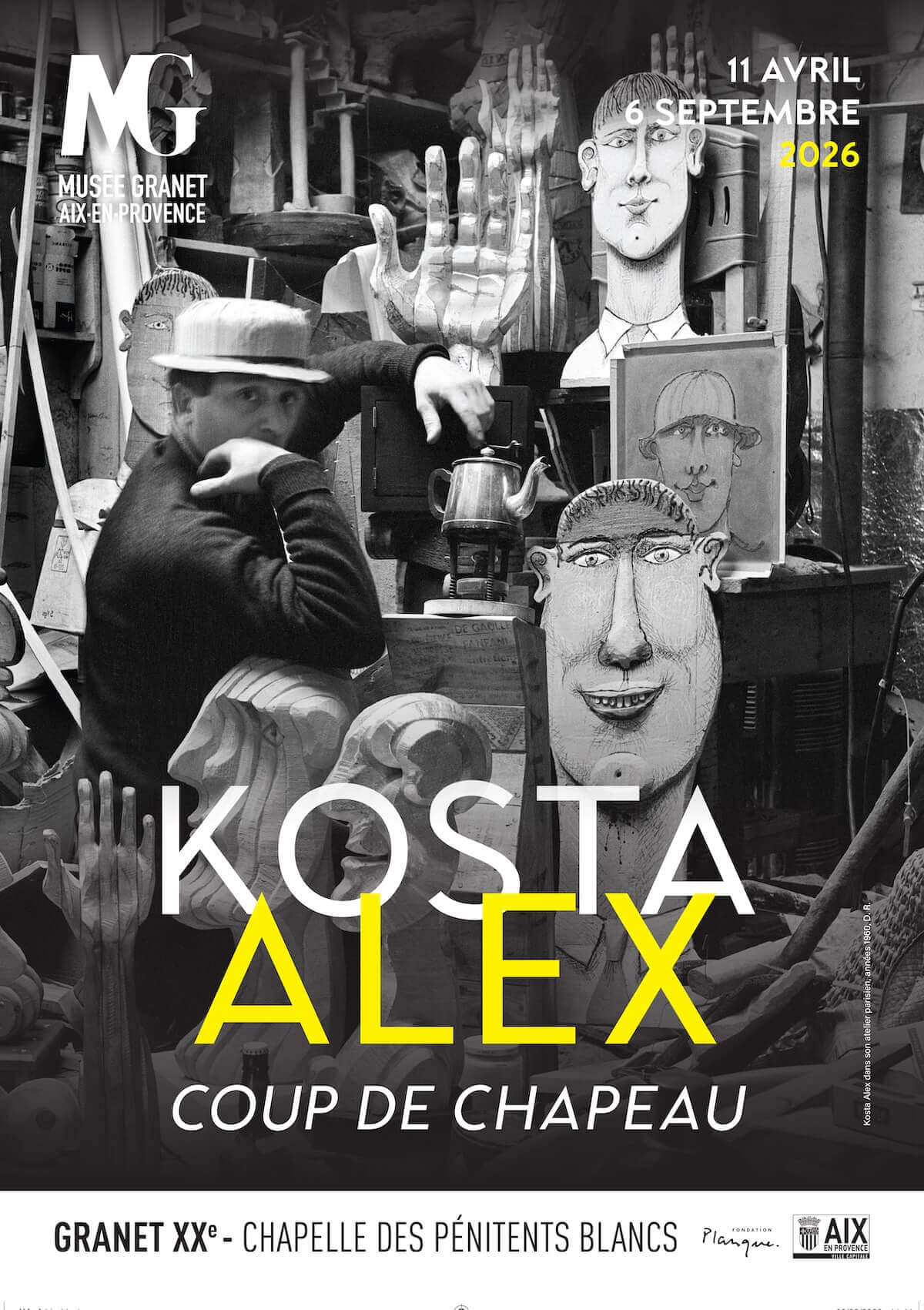
The Musée Granet’s fifteen-year collaboration with the Jean and Suzanne Planque Foundation has consistently championed artists who fell between the official categories: too independent for one movement, too singular for another. Coup de chapeau, running through 6 September 2026 at Granet XXe, Chapelle des Pénitents blancs in Aix-en-Provence, is the last and most personal chapter of that collaboration: a retrospective of some sixty works by Kosta Alex. The Greek-American artist (1925-2005) was for most of his life one of the best-kept secrets in postwar European art.
The sixty works on display span five decades, from the artist’s arrival in Paris until his death in 2005, presenting sculptures, assemblages, reliefs on cardboard, collages, drawings, films, and archival materials. Using humble materials gathered here and there, he created a unique body of work, marked by whimsy and ingenuity, and showing a sculptor of complete technical assurance.

Kosta Alex (1925-2005)
Homme au chapeau n°57, 1965
Assemblage de bois, agrafes, Hauteur 155 cm
Fondation Jean et Suzanne Planque, photo Alberto Ricci, Paris
Alex’s wood assemblages of the 1960s, among them the great Homme au chapeau series, figures up to 155 centimetres tall built from timber and staples, have the presence of tribal objects, simultaneously ancient and irreducibly personal. The later cardboard reliefs and collages, made from corrugated packaging, newspaper, wallpaper, timetables and maps, are the work of an artist who had internalised his formal problems so completely that the solution always looks inevitable. His heads were constructed from thrift materials in a style that invited comparison with the ironic and satirical collages of the Italian Enrico Baj, though the comparison flatters Baj. Where Baj performed irony, Alex simply looked at people, with great care and evident warmth, and made what he saw.
But Alex’s way into the galleries and museums of this world was not always a long tranquil river for the boy who hawked newspapers in Depression New Jersey for his Greek immigrant family. Still, even young Kostas Alexopoulos (his real name) was already driven to create and showed precocious talent when drawing from live models at the Met and placing work at the Whitney by his teens.

Kosta Alex (1925-2005)
The girl from southern France, 1966
Carton-relief, 58,3 x 52 cm
Fondation Jean et Suzanne Planque, photo Alberto Ricci, Paris
He took his formal training seriously: if his early bronzes carry the authority of someone who had served a genuine apprenticeship, it is because Alex had learned his craft at the National Sculpture Service in New York under no other than the Italian master Hugo Ricardi, who taught him carving, casting, moulding and enlargement, before sending him to Paris with instructions “to keep going”. Alex kept going for the rest of his life …
He arrived in Paris in 1947, at age 22, on a US Army grant for veterans with artistic training and enrolled at the prestigious art school La Grande Chaumière, but then had to work on construction sites to earn a living. Here, too, he delivered supreme quality work. He never stopped doing his artwork, though. In 1958, his life would take a decisive turn when Jean Planque, the renowned Swiss collector of Cézanne and Dubuffet, hired him to remake his Paris flat. The brief called for a duplex from the attic, extra walls for paintings, and an atelier. Alex tripled the space. Planque returned from travel to find the attic transformed into “a magical sculpture”, as he told his friends. Only then did he learn that his “artisan” was actually an artist… This encounter would lead to a longstanding friendship between the two men. Years later, Planque described Alex as “so naturally a workman and a sculptor, a workman to survive, a sculptor for pleasure and for joy.”
A prolific and resolutely independent sculptor, Kosta Alex kept his distance from any artistic movements, drawing inspiration instead from everyday life and poetry. He preferred to discreetly remain in the shadow of the greats he associated with, an attitude he shared with Jean Planque. His peers noticed his talent, though: Man Ray, never a man to waste words on the undeserving, called him “a cosmonaut who has broken through the two-dimensional barrier, freeing himself from the force of gravity, peopling space with his new heads without losing his own.”
Courtesy Granet XXe
The quality of Alex’s work attracted serious galleries and collectors in Paris, Basel, Lausanne, and Tokyo, but his discretion did not help him acquire notoriety. He remained entirely unknown to the wider public until his death in 2005… something he was quite content with.
The title coup de chapeau is a friendly pun in the best French tradition: it translates to salute, a friendly tip of the hat, but is also a direct reference to the hatted figures that became the signature of Alex’s career. And it is, one suspects, a gesture of affection from an institution that knew this artist well enough to understand that a grand official tribute would have made him deeply uncomfortable.
Schopenhauer believed that human existence begins where humour begins: that is exactly where you are. I love what you do not only because it is art, but because what you do is so human.”
— Hans Richter, German painter, letter to Kosta Alex dated October 12, 1974


VISITOR INFORMATION
Coup de chapeau – Kosta Alex | Granet XXe, Chapelle des Pénitents Blancs | Through September 6th 2026
Opening hours
- From 11 April to 3 July 2026, Tuesday to Sunday, 12 noon to 6 pm.
- From 4 July to 6 September 2026, Tuesday to Sunday from 10 am to 6 pm.
- Ticket office closes 5.30 pm.
- Closed Mondays.
Admission
Full price: €4 | Reduced price: €2 (Admission to the Kosta Alex exhibition does not include access to the Musée Granet, Place Saint-Jean de Malte.)
Free admission: under 18s, students under 26, long-term job seekers (6 months or more), RSA recipients (upon presentation of proof dated within the last 3 months), etc. Free admission to Granet XXe, Chapelle des Pénitents blancs, on the first Sunday of the month.
Ticket office: at the Granet XXe, Chapelle des Pénitents Blancs from 11 April 2026.
VENUE DETAILS
Site Granet XXe
Chapelle des Pénitents blancs
collection Jean Planque
Place Jean-Boyer
13100 Aix-en-Provence
Tel: +33 (0)4 42 52 88 32
(Access: top of Rue Maréchal Joffre)
PHOTO CREDITS
- All images courtesy Granet XXe and as credited
- Lead image – Kosta Alex (1925-2005); L’échappée belle, 1966; Assemblage de bois, 155 cm; Fondation Jean et Suzanne Planque, photo Peter Schlächli, Zürich








Leave a comment