


An exhibition in Aix-en-Provence looks behind the scenes of the painter’s rapid ascent and those he propelled to fame along with him
If social media had existed in fin de siècle Paris, Henri de Toulouse-Lautrec would have been an influencer of the first order. His posters did what today’s feeds do for celebrities: distil a personality into a few immediately recognisable traits, repeat them until they become a brand, and flood public space with the result. Jane Avril’s whiplash silhouette, La Goulue’s flying skirts, Aristide Bruant’s broad hat and red scarf are almost logos as much as portraits, fixing their owners in the city’s imagination.
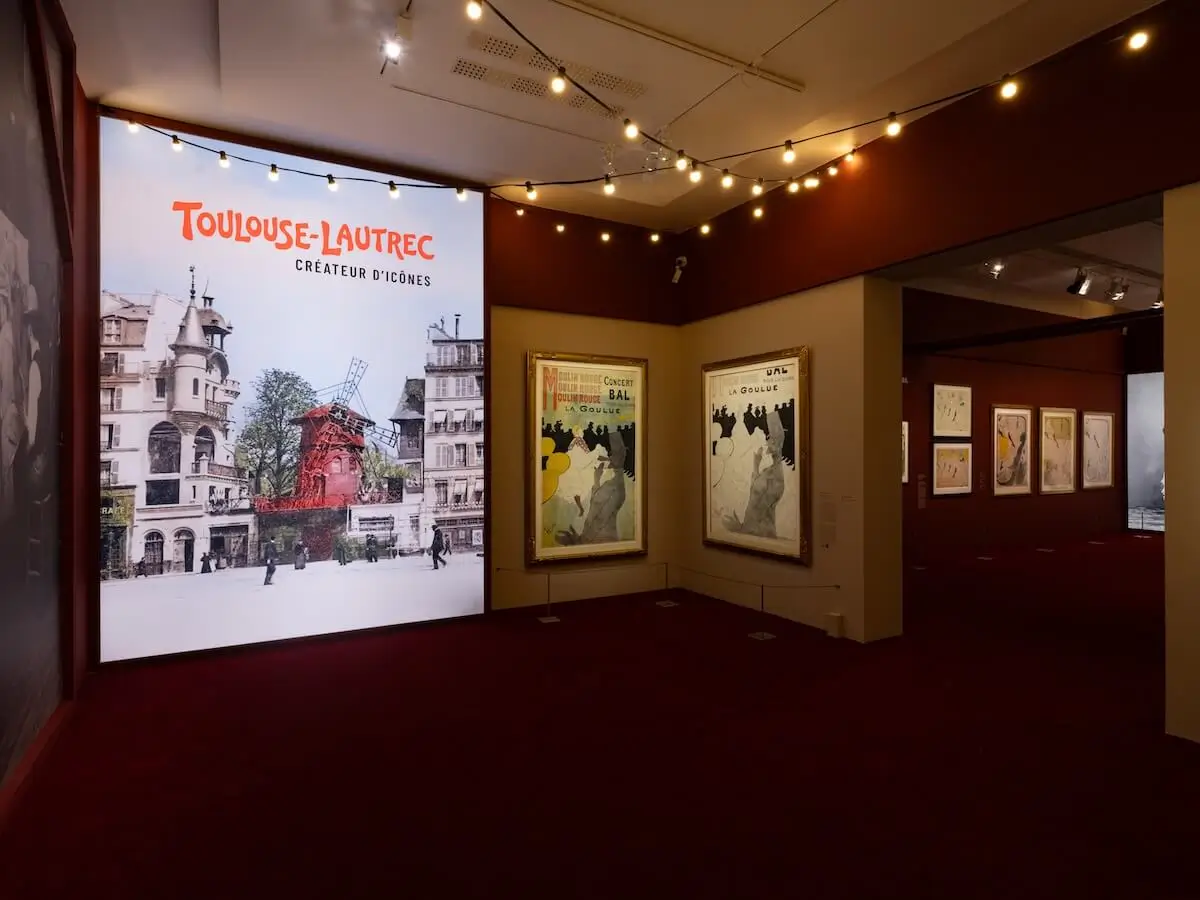
The exhibition Toulouse-Lautrec, créateur d’icônes, running at Caumont-Centre d’Art in Aix-en-Provence through 4 October, turns that familiar story on its head. It examines how quickly he rose and how thoroughly he shaped both the artistic scene of his time and the way we still picture the Belle Époque.
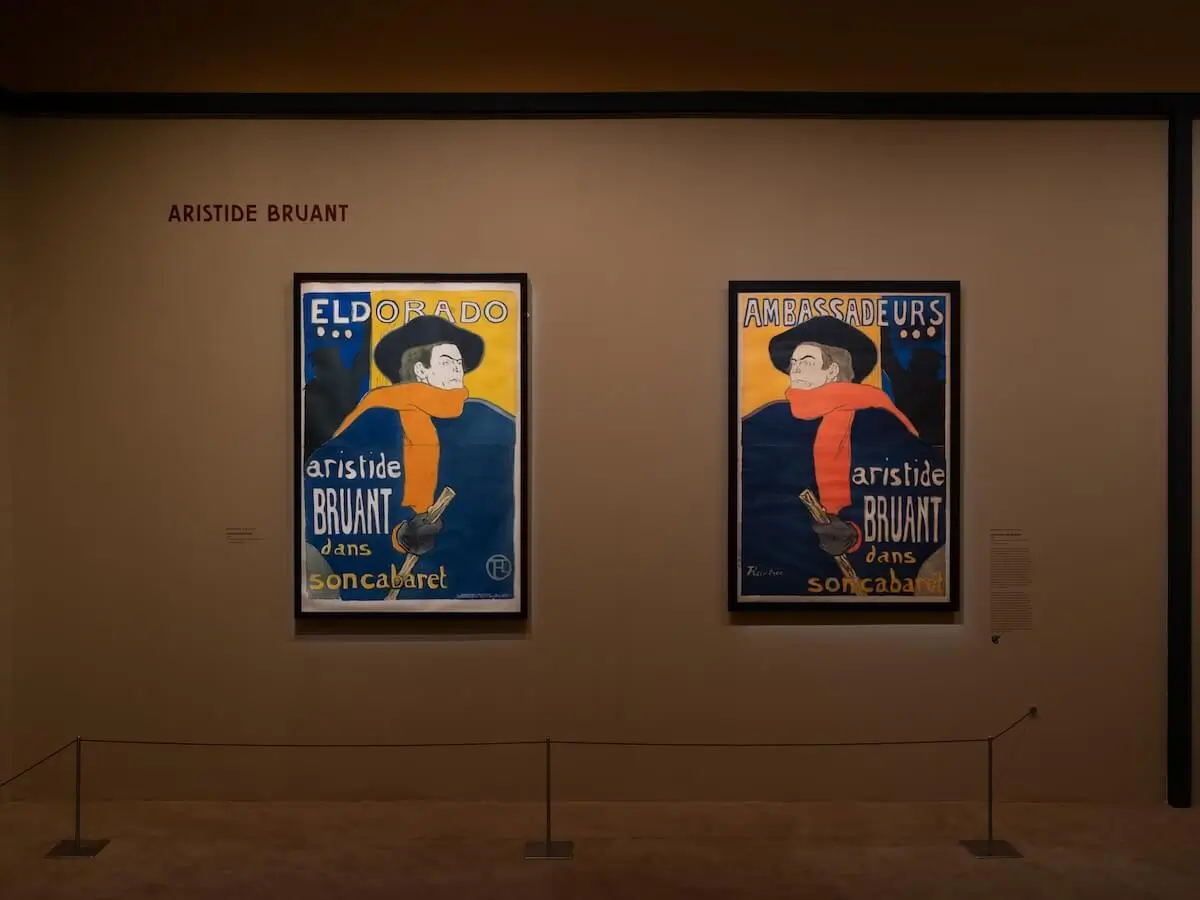
Far from offering yet another stroll past Lautrec’s greatest hits, the exhibition takes his posters seriously as an engine of fame. Curators Fanny Girard and Gilles Genty focus on his knack for turning almost unknown performers into instantly recognisable figures, on the street and decades later in books and museums.
In their view, Lautrec was not merely documenting Parisian nightlife; he was actively scripting who counted as a star and what that star would look like. By placing his lithographic posters on an equal footing with his paintings, the show invites visitors to see how a few deliberate choices of colour, line and pose could turn a working performer into an icon.
The walkthrough turns this argument into the reality of a world now lost but very much alive in his day. It starts in the Montmartre establishments that launched his posters, moves inward through more private interiors and lives at the margins, and gradually widens the lens again to show how he built those images and what they cost him and his models.
Cafés-concerts and cabarets
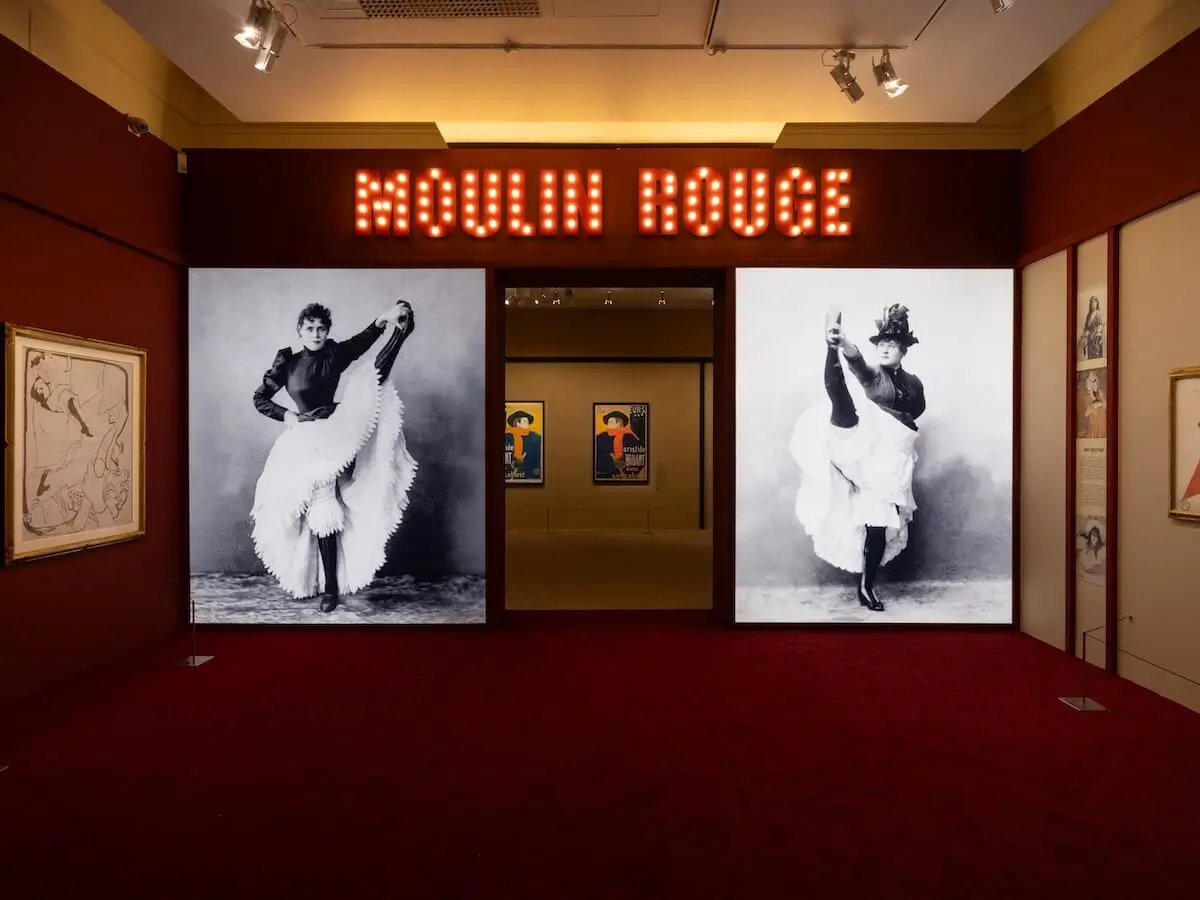
The parcours begins in the world that made Lautrec’s name. The walls are filled with posters for the Moulin Rouge, the Ambassadeurs and the Divan Japonais, alongside paintings such as the portrait of Monsieur Warrener and the Femme au boa noir. Jane Avril flickers across the paper in nervous arabesques, La Goulue kicks her way into legend, Aristide Bruant strides out of his own silhouette. This opening section shows how, in a few sheets of paper, Toulouse-Lautrec distilled dancers and singers into a handful of essential shapes made of bold lines and blocks of colour, and how a coat, a scarf or the angle of a profile could stand in for an entire persona.
Press, posters and publicity
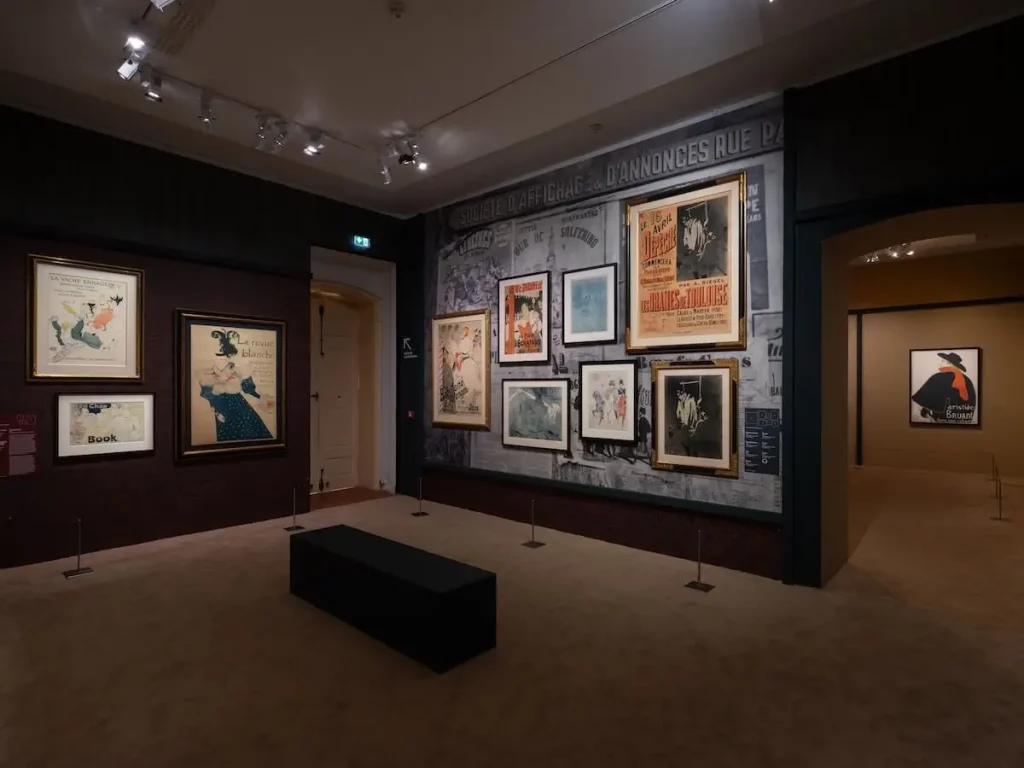
The next section is where his cast of characters steps off the stage and into the city streets. Posters and prints for newspapers, book covers, and commercial campaigns all reuse the same visual vocabulary to sell performances, products and ideas. Letters and image sit tightly together, the text becoming part of the design rather than an afterthought. Lautrec treats the street poster as a place to experiment, using new colour lithography and strict printing constraints to test how far he can push layout and colour.
Theatre and the spectator
The focus now shifts from the performers to those watching them. Here, the spectator is often half-hidden at the edge of the frame or seen from behind, a presence rather than a face. Lautrec is more drawn to the unease of looking and being looked at than to the action on stage. The theatre becomes a place to observe who leans forward, who turns away, who pretends not to watch. The mood is less showy than in the cabaret room, and the tension sits in the way one small figure can tilt an entire scene.
The demi-monde
At the heart of the journey is a space devoted to lives at the margins. Women working in brothels or cabarets appear in quiet and intimate scenes – resting, washing, talking, or simply waiting rather than performing for anyone. The settings feel lived-in and ordinary, with softer colours and a line that stays close to the body. Lautrec, who sometimes lived and worked in these places, treating pictures as payment rather than an afterthought of cash, approaches these scenes not with voyeuristic curiosity but with the ease of someone portraying people he knew well.
Dialogues and influences
Here the exhibition comes full circle. Having started with Lautrec’s boisterous cabaret world, then looked inward, it now peers back out again. Works are placed in dialogue with contemporaries such as Pierre Bonnard, and with Japanese prints that clearly shaped his sense of flat colour, cropping and asymmetry. The composition deliberately keeps comparisons to a few key pairings, enough to make affinities legible. Shared diagonals, cuts through a figure and other compositional elements appear across artists, and Lautrec folds them into his movements and characters. Even a style as distinctive as his, it turns out, is built from a common graphic language.
Video via laprovencemedias on YouTube
Taken together, the route shows how he moves from observing and stylising his contemporaries to manufacturing their public image. His work is not simply advertisement for evenings out but creates a cast of recurring characters whose gestures and silhouettes become part of Parisian everyday life. Lautrec had understood how a handful of visual decisions could turn ordinary performers into icons that outlived the stage itself.
During Lautrec’s working years, Paris discovered the power of the poster, and he understood it faster than most. New colour lithographic techniques allowed artists to print larger, brighter images for the streets, and he seized on them as a field of experimentation. The signature style he developed for the cabarets was perfectly suited to grab attention at a distance, and his name quickly became synonymous with this new urban visual language.
Timing helped: he arrived just as the golden age of the artistic poster was beginning, and while others still treated it as decorative advertising, he treated it as painting in public. Combined with his choice of subject matter, venues already at the centre of popular curiosity, this approach turned his work into a kind of early mass media, bringing rapid professional recognition.
In Montmartre, the disabled aristocrat – all of 1.52 m (4’9”) tall and carrying the consequences of childhood accidents and a bone disorder – finally found acceptance, building himself a circle that looked nothing like the family tree on his birth certificate. To the respectable circles of gentry and nobility he hailed from, his devotion to nightlife and the pictures that resulted were proof that he had squandered his birthright and taken art into indecent territory.
His work sits squarely in that gap between the world he inherited and the one he chose: made by a man who knew the codes of privilege yet preferred to spend his talent on those whom privilege preferred not to see. Dancers, singers, prostitutes, and cabaret owners were his daily company, not occasional exotic subjects. He was a familiar presence in their establishments, sketchbook open, glass in hand, and more at ease among workers and bohemians than among the counts and cousins of his own milieu.
Video via La Provence on YouTube
His short life of only 36 years, marked by pain, heavy drinking and illness, may help explain why his gaze on other outsiders never slides into judgement, and why the same hand that fixed their public image also recorded offstage fatigue, solitude and quiet moments with unusual tenderness.
In his final years, worn down by illness and alcohol, he was confined and obliged to prove his sanity with a series of drawings made under supervision, as if his art were the only language in which he was allowed to speak.
Seen as a whole, the exhibition at Caumont reads almost like a biography in images. The attention given to his lithographic technique alongside painting traces the outline of a person whose art and life are inseparable – a social misfit who chose to spend his creative energy on people at the margins and who, in doing so, shaped how an entire era still looks in our minds.
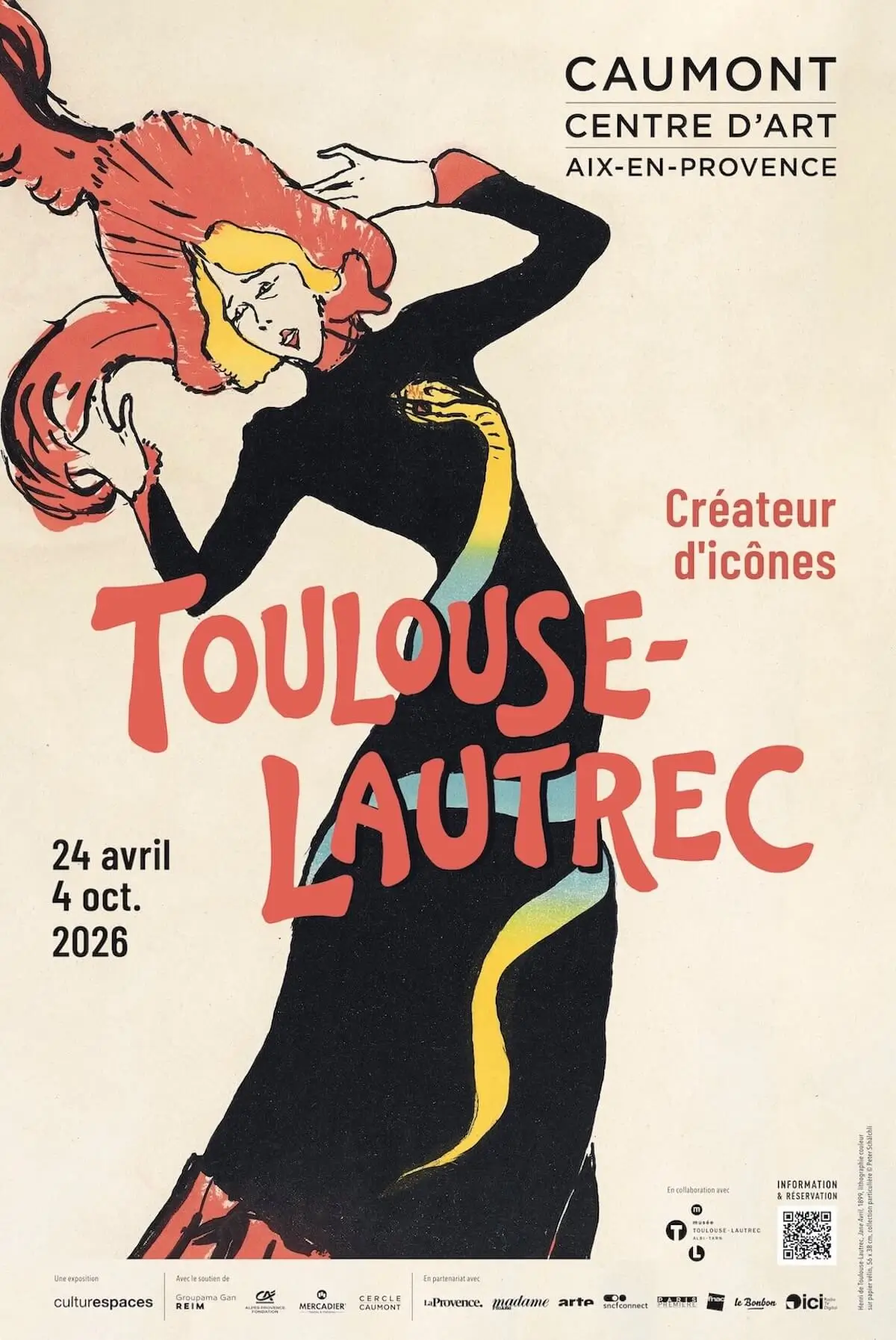
Toulouse-Lautrec, créateur d’icônes therefore does more than bring together masterpieces of lithography and painting; it offers a chance to see work and life as one continuous line, and to recognise behind the posters that still define the Belle Époque a fragile, stubbornly lucid artist who gave lasting form to people and places the world was all too ready to overlook.

VISITOR INFORMATION
Toulouse-Lautrec, créateur d’icônes
Through 4 October 2026
Open daily: 10 am – 7 pm | Last admission 30 minutes before the art centre closure
Detailed ticket information here
VENUE DETAILS
Caumont Centre d’Art
3, rue Joseph Cabassol
13100 Aix-en-Provence
Tél: +33 (0)4 42 20 70 01
Email: message@caumont-centredart.com
PHOTO CREDITS
- All photos courtesy Caumont Centre d’Art, by Culturespaces – Thomas Garnier
- Video as credited
Advertisement








Leave a comment