


Two exceptional exhibitions in Hyères and Paris capture the American sculptor’s full artistic and human dimension
Alexander Calder was one of those artists – like Picasso or Miró – who is usually known by surname alone. Yet the name carries a small paradox: almost everyone has seen the mobiles, the silhouettes, or the bright suspended forms but fewer people can picture the man who made them. Two concurrent summer exhibitions, one in Hyères at Musée la Banque and the other in Paris at Fondation Louis Vuitton, seek to close that gap.
While the Paris show focuses on the centenary of Calder’s arrival in France and the fiftieth anniversary of his death, the one in Hyères places him not simply before us as a modern master, but as a human being shaped by appetite, play, friendship and an unusually instinctive sense of line.
Each show is a stand-alone production in its own right, focusing on one side of Calder’s story, yet they interweave. Paris shows Calder the major figure, the artist whose work belongs on the broadest stage. Hyères presents Calder the maker, the friend, the collaborator, the man whose art grew out of a lifelong curiosity about motion and form.

Alexander Calder
Les trois soleils jaunes
1965
Mobile
Tôle, fil de fer et peinture
100 x 233 cm
Fondation Marguerite et Aimé Maeght, Saint-Paul-de-Vence
© Photos Claude Germain – Archives Fondation Maeght
© 2026 Calder Foundation, New York / ADAGP, Paris
But together, they restore the public image of a Calder who has been reduced to mobiles for too long: the sense that behind the instantly recognisable mobiles was a highly intelligent, technically minded, mischievous human being who never stopped testing what art could do. His work is beautiful, certainly, but the life behind it is just as compelling.
Calder was born near Philadelphia, USA, in 1898 into a family of artists – his grandfather and father were sculptors, his mother was a painter. This awakened an early appreciation of creativity. Yet the young Calder was not destined to move along a single track. He studied engineering before fully turning to art, and that technical training helped him understand structure, weight and suspension from the inside. His shapes and mobiles seem to float effortlessly but there is mathematical logic behind them.
Calder’s deepest passion, however, was not sculpture at all, but the circus. The Cirque Calder, which he was forever building and expanding, was a miniature world of acrobats, animals, ringmasters and wire performers. For him this became a way to think about movement as performance, performance as form, form as art, and art as movement. It also reveals something crucial about his temperament: he liked things in motion, but he also liked them in control.
That mixture of freedom and discipline runs through everything he made. It appears in the drawings, where a few lines can suggest an entire physical gesture. It shows up in the gouaches, where colour seems to hover, buoyant but never arbitrary. And it is most prominent in his mobiles, those constructions that changed the language of sculpture by allowing air itself to become part of the work. Calder never just wanted to create an object, but “a condition”. His art asks us to look at balance not as a fixed state, but as something negotiated in real time.
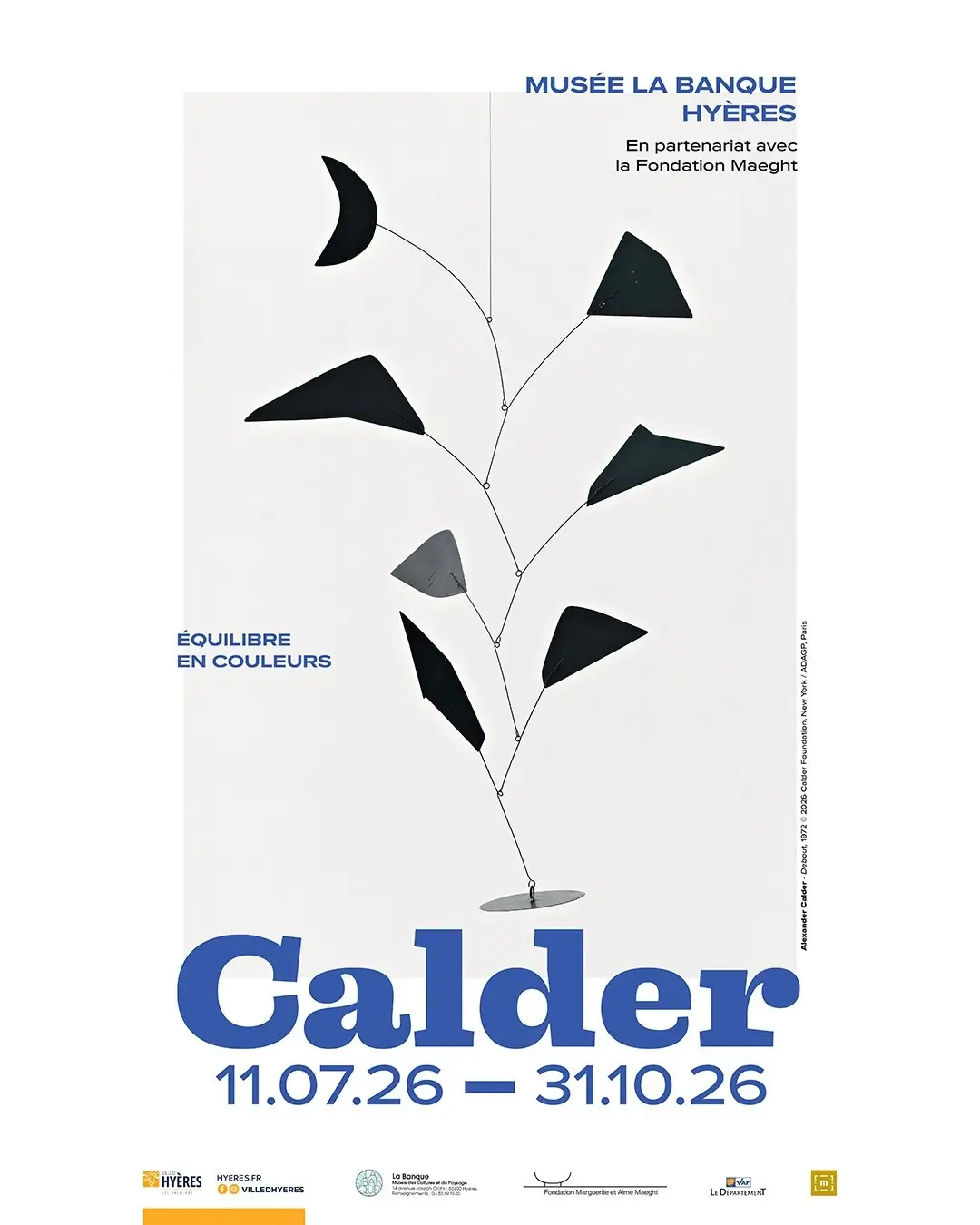
HYÈRES: CALDER – ÉQUILIBRE EN COULEURS
Musée la Banque, through 31 October 2026
The Hyères exhibition picks up on this red thread of movement, colour, and equilibrium. Across 69 artefacts drawn from the collection, 18 highlight works from the Cirque Calder ensemble, as well as later lithographs and gouaches, especially from the 1960s and 1970s, when the printed image becomes a logical extension of the sculptural language.
Along with bronzes, ink works, and mobiles they emphasise Calder’s recurring obsessions: the circus, animals, mobiles, stabiles, colour, balance, and how works on paper and sculptures belong to the same visual universe. Here, he is shown as an artist of poise and movement who masters the elements and turns instability into form. Yet, equilibrium becomes something dynamic rather than fixed.

Alexander Calder
Autres têtards
1976
Lithographie originale en couleurs sur Rives
58 x 78 cm
Fondation Marguerite et Aimé Maeght, Saint-Paul-de-Vence
© Photos Claude Germain – Archives Fondation Maeght
© 2026 Calder Foundation, New York / ADAGP, Paris
But the emotional spine of this exhibition is the human thread and the artist’s collaboration and friendship with the Maeght family.
Alexander Calder met Aimé and Marguerite Maeght in 1947, and the relationship quickly became both personal and professional, with Calder even bringing the Cirque to life in the Maeght apartment for their young son Bernard, who suffered from leukaemia and would later die from it.
The Maeghts recognised Calder’s independence, but also his generosity, his humour and his appetite for collaboration. Calder, in turn, found in them people who could support his work without diluting it.
Over roughly three decades, he produced more than 200 lithographs and etchings for Maeght Éditeur and repeatedly created original lithographs and posters for Galerie Maeght exhibitions. A major 1969 retrospective at the Fondation Maeght in Saint-Paul-de-Vence confirmed that this was a true artistic alliance rather than a simple dealer-artist arrangement.
Courtesy La Banque, musée des Cultures et du Paysage, Hyères
The Hyères exhibition makes the most of this connection. It does not treat Calder’s work on paper as secondary to his sculpture, but as another way of seeing the same mind at work.
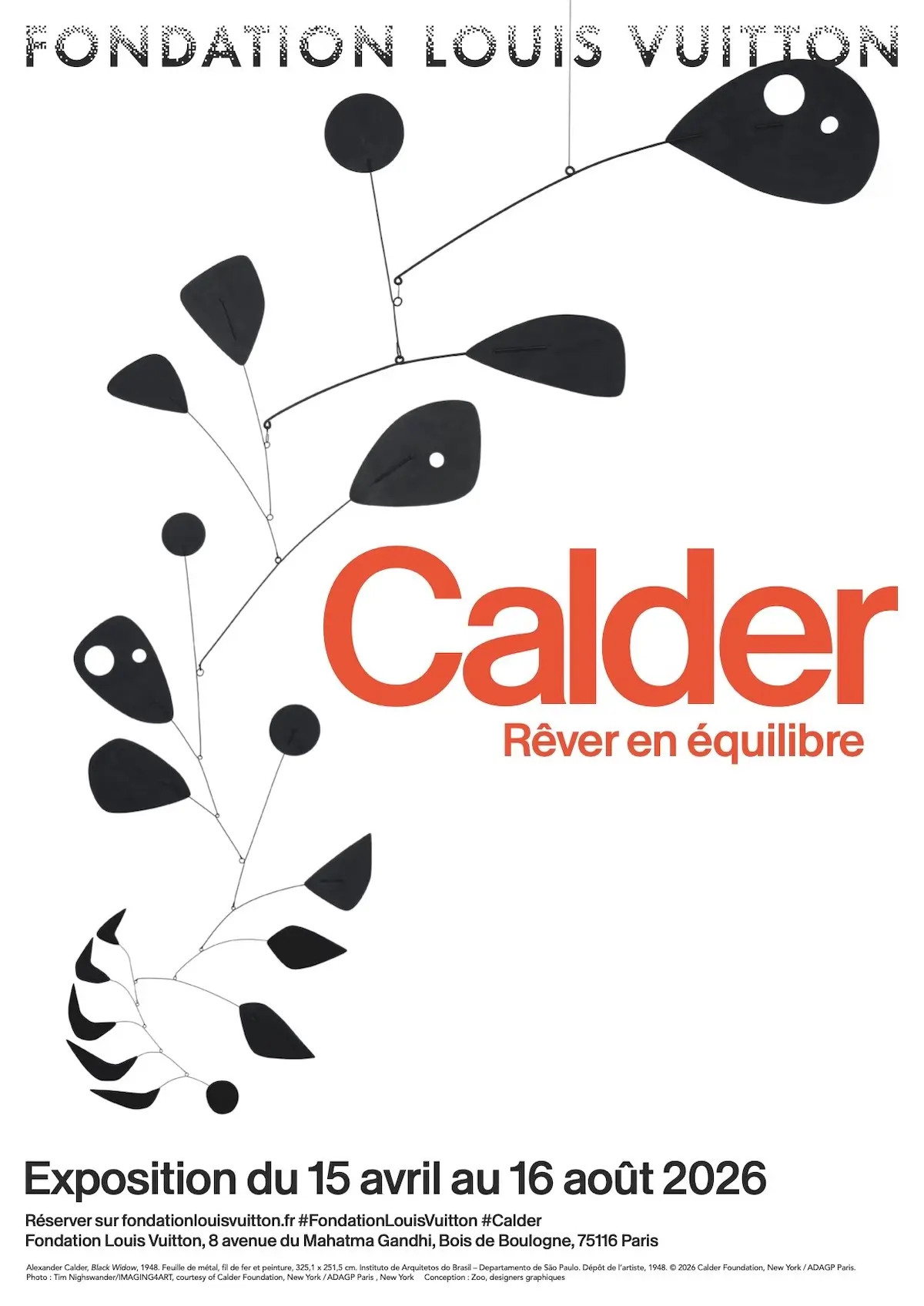
PARIS: CALDER – RÊVER EN EQUILIBRE
Fondation Louis Vuitton, through 16 August 2026
If the Hyères exhibition, more intimate in scale, has the advantage of perspective, the Paris show is a complementary counterpoint, zooming out to the larger, more panoramic picture. Spanning nearly half a century of creation and marking both the centenary of Calder’s 1926 arrival in France and fifty years since his death in 1976, it shows him not as a monument frozen in time but as a working presence – an artist in conversation with friends, with paper, with colour, with balance. The theme bridging both exhibitions is once again Cirque Calder.
Courtesy fondationlv on Instagram
The Fondation Louis Vuitton’s exhibition makes a subtle but clear claim: Alexander Calder was never really searching for perfect balance. He was staging a lifelong experiment in controlled imbalance, a choreography of metal and air that only becomes complete when something disturbs it.
The exhibition opens with the intimate world of Cirque Calder, the pocket‑sized theatre painstakingly assembled from wire, fabric and found objects. Acrobats, animals and props become a miniature laboratory for ideas that will later expand into the language of mobiles and stabiles. Already, the key principle is there: nothing exists in isolation. Every figure depends on strings, gravity, the flick of a wrist.
As visitors move deeper into the galleries, balance becomes less a static achievement than a provisional state. The wire portraits buzz with implied motion, lines almost vibrating in space. The Constellations, made of light wooden elements pierced and linked by wire, turn wartime scarcity into a kind of celestial notation: dots and dashes poised on the verge of drifting apart. Nearby, jewelry pieces read as wearable experiments, small sculptures that come alive only when attached to a moving body.
Courtesy Fondation Louis Vuitton
Frank Gehry’s architecture of the Fondation’s exhibition hall amplifies this narrative. Suspended in the glass and steel volumes, the mobiles do not merely hang; they hover, hesitate and slowly adjust to imperceptible currents.
The curatorial choice to treat these works as choreographic elements rather than isolated masterpieces pulls the whole show towards performance. And side events like dance evenings and live, remote visits are extensions of Calder’s logic: art that only truly exists in time, in relation, in flux.
Here, Calder’s vision is expressed fully by not making his work about equilibrium achieved and secured but about accepting that the most vivid forms of balance are the ones that can always tip, sway, or drift – just enough to stay alive.
Video via Expertisez on YouTube
Two paths merge to reveal the real person and his message
In the end, it is tempting to think of Calder not standing in front of a monumental stabile, but hunched over a suitcase, unpacking his circus in some borrowed room. A wire acrobat, a cardboard lion, a handful of string: nothing built to last, everything intended to come alive for just a brief moment. The people watching – friends, a child on the floor, someone leaning against a doorframe – will remember the performance more than the props. The circus folds away, the drawings go back in their portfolios, the sculptures stay in place, but what persists is a memory of something briefly in motion.
Calder’s larger works, even when they tower over us, carry something of that same modesty. They move if the air allows it, they glow if the light is kind, they change depending on who has come to look.
Taken together, the exhibitions in Hyères and Paris suggest that Calder’s real medium was neither metal nor paper, but time. His greatest gift may be less the elegance of his forms than the subtle, persistent lesson they offer… that there is a particular kind of grace in things that are always just about to move.
Just as one can compose colors, or forms, so one can compose motions.”
— Alexander Calder

VISITOR INFORMATION
Fondation Louis Vuitton, Paris
CALDER – RÊVER EN EQUILIBRE
Through 16 August 2026
Visitor information here
La Banque, musée des Cultures et du Paysage, Hyères
CALDER – ÉQUILIBRE EN COULEURS
Through 31 October 2026
Visitor information here
VENUE DETAILS
Fondation Louis Vuitton
8 Av. du Mahatma Gandhi
75116 Paris
Tel: +33 (0)1 40 69 96 00
Web: https://www.fondationlouisvuitton.fr/
La Banque, musée des Cultures et du Paysage,
14 Av. Joseph Clotis
83400 Hyères
Tel: +33 (0)4 83 69 19 40
Web: https://www.hyeres.fr/
PHOTO CREDITS
- Lead image Installation view of the exhibition Calder. Rêver en équilibre, presented from April 15 to August 16 2026 at Fondation Louis Vuitton, Paris; © 2026 Calder Foundation, New York / ADAGP, Paris; © Fondation Louis Vuitton / David Bordes
- All other photos, images, videos and posts as credited
Advertisement








Leave a comment