


A Founding Father’s rice heist, and generations of American dreamers and doers, helped shape the Côte d’Azur as we know it.
In spring of 1787, eleven years after the foundation of the United States of America, a tall, red-headed American diplomat left his carriage in Nice and climbed onto a mule bound for the Alps. He had not come sightseeing. Thomas Jefferson, then America’s minister to France, was chasing a trade mystery: French buyers were snubbing Carolina rice in favour of the Italian kind, and he wanted to know why. He crossed into Lombardy, inspected the rice fields himself, and – finding the export of raw grain punishable by death – stuffed his coat pockets with contraband seed anyway, smuggling it back through Nice to send home to South Carolina. In his correspondence with back home, he couldn’t stop raving about the region’s beauty and the fine weather.
It is a fittingly American story to kick off with: brazen, driven, curious, and armed with the conviction that a problem back home was worth crossing an ocean and a mountain range to solve. Jefferson’s rice never quite revolutionized Carolina agriculture, but his trip, 239 years ago, set a template: an American arriving on this coast, falling for it instantly, and finding a reason to stay a little longer than planned.
A Two-Way Gift Exchange
Before we get to the Americans who called the Riviera home, it is worth remembering how deeply intertwined France and the United States have always been. It is a friendship built on genuine exchange, not just proximity of Western culture.
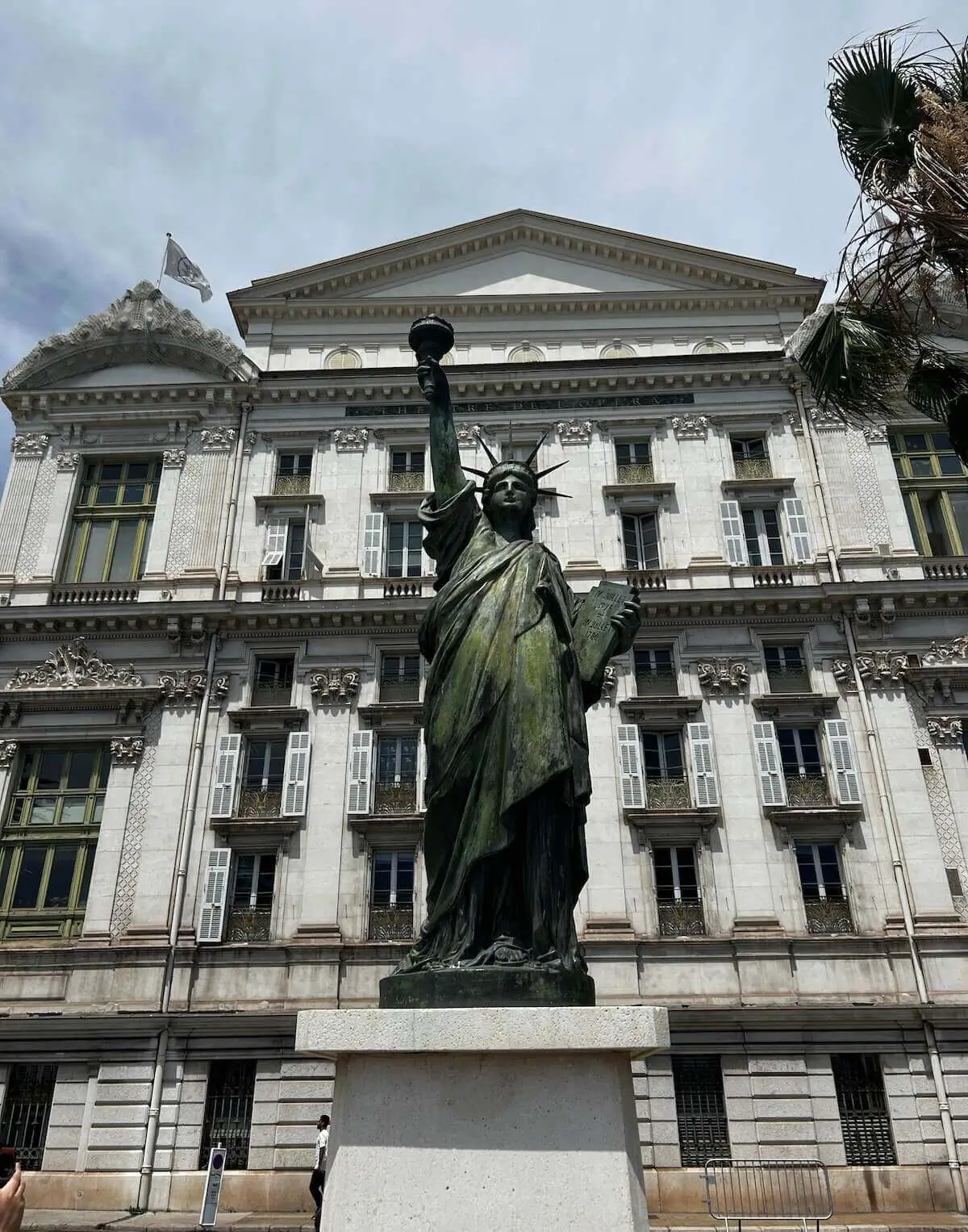
Photo © Marcus Gualberto
France gave America the Statue of Liberty, a symbol of freedom gifted for America’s centennial in 1886 and still the first thing many visitors see arriving in New York harbour. French officers and money helped win the Revolutionary War itself – without Lafayette and the French navy, there may not have been an America to celebrate on the Fourth of July at all. And French cuisine, wine culture, and fashion have shaped American taste for centuries. (Or at least, France likes to think it did.)
America, in turn, gave France jazz, rock and roll, Hollywood… and fiendish love of Apple products (sorry, Microsoft, the French do have their standards!). French cinemas and radio have been in a decades-long love affair with American music and movies, and the Cannes Film Festival itself owes much of its glamour to American stars walking its red carpet. American tech, from Silicon Valley software to the computer itself, now runs half of France’s economy, with the Sophia Antipolis tech park as a visible testimony. And despite the best efforts of the purveyors of the purity of the French language, they cannot help that English words keep seeping in, when the French no longer go to the réunion but to le meeting, no longer do their courses but their shopping, and no longer go for a course à pied but le footing. Vive le franglais !
That exchange, both visible and invisible, has left its traces on the Côte d’Azur. In honour of the USA’s quarter millennial birthday, we are taking a look at some of the famous Americans who came after Thomas Jefferson and, besides their cheerful disposition and their accents, brought big ideas and distinctive impact to Nice, Monaco, or Cannes.
How Americans Shaped the Côte d’Azur
Novelist Louisa May Alcott spent the winter of 1865–66 in Nice as a paid companion to an ailing family friend, homesick but captivated by the light and sea air along the Promenade des Anglais. This would later be written into Little Women. It was a modest, unglamorous stay compared to what would come later, but it planted one of the first seeds of Riviera romance in American popular literature, decades before Antibes and Monaco became household names.
New Orleans-born heiress Alice Heine became the first American woman ever to marry a reigning European monarch when she wed Prince Albert I of Monaco in 1889 – decades before Wallis Simpson, Grace Kelly, and Meghan Markle each also joined European royal families. She arrived with a six-million-dollar dowry and a sharp head for business, helping stabilize the principality’s finances before turning her attention to the arts. Marcel Proust, a regular guest at her Paris salons, is even said to have modelled a character on her – proof her influence reached well beyond Monaco’s borders.
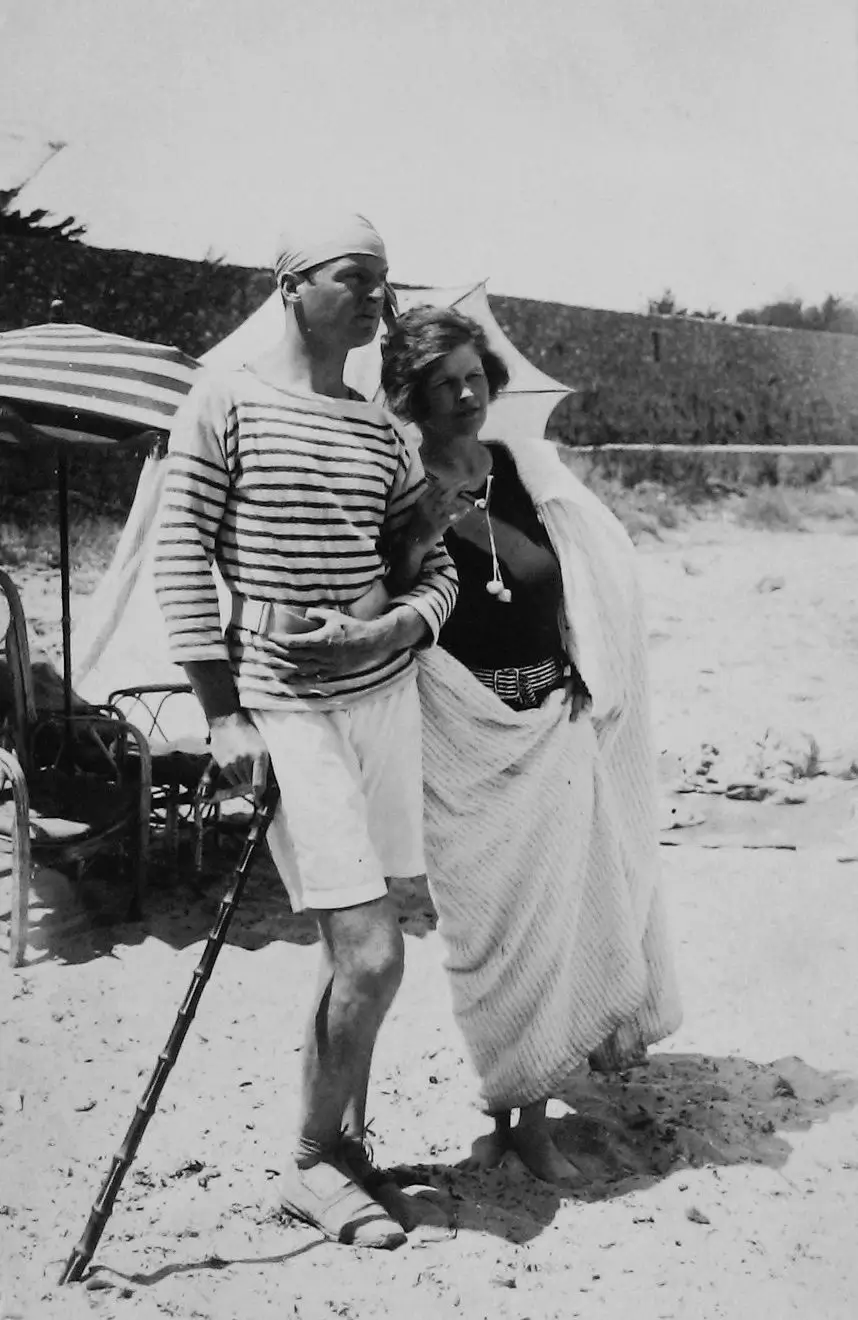
Gerald and Sara Murphy at Cap d’Antibes beach, 1923; by Unknown author – Public Domain, link
Socialites Gerald and Sara Murphy were the original influencers in the 1920s and 30s, long before the term was coined. They may be the most consequential Americans this coast has ever hosted. In 1923, this glamorous, generous couple persuaded the Hôtel du Cap in Antibes to stay open through the summer… unheard of at the time, when the wealthy fled south only in winter. Their home, Villa America, became the social heart of a golden decade, hosting Hemingway, Picasso, and the Fitzgeralds, with long, sun-drunk picnics on La Garoupe beach that Picasso commemorated in five separate portraits of Sara. They’re also credited with popularizing sunbathing itself, and their glittering hospitality later inspired the doomed golden couple at the centre of Fitzgerald’s Tender Is the Night. Simply put: without the Murphys, there might be no summer season on the Riviera at all.
Artist Man Ray ran in the same Antibes circles in the 1920s-30s, and his photographs of that era’s parties and personalities became the defining visual record of Riviera glamour. His surrealist eye turned casual beach gatherings and late-night soirées into striking portraits of the artists and writers passing through – the images people still picture when they imagine the Jazz Age Côte d’Azur.
The writer couple F. Scott and Zelda Fitzgerald settled in Juan-les-Pins from 1924 to 1926 at the Murphys’ invitation, and Scott turned what he saw into Tender Is the Night, permanently linking the Riviera in the American imagination with beauty, wealth, and a certain glamorous heartbreak. Their own marriage, brilliant and combustible in equal measure, mirrored the novel’s unravelling almost too closely, and their stormy years on the coast became as much a part of Riviera legend as the book itself.
Ernest Hemingway, another regular at Villa America in the 1920s, added his own mythology to the coast, spending summers there with the same crowd of writers and artists and even receiving an extravagant Murphy-hosted party in Juan-les-Pins to celebrate the publication of The Sun Also Rises. He later wrote about that world (less generously) in A Moveable Feast and The Garden of Eden, cementing the Riviera’s reputation as a literary breeding ground as much as a playground.
Video via London Sinfonietta – Topic on YouTube
Jazzman Cole Porter was already living it up in a rented château in Antibes when a visit from the Murphys sparked the whole 1923 summer experiment in the first place. He and Gerald Murphy even collaborated on a jazz ballet, Within the Quota, a playful sendup of American culture staged in Paris, and Porter’s songs became the soundtrack most associated with that era’s high life on the coast.
Isadora Duncan, celebrated dancer and choreographer, met a sudden, tragic end on the Promenade des Anglais in 1927, when her trailing scarf caught in the wheel of her convertible. It was a tragic final chapter for a dancer who had already endured devastating personal loss, and her death became one of the most talked-about celebrity stories of the century, adding a note of dark glamour to Nice’s mystique that lingers in the city’s lore to this day.
But beyond artists, athletes left their imprint, too. Helen Wills, the dominant tennis champion of the 1920s and the first American woman athlete to become a true global celebrity, made the Riviera part of her annual circuit, putting it on the map as a serious destination for competitive tennis. Her famous 1926 showdown against French idol Suzanne Lenglen at the Carlton Club in Cannes – 100 years ago this year! – drew such a crowd that spectators packed nearby rooftops just to catch a glimpse, and it remains one of the most talked-about matches in tennis history.
Video via British Movietone on YouTube
When Hollywood star Grace Kelly arrived in Monaco to marry Prince Rainier III, the tiny state did not have much to offer. After giving up her acting career at its peak to become Princess Gracia Patricia (1956–1982) and drawing a level of global attention to the principality not seen since Alice Heine’s day, she threw herself into charitable and cultural work and helped shape Monaco as a centre of excellence for the arts. In one of the coast’s saddest ironies, she died in 1982 after a car accident on the same winding corniche road she’d once driven in her iconic movie To Catch a Thief. Her children and grandchildren continue to shape Monaco’s public life today.
Hungarian-born and US-naturalized architect Marcel Breuer brought his signature Bauhaus rigor to the Riviera in 1962 when IBM commissioned him to design its new French research centre at La Gaude, just outside Nice. His striking, double-Y-shaped concrete building on stilts, chosen partly to lure France’s best engineers with the promise of a posting on the Côte d’Azur, became the birthplace of the world’s first computer-controlled business telephone systems. Now a protected historic monument, it stands as proof that American ingenuity shaped the coast’s skyline as much as its social scene.
Video via Bellagio Las Vegas on YouTube
Steve Wynn, the Las Vegas casino magnate who built the Bellagio, Wynn, and Encore resorts, is one of the ones who packed an overnight suitcase and ended up putting down roots. He was granted Monegasque citizenship by Prince Albert II in 2010 for his role advising a Monaco-Qatar hospitality venture, all while keeping his American passport. He has since become a fixture of the principality’s luxury hotel and dining scene, even nudging Monaco’s famously rich menus toward his own health-conscious, vegan-friendly tastes, proof that American influence on the coast didn’t stop with the Jazz Age.
An Enduring Friendship
From a founding father smuggling rice through Nice to a Hollywood star becoming a princess of Monaco, and businessmen influencing tastes and trends, Americans haven’t just visited this coast, they have helped build it. They opened its hotels for the summer, filled its villas with art and music, wrote the books that made the rest of the world fall in love with it, and, in more than one case, never left.
To every American who has called the Côte d’Azur home, whether for a season or a lifetime: this coastline is richer for you, and we know it. To all our American readers back home who dream of visiting or moving here, we are looking forward to meeting you! From all of us at RIVIERA BUZZ:
Happy Birthday, America!

PHOTO CREDITS
- Lead image by frank mckenna on Unsplash, licenced under the Unsplash License (edited – cropped)
- All other images and videos as credited
Advertisement








Leave a comment