

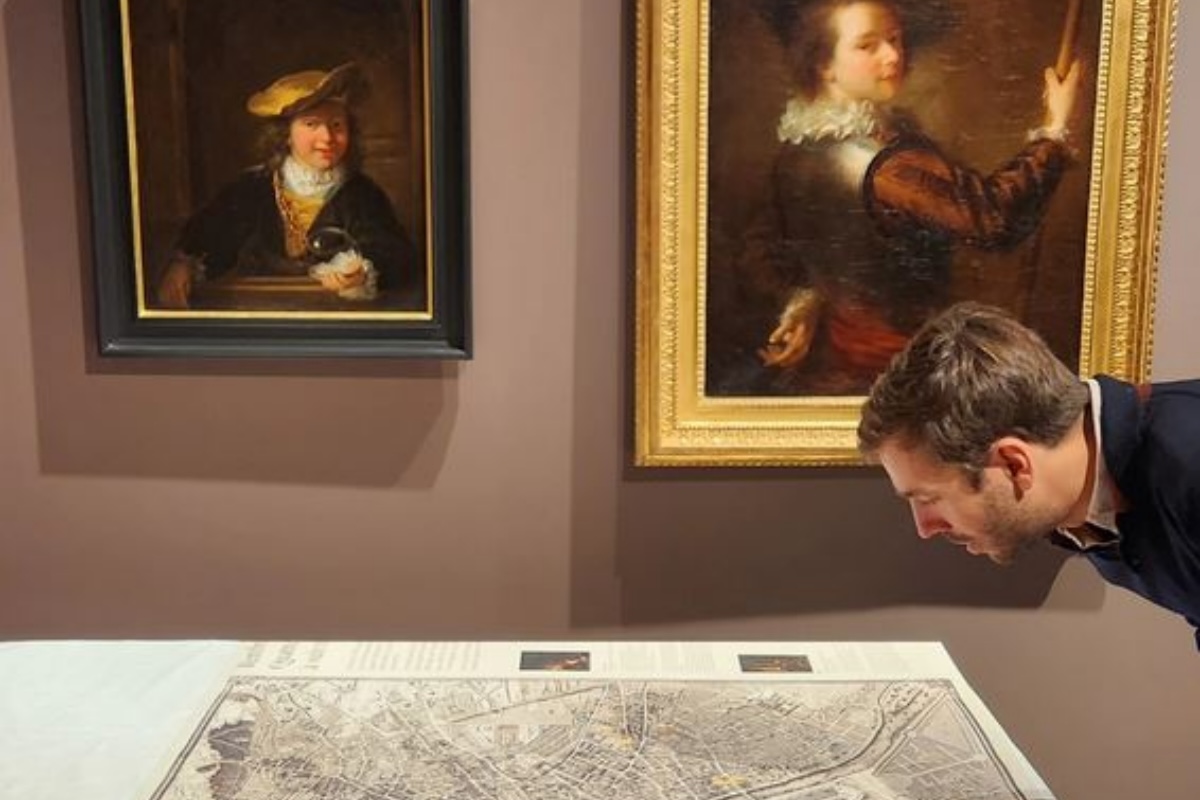
After a spectacular art heist at the Musée des Beaux Arts in 1999, its forgeries on display write an unexpected story.
When Rembrandt van Rijn died in Amsterdam in 1669, bankrupt and largely ignored by art patrons, he could scarcely have imagined his posthumous resurrection. Yet within fifty years, his name had become synonymous with artistic genius across Europe. The transformation was so complete that by the mid-18th century, French collectors were clamouring for anything bearing his signature, and forgers were working overtime to satisfy demand. Attribution though, as it turned out, was more fluid than one might hope. This peculiar chapter in art history forms the heart of Le Phare Rembrandt – Le mythe d’un peintre au siècle de Fragonard, now showing at the Musée des Beaux-Arts de Draguignan through 15 March 2026.
Labelled an exhibition of national interest by France’s Ministry of Culture, the show assembles 66 works on loan from institutions including the National Gallery of Art in Washington, the Leiden Collection, the Louvre Museum, the Palace of Versailles, and numerous French fine arts museums, as well as private collectors from Europe and the USA.
The exhibition takes a bold stance: it is less interested in authenticity than in influence, less concerned with provenance than with perception. Why? “The starting point for the exhibition is a pair of paintings in the museum’s collection, “L’Enfant à la bulle de savon” (Child with a Soap Bubble) and “Portrait de jeune homme portant une toque rouge et une chaîne d’or” (Portrait of a Young Man Wearing a Red Cap and a Gold Chain”, curator Yohan Rimaud explains. For more than two centuries, both works were considered to be by the hand of Rembrandt but were later proven to be forgeries.

And one of them would find worldwide media fame when stolen by a Niçois thief in 1999. But more about that later.
At the core of the exhibition lies a provocative premise: why did artists paint in the manner of Rembrandt? The answer reveals how artistic legacy is constructed through layers of interpretation, imitation, and sometimes outright fabrication. Several works in the exhibition were once attributed to Rembrandt, some even bearing his signature. While they are no longer considered authentic, they seem practically indistinguishable from Rembrandt’s style. The show demonstrates precisely how and why.
The French Discover Rembrandt
By the early 18th century, Paris had become the capital of the European art market, and Rembrandt’s paintings flowed through the city before being exported to Germany, England, and Russia. French artists encountered these works in private collections and auction houses, studying the master’s technique and adapting his dramatic chiaroscuro to their own sensibilities. Some works were genuine, others optimistically attributed, still others outright fabrications.
The exhibition reinforces these connections. Each thematic section includes a Rembrandt or a work once attributed to him, placed alongside 18th-century French works that respond directly or intuitively to his example. Every painting in the exhibition was visible in France during the period under examination. Curator Yohan Rimaud identified approximately 400 works mentioned under Rembrandt’s name before the French Revolution, though the artist painted nothing for export during his lifetime. His influence spread first through prints, with paintings arriving only in the late 17th century.

The show takes its visitors through a carefully curated selection of paintings attributed to Rembrandt or created by artists who studied and collected his work. It opens with the “cabinet” (collection) of the Marquis de Robien, whose fifteen attributed Rembrandts exemplify what the Dutch master’s name meant to 18th-century French collectors. From there, it traces how artists absorbed his treatment of light and shadow, his rendering of flesh and age, his exotic costumes and accessories.
What emerges then goes beyond a survey of Dutch Golden Age painting to examine how artistic reputation is constructed across time and geography. The works on display reveal themes of imitation and appropriation, showing how French painters absorbed Rembrandt’s revolutionary use of light and shadow, his psychological depth, his willingness to dignify ordinary subjects with monumental treatment.
Well-known masters appear in unfamiliar guises. Jean-Baptiste-Siméon Chardin, celebrated for still lifes, contributed a large-format portrait in which sombre tones and dramatic lighting invite explicit comparison to Rembrandt. Hyacinthe Rigaud, Louis XIV’s court portraitist, painted a Presentation at the Temple where chiaroscuro replaces the crystalline illumination of his ceremonial works. Lesser-known painters receive equal attention: Jean-Baptiste Santerre conjures graceful figures in fantastical dress, Alexis Grimou produced scrupulous imitations complete with turbans and armour that might fool the untrained eye, whilst Jean-Baptiste Greuze’s uncompromising early portraits revealed a young artist grappling with how to render aged flesh and weathered dignity.
Video via Canal.D Draguignan on YouTube
The most spectacular homages come from fellow painter Jean-Honoré Fragonard, who copied Rembrandt repeatedly in Parisian collections during the 1750s. His series of old men’s heads from the 1760s demonstrates an almost violent engagement with the Dutch master’s technique – loose, furious brushwork that transforms study into creative dialogue. These are not timid exercises but assertions of artistic kinship.
What exactly separated Rembrandt from his imitators remains elusive. Whilst painters could master his dramatic chiaroscuro, they struggled to replicate the psychological intensity that made his figures seem alive. His thick, seemingly chaotic brushwork resolved into startling realism when viewed from a distance, and he refused to idealise his subjects according to academic conventions. It was this combination of technical audacity and unflinching honesty that his admirers could study but never fully capture. According to some research, Rembrandt likely suffered from strabismus, limiting him to two-dimensional vision, which makes his ability to create such profound spatial depth all the more remarkable.
Throughout, the show emphasises how 18th-century viewers learned to look at painting. Merchants and collectors developed precise vocabularies to describe Rembrandt’s methods: his “greasy” touch, his dramatic contrasts, his ability to make paint trompe-l’œil from a distance whilst dissolving into chaos up close. Learning to describe, the exhibition argues, meant learning to see. This analytical approach shaped French painting as surely as any direct copying.
The Art Heist that was a Curse… and a Blessing
For all its art historical significance, Le Phare Rembrandt carries an undercurrent of notoriety linked to Draguignan’s own collection. Two paintings seized during the Revolution from the Château de Valbelle were considered authentic Rembrandts for over two centuries. One depicts a young boy holding a soap bubble, the other a young man in a red cap with a gold chain. Both occupy an important place in local imagination. Both are now known to be imitations…

Cat. 21. Ecole française du XVIIIe siècle, L’enfant à la bulle de savon, huile sur toile, Draguignan, musée des Beaux-Arts, inv. 8 © CICRP – Musée des Beaux-Arts, Draguignan – Caroline Martens
The works entered the museum’s collection in the 1790s following Revolutionary seizures, at the height of the period this exhibition examines – when Rembrandt’s name carried immense prestige but attribution remained uncertain.
The soap bubble painting acquired a particularly strange afterlife. On 13 July 1999, as Bastille Day celebrations thundered through Draguignan’s streets, 24-year-old Patrick Vialaneix hid inside a museum cabinet as it closed. Six hours later, military helicopters and armoured vehicles provided acoustic cover as he smashed through bulletproof glass and disappeared with L’Enfant à la bulle de savon, valued at approximately four million euros at the time (or €7m in today’s money).
Vialaneix had first seen the painting at thirteen. The image lodged itself in his psyche with peculiar force. He saw the child as a mirror, then a friend, eventually developing paternal feelings towards the figure. As an alarm technician, he spent years studying the museum’s security before executing his theft. He sought not profit but possession, not wealth but proximity to an image that haunted him.
The painting spent fifteen years wrapped in bubble wrap under his bed. Vialaneix married, had children, and moved repeatedly to avoid detection. He would prop the work on an empty easel to gaze at it and speak to it in private. The object he stole to possess had instead possessed him.
Video via Europe 1 on YouTube
Depression consumed him. In March 2014, desperate for release from this psychological pressure, he confided in a friend who arranged a meeting with supposed insurance agents. Days later, police arrested these men in Nice attempting to sell the work. Vialaneix surrendered immediately thereafter.
The statute of limitations had expired on the original theft, though he faced conspiracy charges related to the attempted sale. Considerable media attention followed, and he became the subject of a documentary and even a book, L’Homme à la bulle de savon, which described the case as The Picture of Dorian Gray in reverse: a painting that gradually consumed its possessor.
In January 2015, several months after confessing, Patrick Vialaneix died in his sleep at 43. His widow remarked simply: “He returned the picture, and he departed.”
The Child with the Soap Bubble Returns Home
The tragic irony: the painting Vialaneix stole was almost certainly not painted by Rembrandt at all. This speaks directly to the exhibition’s themes. The museum now acknowledges both its long-attributed works are imitations, one even bearing a false signature. Does this revelation diminish the story? The exhibition argues otherwise. The work had shaped Vialaneix as surely as any authenticated masterpiece might have done. It had been collected, preserved, and valued across centuries precisely because it embodied qualities associated with Rembrandt’s vision. The forgery had successfully transmitted something essential about the master’s approach to light, psychology, and mortality.

This paradox animates the entire exhibition. Eighteenth-century collectors and artists responded to what they perceived as Rembrandt’s genius, and that perception shaped French painting regardless of attribution. The technical vocabulary they developed, the formal problems they identified, the creative solutions they pursued all emerged from sustained engagement with works bearing his name. Some were authentic, others optimistically attributed, still others deliberate fabrications. All contributed to constructing Rembrandt as myth.
The show concludes by placing an old painted copy of Rembrandt’s Autoportrait aux deux cercles on loan from the Musée Granet alongside Jean-Honoré Fragonard’s wash drawing of the same work. The original hung in the collection of Paris’s greatest Rembrandt collector, the Comte de Vence, making it a touchstone for French artists throughout the century. That Fragonard – perhaps Rembrandt’s most accomplished French interpreter – copied it repeatedly suggests how this self-portrait came to embody everything the master represented: dramatic light, visible brushwork, and above all, figures that seemed to breathe.
Rembrandt’s name is one of the most famous in art history, but his painting retains an element of the unexplained and inexplicable.
— Yohan Rimaud
The once-stolen painting that inspired this show, now resides in a secure display near the museum’s reception, a witness to its own strange journey.
The bubble in that contested painting continues to shimmer, fragile and transient. Whether created by Rembrandt’s hand or by an accomplished imitator matters less than one might suppose. The image has survived revolution, theft, and the corrosive effects of obsession. It speaks across centuries about the vanity of earthly things whilst simultaneously embodying art’s stubborn refusal to vanish. That paradox, more than any signature, feels authentically Rembrandtesque.

Guided tours in French, English, and French Sign Language, plus programmes for visually impaired visitors are available. Concerts, lectures, and workshops punctuate the schedule. A “Rembrandtmaton” photo booth at the nearby media library allows visitors to insert themselves into recreations of the master’s compositions.

VISITOR INFORMATION
Le Phare Rembrandt – Le mythe d’un peintre au siècle de Fragonard
Musée des Beaux-Arts de Draguignan – Through 15 March 2026
Open Tue – Sat 10 am – 6 pm, closed on Mondays and public holidays
Admission €6 / concessions available | Online ticket booking

CONTACT DETAILS
Musée des Beaux-Arts de Draguignan
9, rue de la République
83300 Draguignan
Tel: +33 (0)4 98 10 26 85
Email: mba@ville-draguignan.fr
website www.mba-draguignan.fr
All images and photographs courtesy Musée des Beaux Arts, Draguignan; credits as indicated; all photographs via museum Facebook page
Share article
Leave a Reply