


The Musée des Merveilles in Tende is currently hosting a landmark exhibition of mythical rock carvings and sculptures from the Mediterranean basin.
The Musée des Merveilles is one of the most important museums you have never heard of. Tucked away in Tende, in the upper Roya valley, it sits at a comfortable distance from the hustle of the French Riviera, but its cultural programme holds its own against any arts institution on the coast and well beyond.
To mark its 30th anniversary this year, it has mounted an exhibition of transnational significance: Sorcier & Friends is the well-told story of prehistoric sculpture which started with a single rock engraving discovered on Mont Bego in the Alpine foothills and ends up revealing a fascinating story that spans time, man-made borders, and even the Mediterranean Sea.
A Valley Carved in Wonder
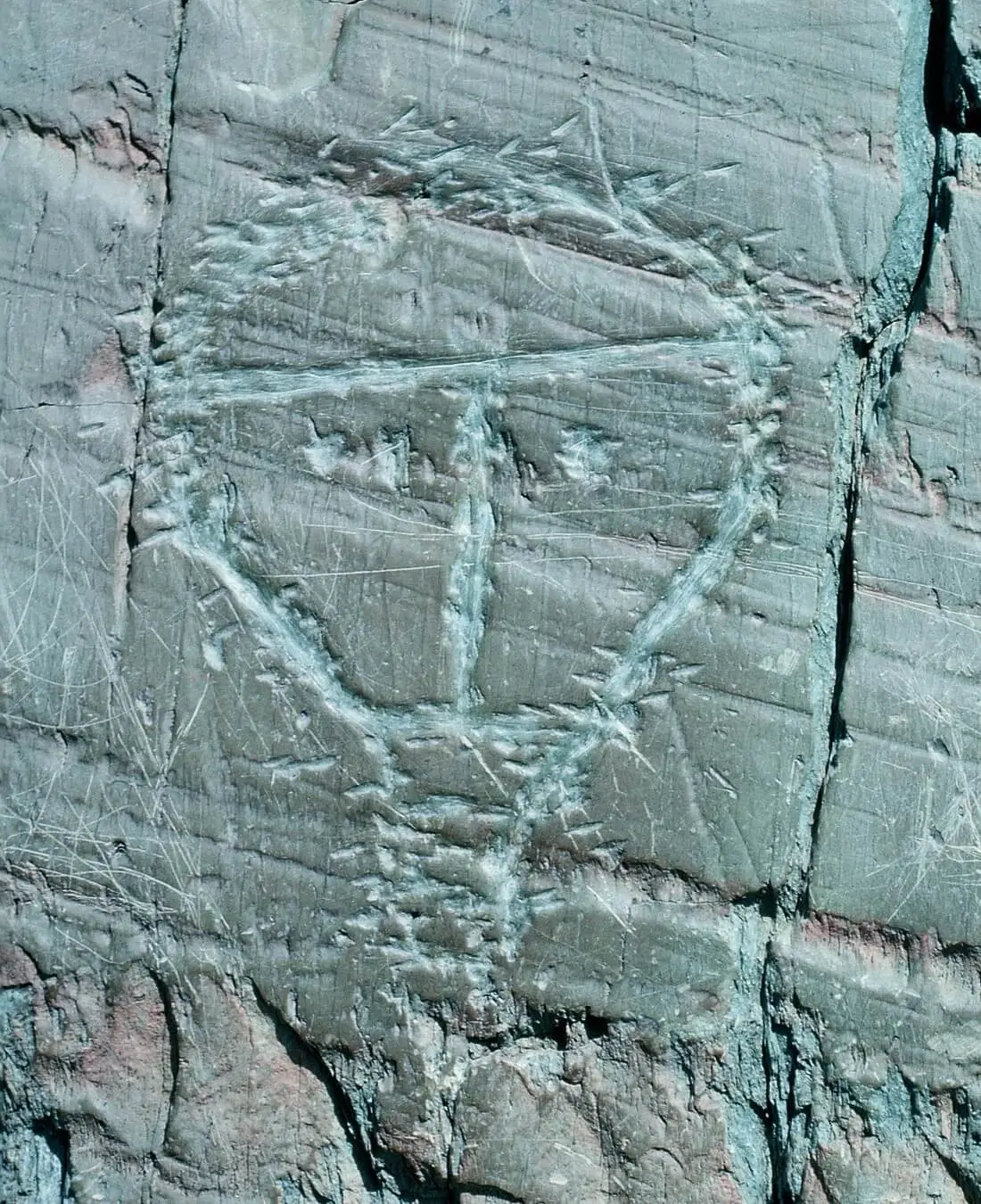
‘The Christ’ – photo by Philippe Kurlapski – Private work, CC BY 2.5, link
The Vallée des Merveilles (“Valley of Wonders”) owes its name not only to its dramatic mountainous terrain dotted with lakes and forests but also its history and an abundance of prehistoric artwork. Among the thousands of rock engravings on Mont Bego, anthropomorphic representations (figures with a human appearance) are the rarest but the most well-known. They have traditionally been given grandiose names: “the Christ,” “the Tribal Chief,” “the Man with Zigzag Arms”…
At the heart of the show, which runs through 31 October, is “le Sorcier”, a pecked-stone figure brandishing a dagger in each raised hand. Those daggers date him to the 4th millennium BCE, the moment copper metallurgy arrived and upended social hierarchies across Europe.

Courtesy Département des Alpes-Maritimes
But the exhibition is not about one figure. As the deliberately light, almost playful title gives away, the Sorcier of Mont Bego is not alone; he has always had companions. He was part of a society across the whole Mediterranean arc, when thousands of people followed a civilisation-wide impulse across several centuries and several hundred kilometres, carving friends and enemies, chiefs and mothers, warriors and divinities into stone and leaving them standing in the landscape.
One Sorcerer, an Entire Mediterranean
What does that collective act tell us about how early societies saw themselves, and how they chose to be remembered?
Video via RegVdA – Regione autonoma Valle d’Aosta on YouTube
That is the question curators Silvia Sandrone and Nicoletta Bianchi pursue. Their intellectual ambition is to go beyond rock art and explore links with megalithism and anthropomorphic statuary, reaching into the origins of prehistoric iconography. The show moves the visitor outward from Mont Bego to the wider Mediterranean, tracing a shared cultural moment – the Neolithic and Copper Age impulse to fix human identity in stone – across its full geographic expression. It is a transnational story by design: the lenders span France and Italy, reaching as far as Aosta, Genoa, Montpellier, and Toulouse by way of Corsica and Sardinia. Over twenty researchers contribute to the catalogue, a sign of how the exhibition has mobilised a field.
Standout Objects, Unresolved Questions
The single most striking object in the exhibition is the replica set of the Campu Fiureddu statuette from Corsica. The original, just 7 centimetres high, has not been in Corsica for nearly a century; it has been the property of the British Museum since 1927. In 2024, researchers located a previously unknown second example in the museum collections at Cambridge. The exhibition shows replicas of both versions, made using materials and techniques available during the Neolithic period, displayed alongside original figurines from Sardinia.
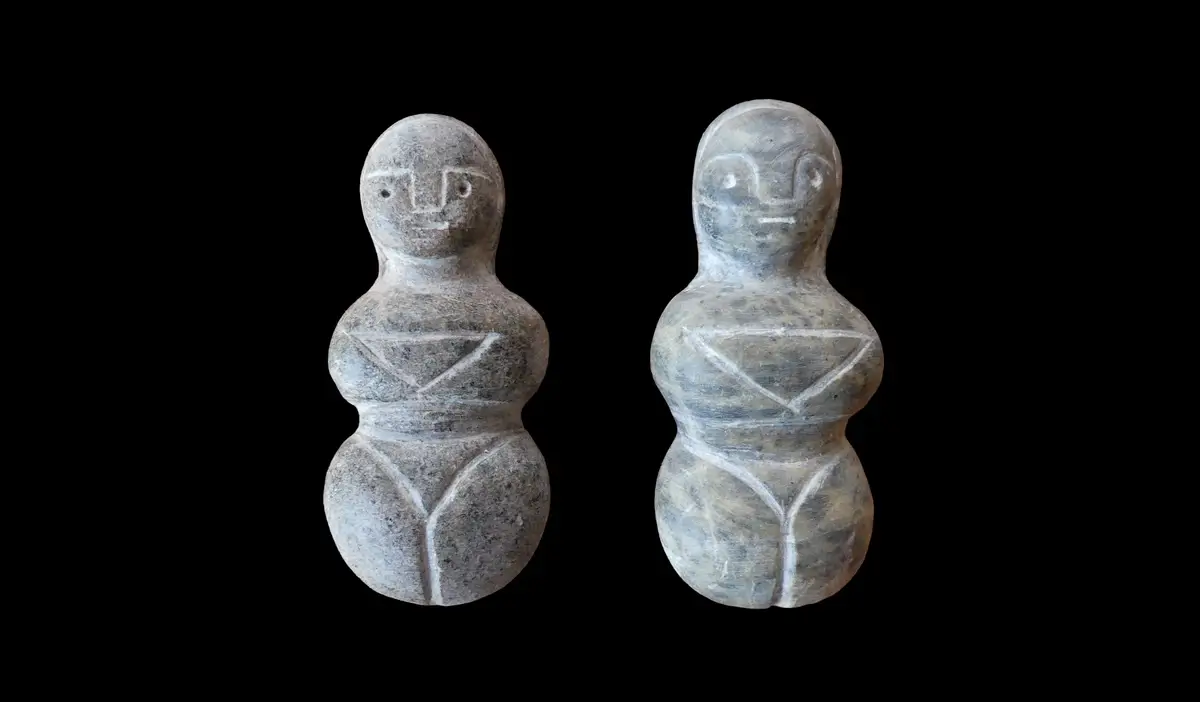
Campu Fioreddu – photo © K. Peche-Quilichini
Another impressive moment comes from a single, solitary object: the only copper-alloy dagger blade ever found in the Roya valley. Thousands of daggers are carved into the rocks above; only one physical example has been recovered from the valley below. That mismatch raises a question the exhibition keeps returning to: what was the relationship between what was depicted and what was actually used, exchanged, or revered?
The show also takes a distinctly modern stance on gender. Since the 19th century, researchers have sorted these figures into male and female, but several stelae combine what were assumed to be markers of each, and some appear to have been modified over time, their identity shifting. The curators raise the possibility that prehistoric communities were less concerned with gender as a fixed category than with something more like social role, status, or ritual function, and that the weapons and ornaments carved into the stone were a language for that, not a label.
How the Modern World Found the Ancient One on Mont Bego
The story of Mont Bego’s discovery by the modern world is itself a remarkable one. The first mention of the Vallée des Merveilles is attributed to Pierre de Montfort in 1460, but the site did not arouse serious research interest until the late 1800s. It was Clarence Bicknell, a British botanist who first visited in 1881, who systematically documented the engravings, spending the best part of his retirement years examining and making heel-ball rubbings of every figure he could find. At the time of his death in 1918, he had documented 7,428 figures in Val Fontanalba, 5,139 in the Merveilles district, and 151 in neighbouring valleys.

Bicknell’s interpretation had a poetic quality. He felt the engravings were not just the work of bored shepherds. The area was too remote, too high, and the sheer number of engravings would have required far more time than a shepherd tending his flock could spare. He saw them as pilgrimages: “Those coloured rocks were their archives, their Jerusalem or Mecca, and they went there to engrave something, each one hoping to get some benefit in so doing.”
After Bicknell, systematic research was taken up by Italian archaeologists Piero Barocelli and Carlo Conti, and then, most consequentially, by Henry de Lumley, the renowned archaeologist who notably excavated the Cave du Lazaret in Nice. He directed annual field campaigns from 1967 onward for four decades, building the scientific corpus that the museum was eventually created to interpret and protect. Tende itself only became French territory in 1947, which gives the site an additional layer of Franco-Italian historical complexity: the “French” national monument par excellence was, until living memory, Italian.
The Main Exhibition’s Little Sister
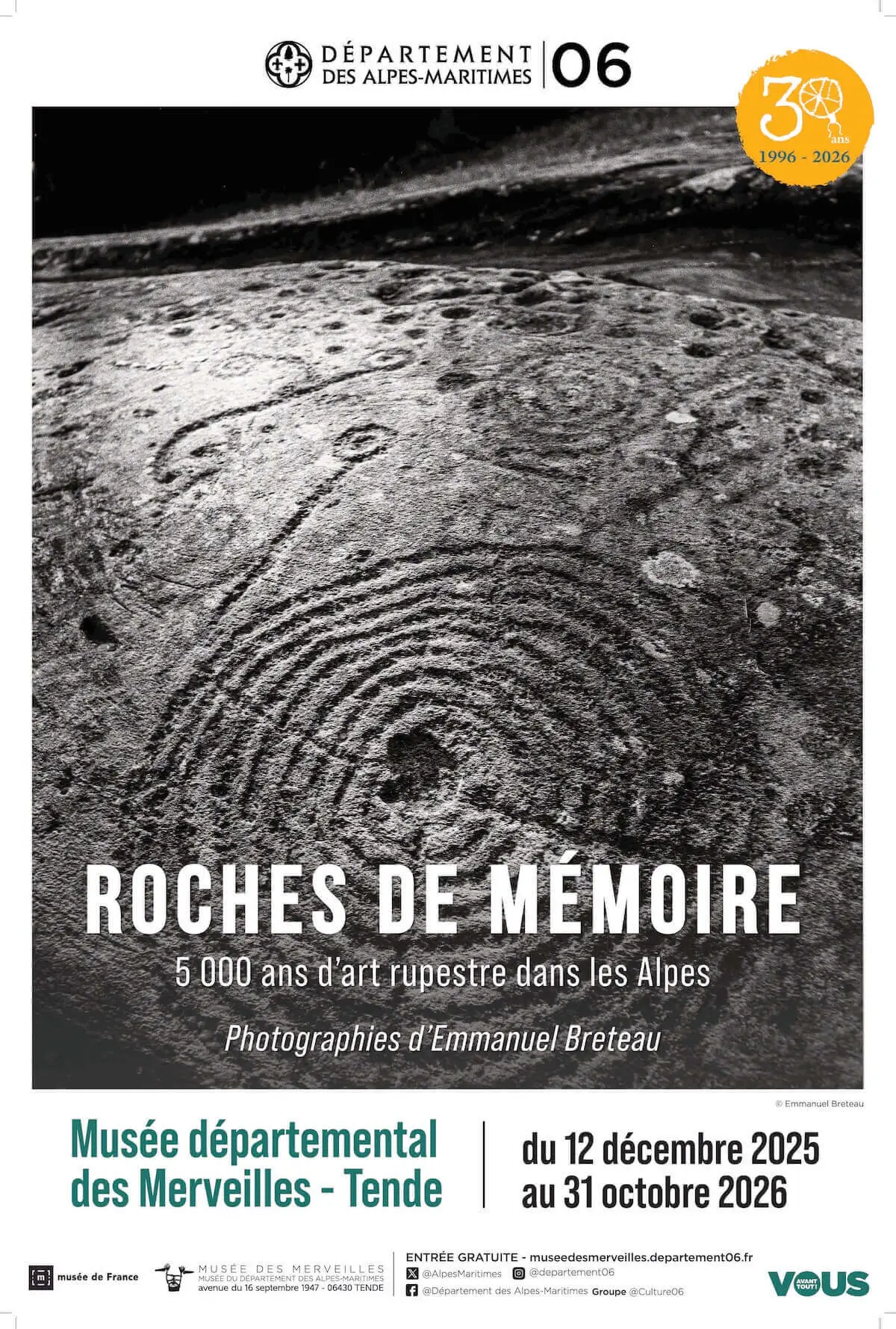
Courtesy Département des Alpes-Maritimes
The anniversary year is marked not only by Sorcier & Friends but by concurrent shows and activities that build on this legacy, including the complementary photo exhibition Roches de mémoire. Emmanuel Breteau takes visitors on a journey through France, Switzerland and Italy to discover the richness and diversity of the motifs engraved by the earliest inhabitants of the Alps.
The Michelin-Starred Museum of Wonders
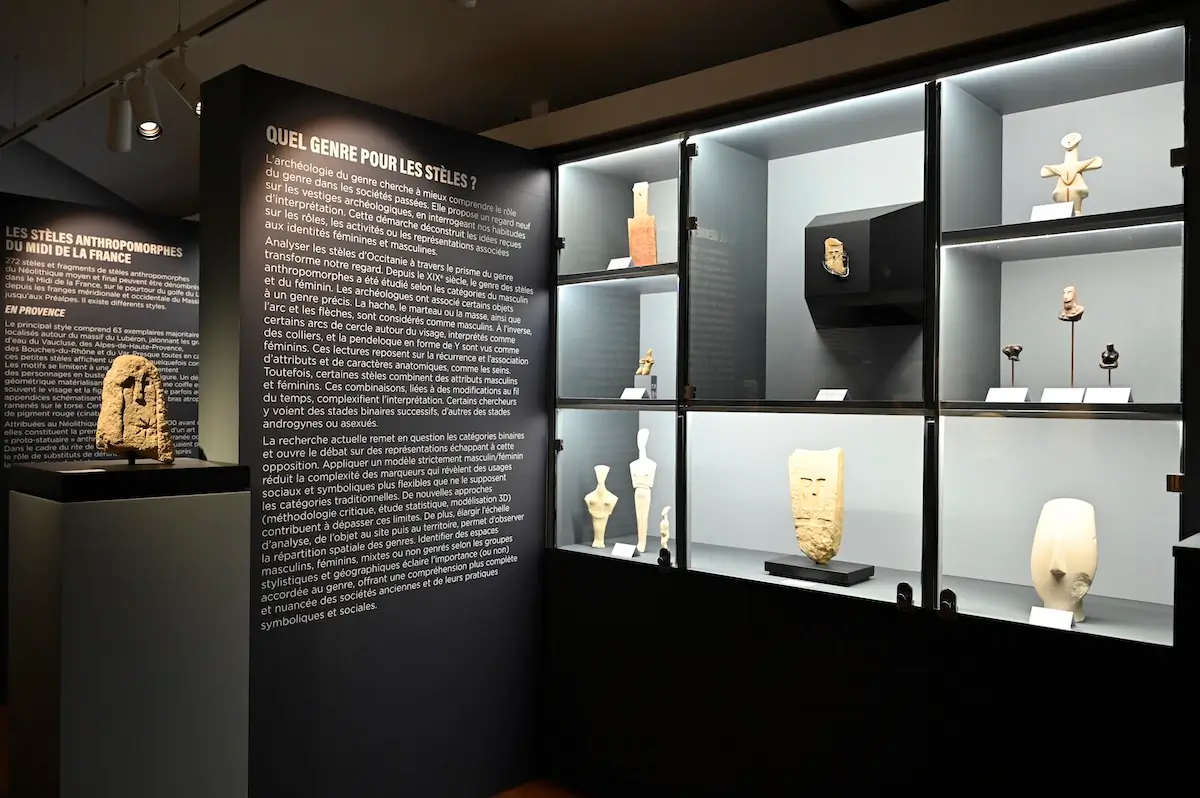
Courtesy Musée départemental des Merveilles de Tende / Département des Alpes-Maritimes
The museum opened on 12 July 1996. Situated 80 kilometres north of Nice, at the heart of the Mercantour National Park’s adhesion zone, it was conceived as a “crossroad of history” between the coast and the hinterland. Over three decades, it has established itself as a pole of scientific and cultural activity, with a public that is increasingly international, original exhibitions, and a programme of cultural and scientific actions. In July 2026, the museum was awarded a star by the Guide Michelin Voyage & Cultures.
The most unsuspecting areas off the busy French Riviera hold unexpected treasures that have shaped this part of the world much more than most people know. Tende, high above the coast, is one of them: a place where a single engraved figure on a mountainside opens onto a continent-wide conversation about identity, memory, and what early societies felt was worth leaving behind.
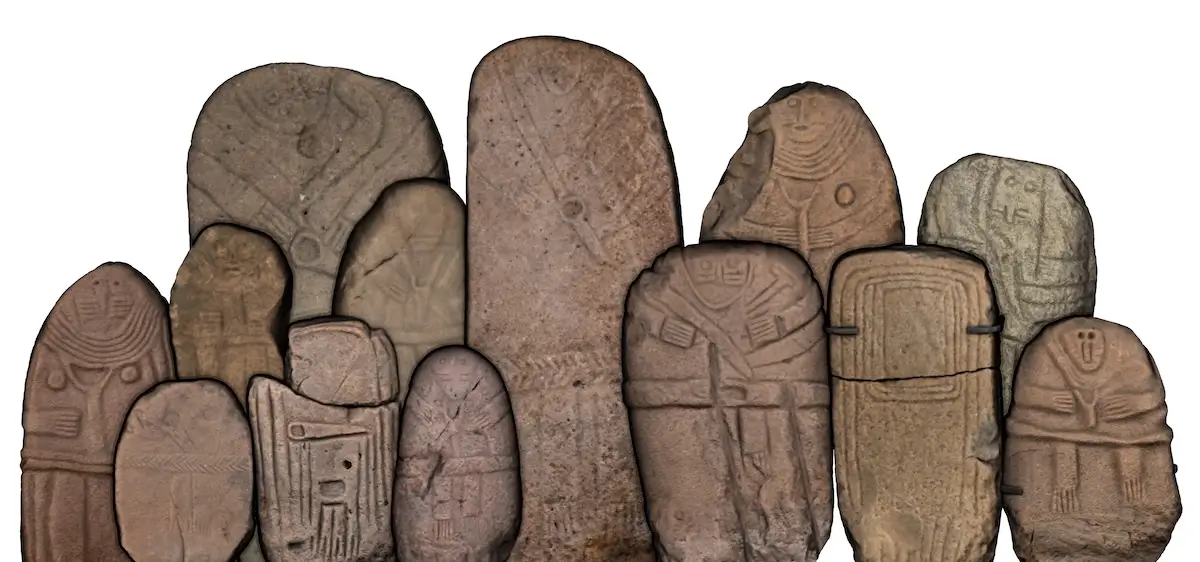
Modelisation 3D stèles Rouergue © A. Laurent

VISITOR INFORMATION
Sorcier & Friends | Musée des Merveilles, Tende
Through 31 October | Free admission
Opening Hours:
- Open daily except Tuesday
- Closed from November 13 to 25, December 25, January 1 & May 1
- Summer schedule (June 16 to September 15): from 10:00 am to 6:00 pm
- Winter schedule (September 16 to June 15): from 10:00 am to 5:00 pm
VENUE DETAILS
Musée des Merveilles
Av. du 16 Septembre 1947
06430 Tende
Tel: +33 (0)4 89 04 57 00
Web: https://museedesmerveilles.departement06.fr/
PHOTO CREDITS
- Lead image © Département des Alpes-Maritimes
- Photo of ‘The Christ’ via Wikimedia Commons and as credited
- All other photos and images courtesy Musée départemental des Merveilles de Tende / Département des Alpes-Maritimes and as credited
Advertisement








Leave a comment