


The Mediterranean Sea is more than a place of longing. Its coasts tell of ancient civilisations, of departures and returns, of leisure and life.
It is a space full of stories, memories, and encounters – a sea that has connected cultures for thousands of years and inspired generations of travellers, artists, and researchers.
Yet behind its beauty lies a fragile reality. Overfishing, pollution, increasing maritime traffic, and the effects of climate change are rapidly transforming one of the world’s most fascinating ecosystems.
How do you tell the story of a sea that is marked both by extraordinary beauty and profound vulnerability?

Photo by E. Lodigiani / Tethys Research Institute
The Italian marine ecologist Giuseppe Notarbartolo di Sciara (pictured above in lead image) has found a remarkable answer. In his acclaimed book Sailing Across a Wounded Sea, he takes his readers on an imaginary sailing journey across the Mediterranean – from Venice along the Croatian coast, from Rhodes to Alexandria, from Lampedusa to the Spanish shores.
What emerges is far more than a scientific non-fiction book. Personal memories are interwoven with half a century of research and conservation work. Encounters with sperm whales, fin whales, dolphins, seals, and sharks form a portrait of a sea of extraordinary beauty – and of a habitat whose future is anything but certain.
Few people could tell this story more credibly. For decades, Notarbartolo di Sciara has been one of the leading voices in international marine conservation. In 1986, he founded the Tethys Research Institute, one of the leading research centres for marine mammals in the Mediterranean region. He also played a key role in the creation of the Pelagos Sanctuary, jointly managed by France, Italy, and Monaco.

Photo by Anna Marchenkova on Wilimedia Commons – Opera propria, CC BY-SA 4.0, link
It is precisely this personal perspective that makes his book so special. It is not only about scientific findings, but about the relationship between humans and nature – about what we stand to lose, and why it is worth preserving this world.
At a time when environmental debates are often shaped by alarmism or resignation, Sailing Across a Wounded Sea offers a different perspective: one guided by curiosity, wonder, and a quiet form of hope.
And this is exactly where the conversation with the author begins: with the reminder that every relationship with nature is personal.
The Sea Teaches Us Humility
When listening to Giuseppe Notarbartolo di Sciara, it quickly becomes clear that his work has never been purely scientific, but always existential as well. After more than five decades on and with the sea, one question inevitably arises:
Is there a moment in the Mediterranean that fundamentally changed your own view of nature – and perhaps even of life itself?
I have always regarded the Mediterranean as a home, a place where I belong. My life began in a saltwater lagoon, directly connected to the sea, so being at sea has become a natural part of my existence. In this environment, it was inevitable for me to observe change. However, at some point I realised that this change was turning into degradation caused by humans, and in that moment I understood that fighting for the Mediterranean was like fighting for my own life.

Photo by S. Airoldi / Tethys Research Institute
Your book combines research with memory, data with storytelling, observation with experience. But how does something emerge from these layers that truly reaches readers emotionally? Or, put differently:
Can stories and emotions today actually achieve more than pure facts when it comes to protecting the oceans?
They do, in the minds of the public. Facts are considered dull, and people are not interested. Stories, however, can touch our hearts and evoke our emotions. We know this from childhood. That is why I chose to give my message the form of a story. Still, stories need facts to rest on, so science remains essential. It is simply a matter of changing the language to better reach the readers’ hearts.
And finally, there remains perhaps the most urgent question of our time. In the face of climate change, species loss, and the growing sense of overwhelm many people feel, the question of the future also arises in conservation work:
After all your years of direct observation of changes in the Mediterranean, what still gives you hope – and where does our responsibility begin in shaping that future?
Since we humans are the only problem, we are also the only solution. We don’t have to fight an external force; the problem is not an asteroid hitting the planet or a volcanic eruption. It is us. It is our minds, our attitudes, our mistaken sense of ownership with no responsibilities attached that is leading towards disaster. All we have to do is change that attitude into one of belonging: it is not nature that belongs to us, but we who belong to nature. Of course, this is not simple, but I am sure it can be done. That gives me – gives us – hope. And the process for this, too, begins at the individual level.
Why the Sea Concerns Us All
Perhaps the special strength of Sailing Across a Wounded Sea lies in the fact that the book does not provide simple answers. Instead, it reminds us how closely our lives are connected to the oceans – even when we live far from the coast.
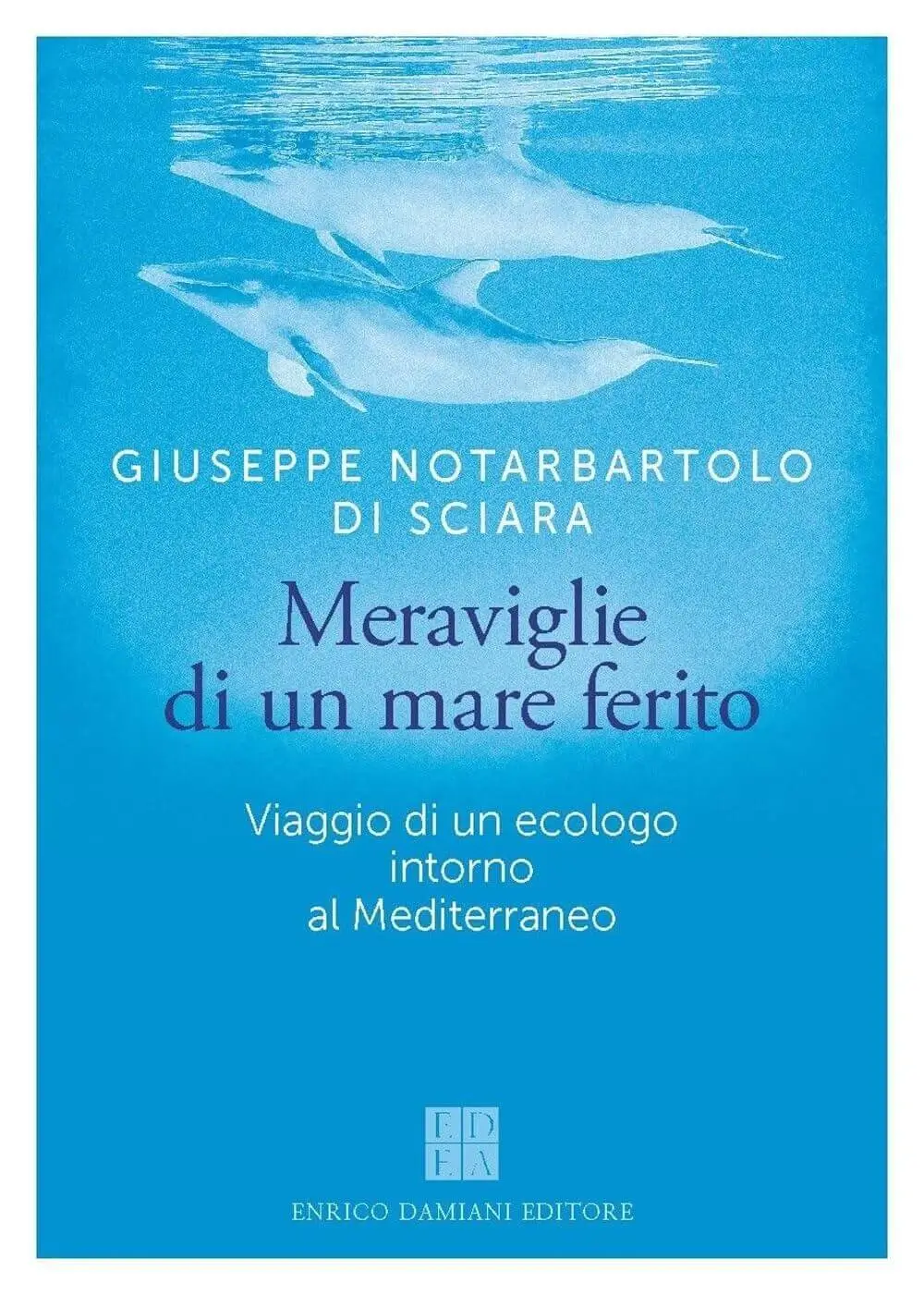
Book cover courtesy Enrico Damiani Editore e Associati
Turning its pages, we travel through landscapes, memories, and habitats that feel both timeless and threatened. We encounter not only whales, dolphins, and the inhabitants of Mediterranean coastal regions, but also a fundamental question of our time: how do we want to relate to the world around us?
The book does not answer this question with a moralising tone. Instead, it invites us to look more closely, to become more attentive, and to perceive the beauty of a nature that often seems self-evident – and is therefore easily overlooked.
Because what we love, we seek to preserve.
Perhaps this is the book’s most important message: before we can change the world, we must learn to see it again.
The book is available in English and Italian and may be purchased online or from your local bookstore.

Photo by N. Pierantonio / Tethys Research Institute
ABOUT THE AUTHOR
Giuseppe Notarbartolo di Sciara is a marine ecologist who spent his life trying to shoehorn scientific evidence into policy and politics. So far, he must admit that he has largely failed, despite episodical successes here and there. He is fascinated by devil rays and horrified by seafood after a childhood encounter with a trout gone bad. When he is not on the Greek island of Patmos he spends his time in Milan, thinking of ways to get back to Patmos.
ABOUT TETHYS RESEARCH INSTITUTE

The Tethys Research Institute is an independent, non-profit organization founded in Milan in 1986 to advance the conservation of marine biodiversity through scientific research, policy support, and public engagement. For four decades, Tethys has conducted pioneering studies on whales, dolphins, monk seals, and other large marine vertebrates, generating one of the most extensive datasets on Mediterranean cetaceans. Its research has contributed to major conservation initiatives, including the creation of the Pelagos Sanctuary for Mediterranean Marine Mammals. Through scientific publications, international collaboration, and citizen-science programs, Tethys helps translate robust science into effective marine conservation action.

PHOTO CREDITS
- All images (except author and book cover) courtesy Tethys Research Institute and as credited
- Lead image by Flavio Piccolomini / Tethys Research Institute
Advertisement








Leave a comment