


On the centenary of his birth, Cannes honours one of the last major figures of post-war French art ceramics with a special exhibition.
There is a moment, before the object becomes an artwork, when it is simply earth. In Gilbert Portanier‘s Vallauris workshop, that transformation began with the most modest of tools: turntables, plaster moulds, brushes in jars, stamps and small spoons he made himself for hollowing and shaping the clay. And colour, lots of colour. Six decades later, the tools remain in place, as if their owner has only just stepped away…
This autumn, Cannes pays tribute to the artist who carried the Mediterranean’s light, colour and unruly imagination into French ceramics. From 8 to 27 September, Gilbert Portanier, les céramiques en liberté 1926–2023 brings around thirty ceramics and engravings to the Espace Miramar. The exhibition marks the centenary of the artist’s birth and offers a timely opportunity to encounter a figure whose work sits at the meeting point of painting, sculpture and ceramics, without settling comfortably into any one category.
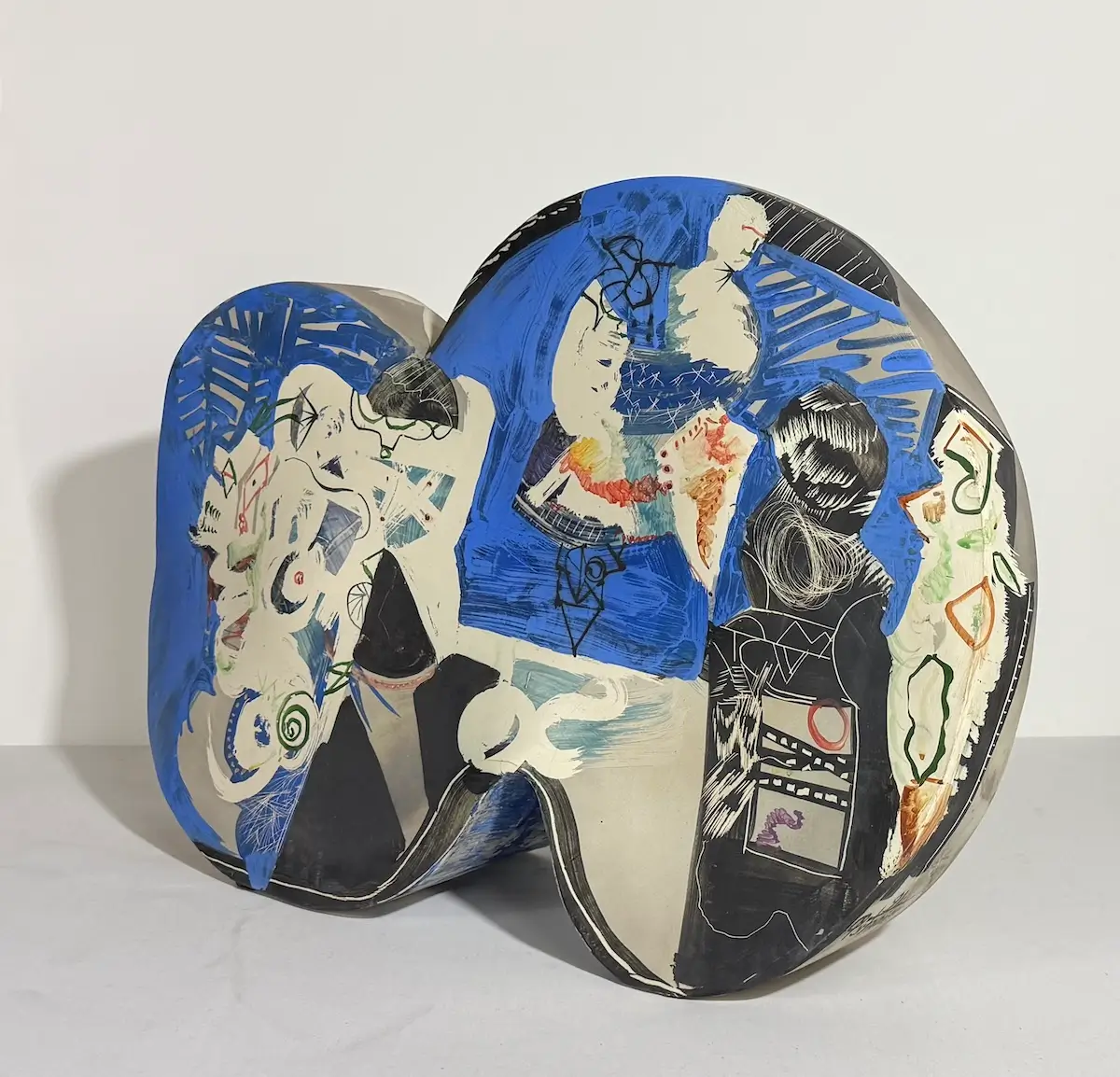
Sans titre, 1991, terre cuite émaillée; h57x78x20 cm; © Gaby Giordano
The self-taught ceramicist’s unique approach
Portanier was a son of Cannes, born there on 28 September 1926. After formal painting and architecture studies in Paris and a brief detour to Brussels where he rubbed shoulders with young, progressive artists, writers, and philosophers, he returned to the South in 1948. His intention was to meet Picasso, who had recently arrived in Vallauris and was making the town’s ceramics workshops his personal playground. But one visit, and Portanier’s plans evaporated. Little did he know that he was committing his life when during that visit he decided to try his hand at clay. He set up a studio, taught himself clay work, and never left again.
Often called “le magicien des couleurs” for his vivid, painterly glazes and fantastical décors, Portanier quickly established himself among the key actors in the revival of French ceramics arts in the 1950s, centred on Vallauris. He treated ceramics as a support for painting and sculpture at once, blurring boundaries between “decorative” and “fine” art.
The distinctive surface treatments he developed, using ferruginous engobes that during firing “bite” into the glaze and mute it, created the textured, atmospheric grounds for his painted motifs. He later worked with matte faïence, fine faïence as a painterly support, porcelain, and sculptural forms. This fusion of disciplines and technical innovation helped redefine art ceramics through painterly colour, inventive surfaces, and sculptural freedom.
Art is made by two, I propose and you dispose, I started, it is up to you to perfect the meaning and emotion that will accompany the life of the work. Things are not as inert as we think”.
— Gilbert Portanier
The creative process
Portanier is often mentioned as the other big name of Vallauris ceramics after Picasso, though the two men worked in different registers. Rather than giving Portanier a style to emulate, Picasso gave him something more precious: the licence of absolute freedom… reflected also in the title of the exhibition. The two men were not close collaborators; Picasso was Picasso, a force of nature who bent everyone and everything in his vicinity toward his own gravitational field.
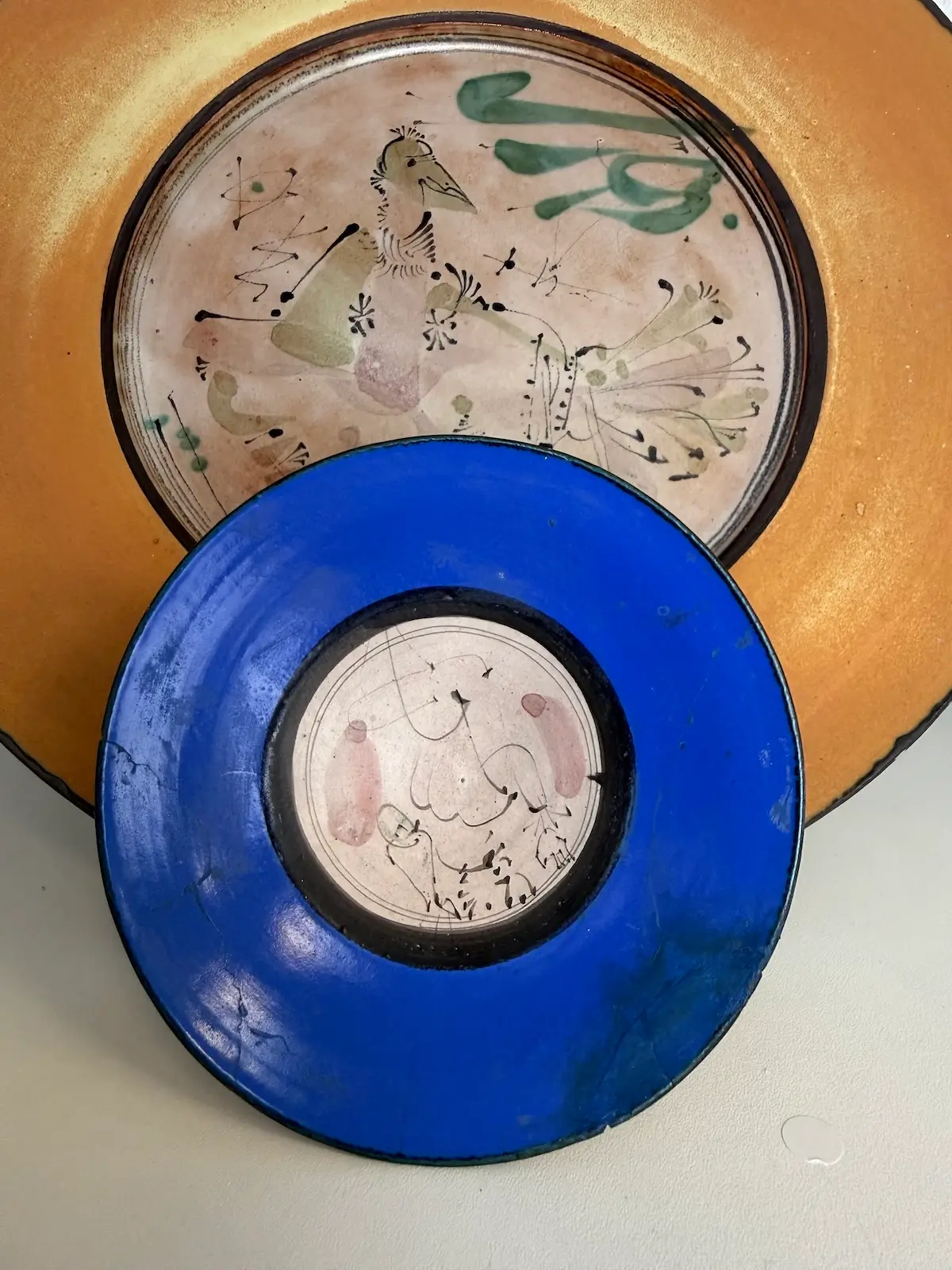
Sans titre, 1952, terre cuite émaillée D.22, © Gaby Giordano
But Portanier resisted being pulled into the great Spaniard’s vortex. Where Picasso’s ceramics are graphic, often playful and frequently built on a white ground, Portanier brought a painterly, almost wild use of colour and narrative decoration into a town known for its more restrained aesthetic. Where Picasso attacked clay with the same volcanic energy he brought to everything else, Portanier developed something more intimate: a conversation between his hands, the material, and whatever ideas came to his prolific mind, without ever making preparatory sketches.
“Creation is the product of a thousand images that float behind my eyes, mixed with previous thoughts, the light, and the moment I sit down to prepare my colours at the wheel,” he explained his process. The finished piece was always, in a sense, a surprise to him, and even today, each one still has the quality of a discovery rather than an execution.
Courtesy gilbertportanier on Instagram
Portanier brought to Vallauris a sense that ceramics could be as emotionally charged and visually complex as painting. His surfaces are dense with imagery: figures, animals, vegetation, architectural fragments, all rendered in a palette that seems to draw directly from the light and colour of the Riviera. The work feels as if each piece has accumulated stories rather than simply being decorated. This approach set him apart from many of his contemporaries, who often favoured cleaner lines and more abstracted forms.
The exhibition at Espace Miramar captures his distinctive voice through a selection of ceramics and engravings that span Portanier’s career. The pieces on show demonstrate his willingness to push the boundaries of the medium, treating clay not as a constraint but as a partner in the creative process.
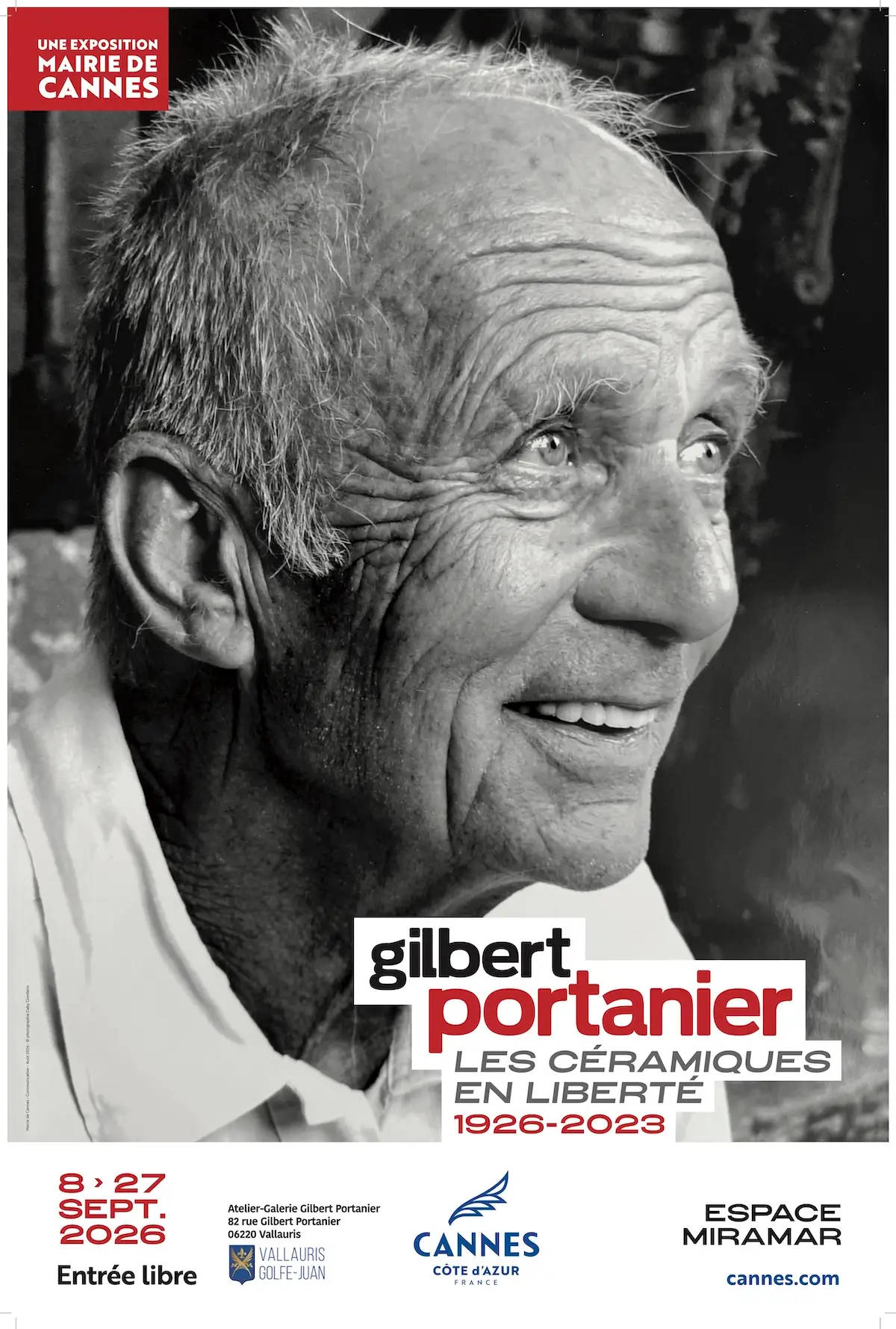
Courtesy Ville de Cannes
His reputation extended well beyond the Riviera. His work was shown widely in Europe, notably in Germany, and entered major public collections, including the Musée national de la Céramique at Sèvres. Yet he remained based in Vallauris throughout his life. The private workshop which was his working environment for around sixty years can also be visited, and remains virtually untouched since the day he left it for the last time.
Gilbert Portanier passed away in Golfe-Juan/Vallauris in 2023 at the age of 96, leaving a legacy not only of hundreds of ceramics that have defined an era but also a reminder that the region’s artistic history was not made only by painters passing through, or by the names that dominate the familiar narrative. It was shaped just as much by artists who stayed, worked with their hands, took the local light seriously and transformed it into something that could be held.
Video via Gilbert Portanier on YouTube

VISITOR INFORMATION
Gilbert Portanier, les céramiques en liberté 1926–2023
Exhibition: 8–27 September 2026 | Vernissage: Monday, 7 September at 6 pm
Espace Miramar, Cannes | Open daily, 10 am – 1 pm and 2 pm – 6 pm | Admission free
Portanier’s workshop, Vallauris
7–27 September, daily except Sunday | 10 am – 1 pm and 4 pm – 7 pm
Further information: Cannes.com
VENUE DETAILS
Espace Miramar
35 rue Pasteur
06200 Cannes
Tel: +33 (0)4 97 06 44 90
Atelier Galerie Gilbert Portanier
82 rue Gilbert Portanier
06220 Vallauris
Tel: +33 (0)6 63 54 80 58
PHOTO CREDITS
- All photos and images courtesy Ville de Cannes and as credited
- Lead image – Vue atelier © François Fernandez
- Instagram post and video as credited
Advertisement








Leave a comment