


Artium Narrandi is the new venture created by Natja Igney, offering artists the ability to tell their story and connect with a new and wider audience.
Having spent more than 25 years at the intersection of journalism, communications, and the arts, and been a valuable contributor to RIVIERA BUZZ since 2014, Natja Igney has distilled these experiences into a singular service for artists: Artium Narrandi.
We sat down for a chat with Natja to find out more about this exciting new project.
ON THE GAP BETWEEN GREAT ART AND GETTING NOTICED
Artium Narrandi – Latin for “the art of storytelling.” Why that name?
I wanted the name itself to make a statement. “Artium” speaks directly to people whose whole identity is built around making things. “Narrandi” is “narrating”. Put them together, and you are saying: what you create is already a story. My job is to find the words that do it justice. That is also why I say, “Your art tells a story – I tell YOUR story”.
Every artist knows their own story. Why do they need someone else to tell it?
Knowing your story and being able to tell it strategically are two entirely different things. Most artists are too close to their work to see it the way a gallerist, a collector, or a journalist does. They are either overly modest, hiding behind the work itself, or they use language so personal and abstract that it means nothing to the outside world. What is needed is a bridge between those two extremes. That is what I build.
Where does the gap typically show up?
The moment a gallery calls, or a curator requests a press kit, or a journalist asks for a biography. Suddenly an artist who has spent years honing their craft is sitting in front of a blank page feeling completely lost. It is not a failure of intelligence or ambition. It is simply a different skill set, one that nobody told them they would need. That is precisely where I come in.

Photo by Luke Jones on Unsplash; licenced under the Unsplash Licence
ON AI AND THE QUESTION EVERY ARTIST IS ALREADY ASKING
Any artist reading this will have already typed a prompt into an AI tool and received a passable biography in thirty seconds, for free. Make the case for why that is not good enough.
Gallerists, curators, and editors receive hundreds of these documents. They know immediately when they are reading something generic. And in the arts world, generic is not merely unremarkable. It is actively damaging
What I offer goes beyond “better writing”. I know this world from the other side of the desk. I read and edit art writing professionally, and I see the full range of how artists present themselves. The difference between a text genuinely crafted for a specific person and one generated from a template is apparent within the first paragraph. When I write for an artist, I apply that same editorial eye in their favour.
And then there is the more fundamental point. Artists spend their entire careers resisting the interchangeable, the mass-produced, the algorithmically averaged. It would be a profound contradiction to then allow an algorithm to be the voice that introduces them to the world.
ON THE CRAFT BEHIND THE KIT
You are an active journalist whose work has been published in some highly discerning publications in the international arts world. How does that inform what you do for artists?
It is probably the thing that makes this service most different from what a standard communications consultant or PR agent would offer. When I write a kit for an artist, I write it knowing precisely how it will be received on the other side of the desk, because I sit there regularly. I know what makes an editor keep reading and what makes them stop. That knowledge is not theoretical. It comes from being actively present in the world these materials are trying to enter.
How do you actually begin?
Conversation, always. I need to understand the person before I can represent them. Not their curriculum vitae, but who they are: what drives them, what they are afraid of, what they are reaching for. I ask the questions a journalist would ask, because that is what I am at heart. That process is as much listening as it is writing, and it is where the most important work happens.
The kit runs to twelve pages or more and covers everything from biography to a pre-prepared Q&A. Why so comprehensive?
Because opportunities do not wait. The kit means that the artist, or whoever is representing them, has a consistent, professionally written response ready for virtually any situation. The Q&A anticipates the questions they will actually be asked, including the difficult ones. The press release is written in the register that working journalists respond to. It is built to last and to work across every context without needing to be reinvented each time.
You offer kits in English, French, German, as well as other languages. What does genuine cultural adaptation mean beyond translation?
Translation is the starting point, not the destination. But every country, every culture has its own conventions for how an artist should present themselves, its own expectations of tone and emphasis. In some contexts, a clear statement of achievement is expected and admired. In others, restraint signals credibility far more effectively. These are not small adjustments. They can be the difference between a document that opens a door and one that closes it before the artist has had a chance to speak. Having worked internationally all throughout my career, I understand those distinctions from the inside, not from a style guide.
Who is a local artist for whom you have created such a kit?
There are several ones, but the one for the Niçois painter and sculptor Michel Anthony was probably the most important one. He was invited to exhibit at the grand opening of the TAIMELESS Art Gallery in Taormina, with the eyes of the entire European Who’s Who in Art on him.
You also work closely with galleries, and you have close, personal access to artists of all disciplines. Does that wider view shape your approach?
It shapes everything. When you understand how galleries think about their artists, where the gaps tend to be between the quality of the work and the quality of the documentation supporting it, you develop a very precise sense of what actually needs to be fixed. Most artists have no idea how their materials read from that side of the relationship. Closing that gap is central to what I do.
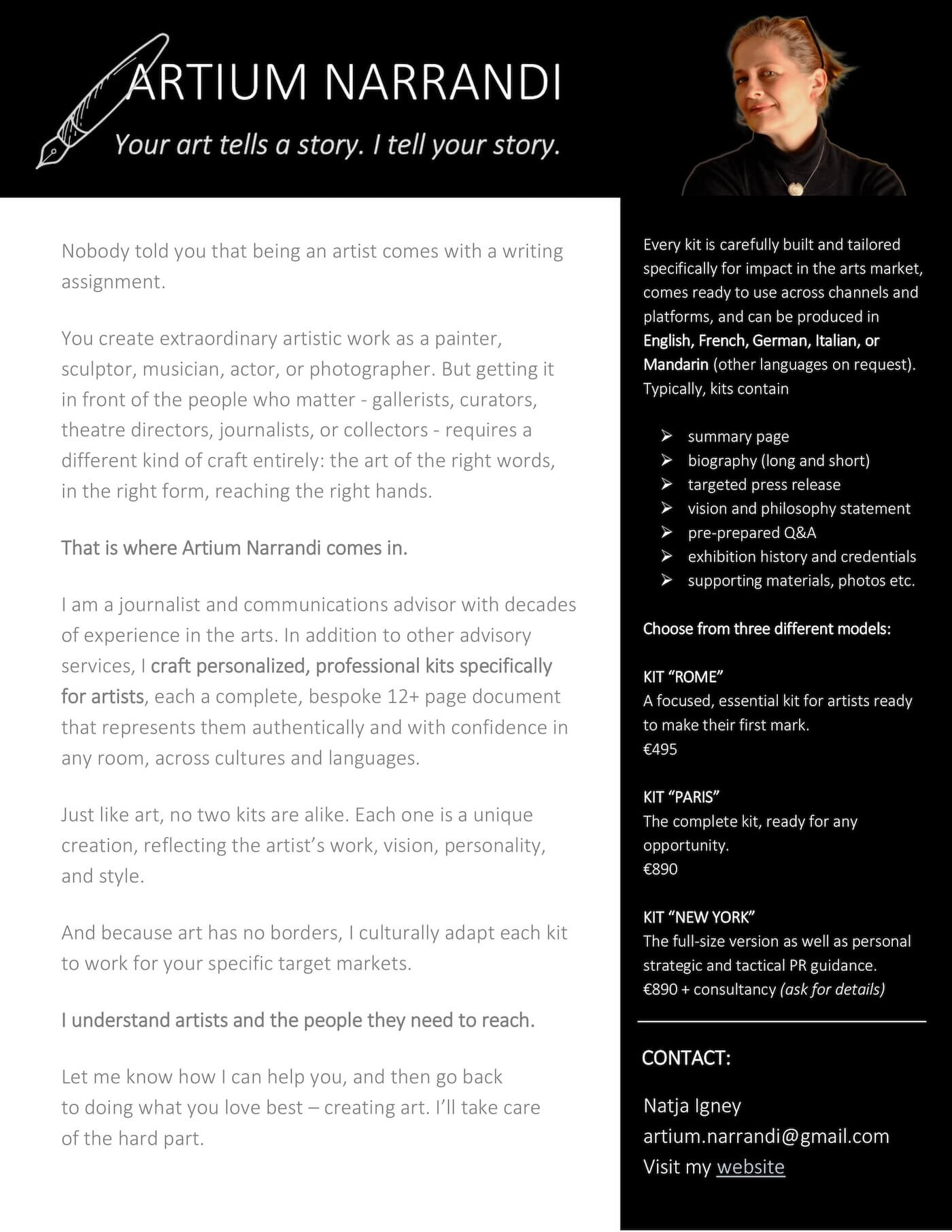
ON THE THREE KITS AND WHAT LIES BEYOND
You offer three tiers: Kit “Rome”, Kit “Paris”, and Kit “New York”. Walk us through the logic.
- ROME is the foundation: focused, essential, for an artist beginning to make their mark.
- PARIS is the complete kit, ready for any room and any opportunity.
- NEW YORK is the full package, together with a personal strategic conversation about where the artist wants to go and how I can get them there as a communications advisor. The scope of that conversation determines its price, and that is a discussion I have with each artist.
The kits start at €495. For many artists, that is a serious outlay.
The prices reflect the work involved, and I have set them to be genuinely accessible by design. For what is delivered – a bespoke, professionally written document of twelve or more pages, ready for any opportunity, adapted for specific markets – the price is reasonable by any professional standard. It is not an expense but an investment that really pays off. And a single missed opportunity, a grant application that did not succeed, a gallerist who moved on, or a journalist who did not follow up, costs far more
Artium Narrandi positions itself firmly in the arts. But the problem you are solving, the gap between exceptional making and the ability to communicate it professionally, surely extends well beyond fine art?
Entirely so, and it is something I think about. The methodology works wherever serious creative or artisanal skill meets a world that requires professional narrative to navigate it. An independent fashion designer trying to reach buyers in Tokyo or Paris, a master ceramicist whose work sits at the boundary of craft and fine art, a natural winemaker whose philosophy is as distinctive as their product but who has never had to articulate it for an international importer: all of them face a version of exactly the same challenge.
For the moment, the arts remain my primary world and my deepest expertise, and I see no shortage of work there. But the door is open, and the conversation is always welcome.
What else do you do in your professional life?
Apart from writing for RIVIERA BUZZ? (laughs). I deliver media trainings for international clients, and am a strategic advisor for crisis communications and reputation management. I have had some pretty cool projects, from working one-on-one with Steve Jobs to working across Africa in the humanitarian context. And I translate books and stage plays.
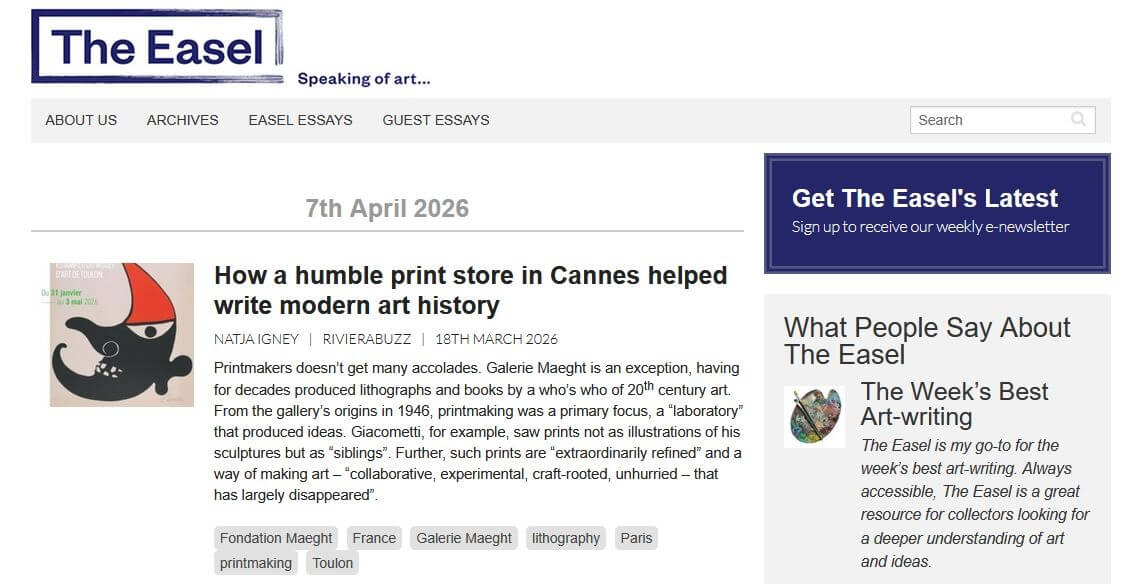
Courtesy The Easel
I adore the many different facets of my job, but writing remains my passion, and I always get super excited when one of my pieces is picked up by renowned international platforms like Traveler Marriott Bonvoy or, most recently, when The Easel republished an article that ran first here in RIVIERA BUZZ.
And finally, what do you like to do when you’re not working? Can we maybe look forward to a book by you in the future?
I am involved with several volunteer projects in the arts and the environmental field, and I also absolutely adore theatre – both as a spectator and working behind the scenes (scenography, stage setting, sound, lighting, and even directing). I am also a serial cat rescuer and always have a couple of fosters around. As for my own book… I have a project in the back of my mind, but I guess you’ll just have to wait and see, and RIVIERA BUZZ will be the first to know, promise!
Please feel free to contact Natja via email for further information on Artium Narrandi.

PHOTO CREDITS
- All photos and images (including lead image) courtesy Natja Igney / Artium Narrandi unless otherwise stated








Leave a comment