


This September, Éric-Emmanuel Schmitt’s “Ma vie avec Mozart” takes to the stage in Villefranche-sur-Mer, questioning the meaning of life’s purpose.
Unfortunately, the show has been cancelled due to technical issues beyond the control of the production team. They thank you for your understanding.
Music, it is often said, has magical powers. It can lift us up in moments of joy and stand as a steady companion through grief and doubt. Few composers seem to connect with listeners on as profound a level as Wolfgang Amadeus Mozart (1756-1791): his music is at once accessible and complex, capable of soothing, comforting and rejoicing with us across generations.
Éric-Emmanuel Schmitt knows this intimately. The celebrated contemporary French author was fifteen when he first contemplated taking his own life… and then discovered Mozart. The Austrian composer’s music helped him change his mind. Schmitt later turned that experience into Ma vie avec Mozart, a book that has since inspired numerous theatrical adaptations in various languages.
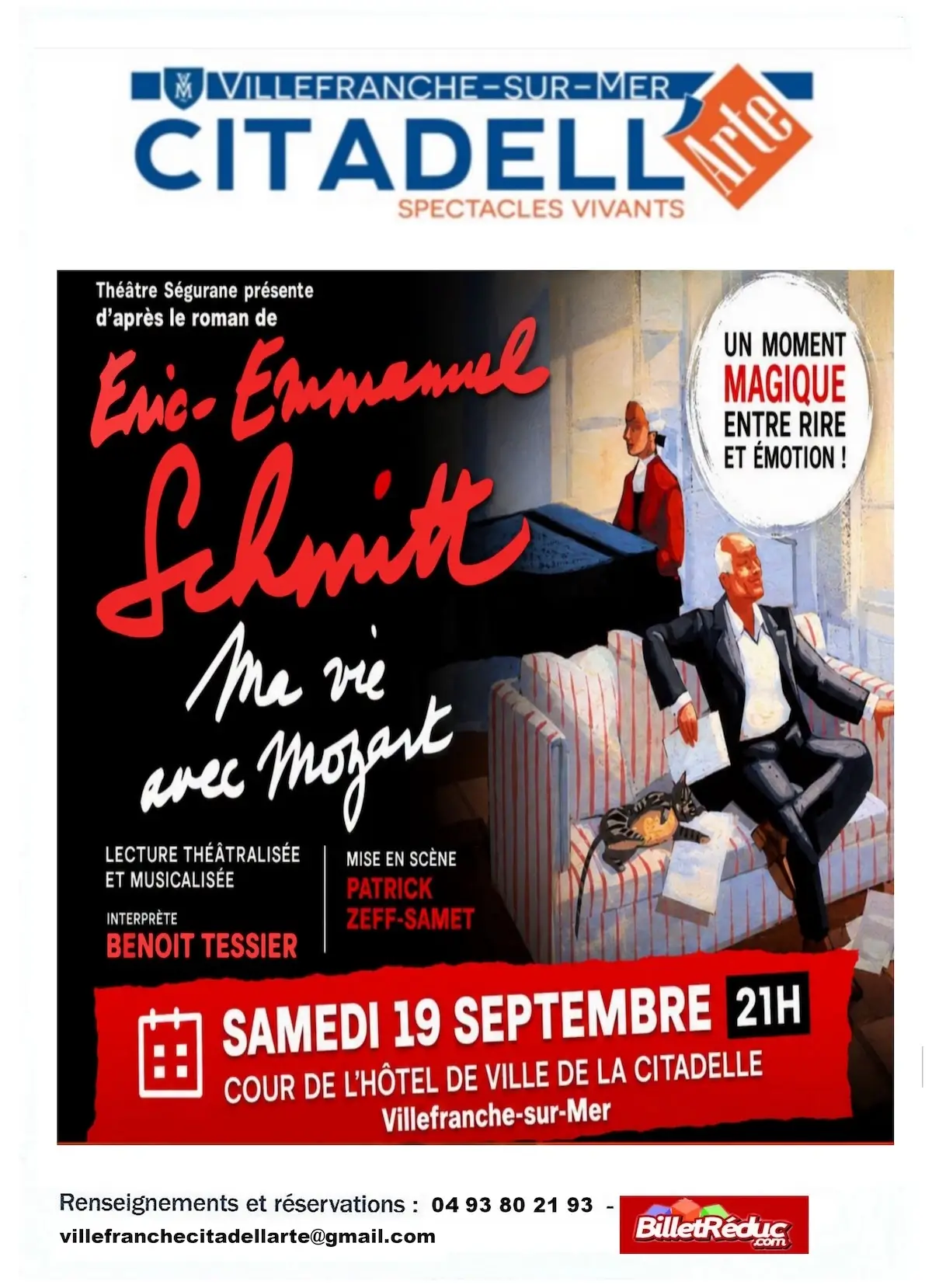
And on September 19, it becomes something else again: a voice under the open sky, resounding from the walls of the Citadelle de Villefranche. Performed by Benoît Tessier and directed by Patrick Zeff-Samet, and conceived as a lecture théâtralisée, the piece unfolds as an imaginary correspondence that spans decades, following the protagonist from fragile adolescence into adulthood and his later life as a renowned writer. Mozart’s music is the invisible second person on the stage, responding to each letter in dialogue fashion, sometimes carrying the emotion, sometimes receding so the words can breathe.
How contemporary artists discovered Mozart’s musical universe
Before becoming a novelist and playwright, Schmitt had trained as a philosopher, and that shows in the way his book is structured: a meditation on art, suffering, and redemption rather than a conventional plot.
One day, he sent me some music.
It changed my life.
Since that day, I often write to him.
When the fancy takes him, he writes back – at a concert, in an airport, on a corner of the street – and he is always startlingly original.
He has become my guru and teaches me precious things: wonder, gentleness, serenity and joy.”— Éric-Emmanuel Schmitt
Unlike Schmitt, Benoît Tessier did not grow up with Mozart. His own path to the musical genius began not in a concert hall but at a book market, drawn by the promise of a CD included with the novel. The format – text and music side by side – suggested a different kind of reading experience, one in which the listener could follow Schmitt’s epistolary journey while hearing the very pieces that shaped it.
“I didn’t have a personal connection with Mozart; I knew little of his music and his life,” he freely admits. “Today I have learned to appreciate him.” That late discovery lends a certain freshness to his approach: he is not interpreting a lifelong obsession so much as entering into one, alongside both Schmitt and the audience. What he did realize along the way, though, were the parallels between his own life and Schmitt’s.
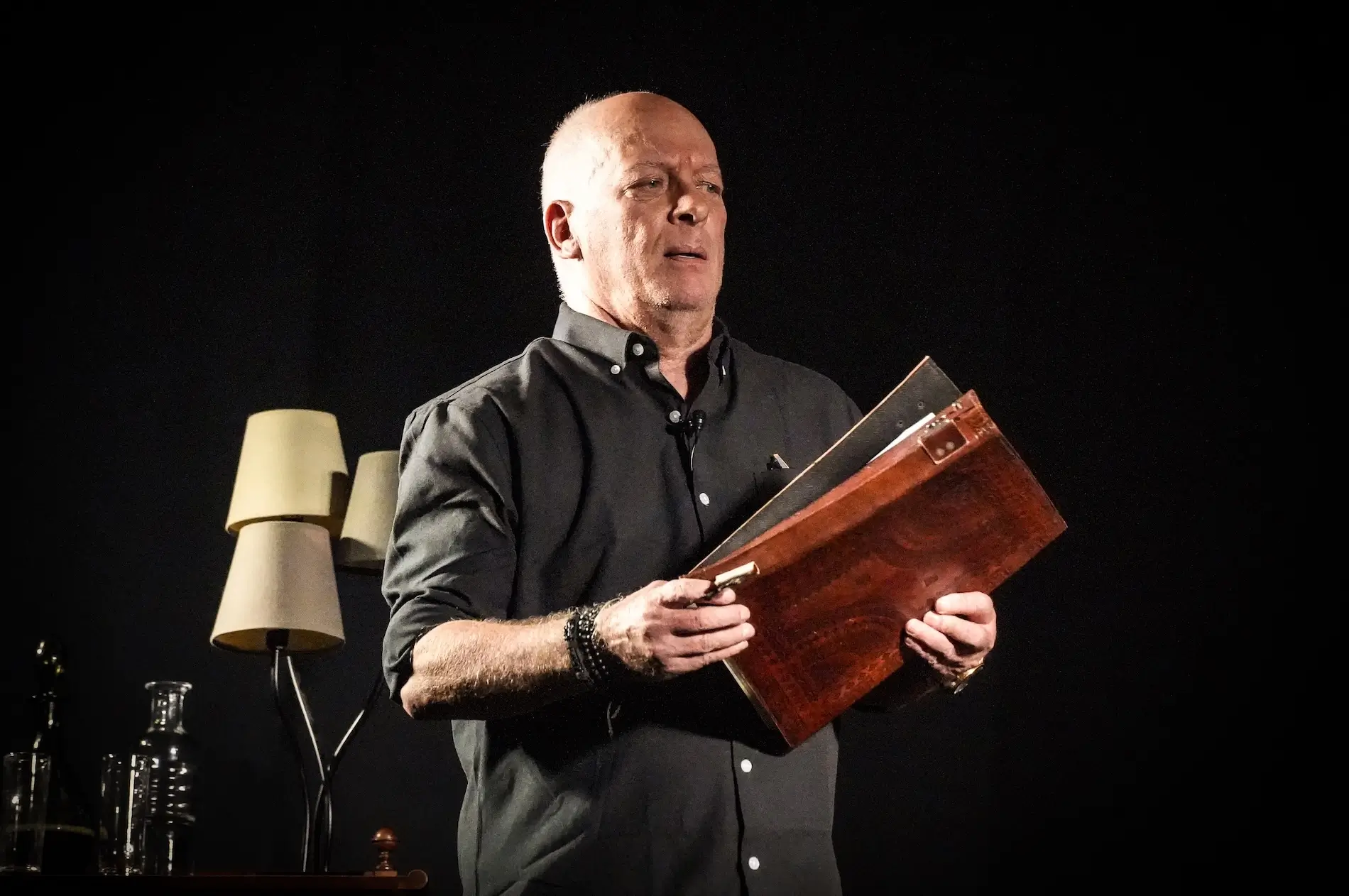
For an actor accustomed to inhabiting characters through voice and gesture, the idea of sharing the stage with recordings rather than live musicians poses both a technical and an artistic challenge. Along with that, Tessier’s task is to embody that arc without the benefit of costume changes or elaborate staging. “The author really understood how to make you feel this evolution just through words,” he notes.
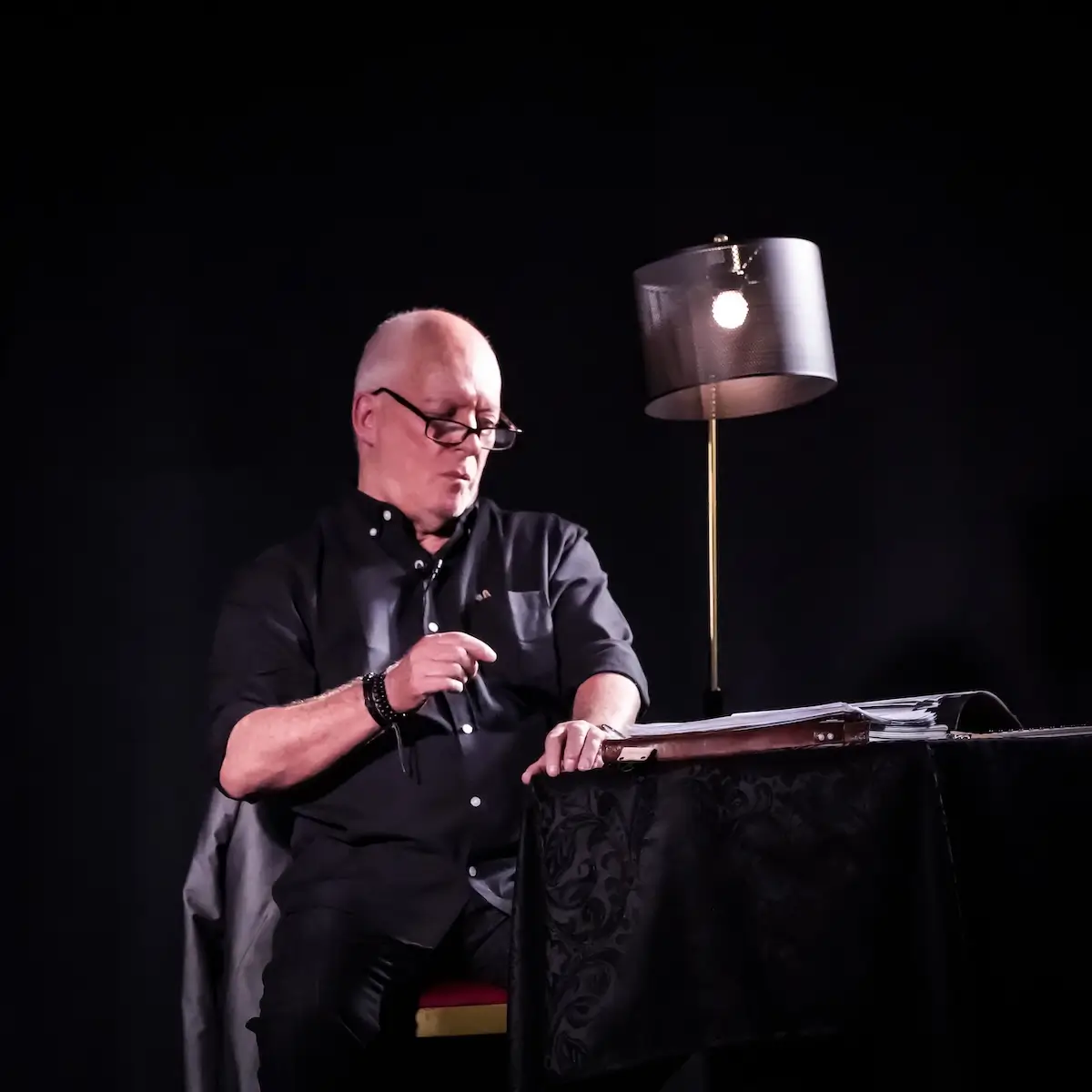
Director Patrick Zeff-Samet is known for his uncanny ability to make spectators travel through complex life stories with restrained scenography, as already demonstrated in plays like Les Eaux Profondes and Ita L. His theatre work has an almost cinematographic quality to it, and, interestingly enough, hearing Mozart’s music alongside Éric-Emmanuel Schmitt’s text conjured images that felt ‘like watching a film’ to both director and actor.
The music as a character on stage
In the original book, Mozart’s compositions “respond” to the letters in the reader’s imagination. On stage, that response is made audible through carefully selected recordings. The question for Tessier and Zeff-Samet was how to position that music: as illustration, as counterpoint, or as a character in its own right.
Their solution was to treat the recordings as an active presence. Balancing speech and sound became key to creating dramatic rhythm. At times the music swells to carry an emotion the text cannot fully articulate; at others it falls away to let a sentence land with precision. The result is a performance that feels far from a recitation accompanied by soundtrack, but an actual conversation, spanning decades, in which Mozart is a silent but eloquent interlocutor.
For Tessier, Schmitt’s journey through life was not unlike his own. He, too, had difficult moments in his youth. He, too, knew the struggle of making a name for oneself as an artist. But one passage carries particular weight: the section dealing with the 1980s and the disappearance of friends during the AIDS crisis. “I lived through those painful moments,” he says. It is a rare moment of direct biographical overlap between actor and author, and it lends an added gravity to his delivery. Schmitt’s meditation on salvation through art – a teenager “saved” by a piece of music – finds an echo in Tessier’s own story. “For me it was art, and the theatre, that helped me a lot.”
A pre-performance ritual
If Tessier did not grow up with Mozart, he has since developed a personal ritual to prepare for each performance. Before going on stage, he often listens to the “Et incarnatus est” aria from Mozart’s Great Mass in C minor, K. 427. Composed in 1782–83, the Mass is one of Mozart’s most profound sacred works, left unfinished but revered for its spiritual depth. The soprano solo with delicate woodwind obbligato is widely regarded as one of its most beautiful movements.
Video via Jack Gibbons on YouTube
For Tessier, the aria serves as a kind of tuning fork, a way of entering the emotional register required for the performance. Its ethereal quality and intimate scale mirror the tone he aims for on stage: reverent but never reverential, attentive to the subtleties of both text and sound.
The third actor
Presented as a dramatized musical reading, the show occupies a hybrid space between concert, monologue and pure theatre. For Tessier, the format is defined by the images it conjures. The setting, the Citadelle de Villefranche with its historic courtyard, open to the sky, with stone walls that carry both sound and history, only heightens the dramatic quality.
Tessier relishes the challenge of such spaces. “I love the outdoors,” he says. “In an indoor space, control is easier. But the imposing beauty of the citadel will add another dimension.” The lighting, carefully designed to complement the natural acoustics, helps to focus attention and create a sense of enclosure despite the open air, and a sound director steers the balance in real time.
The result is a kind of cocoon, a journey shared between actor, composer and audience, even as the elements and the city remain just beyond the stone. In that sense, the venue almost feels like a third actor.
Speaking across generations
One of the enduring questions for any production rooted in classical music is how it speaks to younger audiences whose cultural references lie elsewhere. Schmitt’s novel deals with adolescent distress, a theme as relevant now as in the 1970s, but the language and soundtracks of young people have changed profoundly. When asked how the show might resonate with a generation raised on social media and with rap or hip hop as their go-to music, Tessier’s answer is uncompromising.
“I think Mozart touches the heart and the soul,” he says. “For centuries he has given happiness and will continue to do so for centuries, which may not be the case for these contemporary artists.” It is a statement that could sound dismissive, but it shows Tessier’s confidence in the durability of certain forms of beauty. His hope is that audience members will leave the Citadelle unashamed to say “I love Mozart”, and perhaps inspired to discover or rediscover Schmitt’s books.
What remains
Schmitt’s novel ends with a meditation on legacy: what we leave behind, and how art can outlive its creator. “Mozart died a pauper, at age 35, without descendants, yet he gave more enduring happiness than most anyone,” Tessier says. “So, the question becomes, what do we do on this earth, and above all, what will we leave behind?”
It is a question that resonates beyond the confines of the Citadelle, and one that Schmitt’s epistolary meditation has been asking for two decades. On September 19, under the open sky of Villefranche, it will be asked again – in words, in music, and in the silence between them.

VISITOR INFORMATION
Ma vie avec Mozart | Dramatised musical reading
Saturday, 19 September 2026 at 9 pm
Courtyard of the Citadelle, Villefranche-sur-Mer
Admission : from €14,50 – tickets available online
Information and reservations: +33 (0)4 93 80 21 93
VENUE DETAILS
La Citadelle
06230 Villefranche-sur-Mer
Email: villefranchecitadellarte@gmail.com
PHOTO CREDITS
- All photos and poster courtesy Patrick Zeff-Samet
- Video as credited
Advertisement








Leave a comment